Thank you for visiting SNEWPapers!
Sign up free
Atlanta Daily World
Atlanta, Fulton County, Georgia
What is this article about?
Southeastern US nonagricultural employment rose by nearly 250,000 workers in June 1959 compared to the previous year, signaling recovery from the 1958 recession, led by Florida and manufacturing sectors.
Clipping
OCR Quality
Full Text
Employment
Up
Quarter
Million
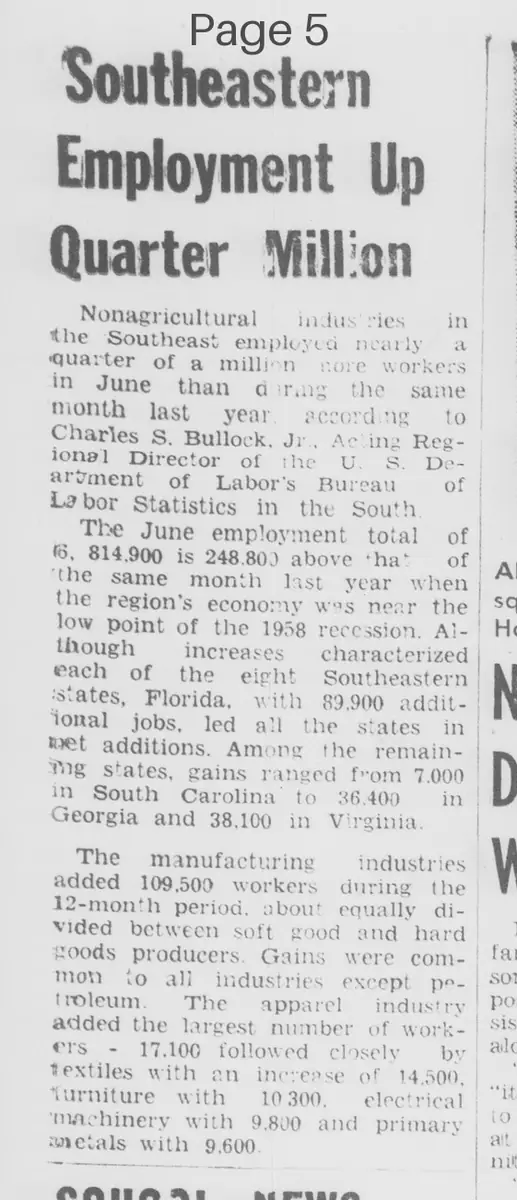
Nonagricultural industries in the Southeast employed nearly a quarter of a million more workers in June than during the same month last year according to Charles S. Bullock, Jr., Regional Director of the U. S. Department of Labor's Bureau of Labor Statistics in the South.
The June employment total of 6,814,900 is 248,800 above that of the same month last year when the region's economy was near the low point of the 1958 recession. Although increases characterized each of the eight Southeastern states, Florida, with 89,900 additional jobs, led all the states in net additions. Among the remaining states, gains ranged from 7000 in South Carolina to 36,400 in Georgia and 38,100 in Virginia.
The manufacturing industries added 109,500 workers during the 12-month period, about equally divided between soft goods and hard goods producers. Gains were common to all industries except petroleum. The apparel industry added the largest number of workers - 17,100 followed closely by textiles with an increase of 14,500, furniture with 10,300, electrical machinery with 9,800 and primary metals with 9,600.
What sub-type of article is it?
What themes does it cover?
What keywords are associated?
What entities or persons were involved?
Where did it happen?
Story Details
Key Persons
Location
Southeastern States
Event Date
June 1959
Story Details
Nonagricultural industries in the Southeast employed 6,814,900 workers in June 1959, an increase of 248,800 from June 1958 near the low point of the 1958 recession. Florida led with 89,900 additional jobs, followed by Georgia (36,400), Virginia (38,100), and South Carolina (7,000). Manufacturing added 109,500 workers, with largest gains in apparel (17,100), textiles (14,500), furniture (10,300), electrical machinery (9,800), and primary metals (9,600).