Thank you for visiting SNEWPapers!
Sign up free
The Virginia Gazette
Williamsburg, Virginia
What is this article about?
Extracts from a pamphlet published in London titled 'Considerations on the measures carrying on with respect to the British colonies in North America,' arguing against taxing the colonies without consent, highlighting risks of conflict, and emphasizing benefits of current trade relations.
Merged-components note: Continuation of extracts from a London pamphlet discussing measures against the British colonies in North America.
Clippings
1 of 2
OCR Quality
Full Text
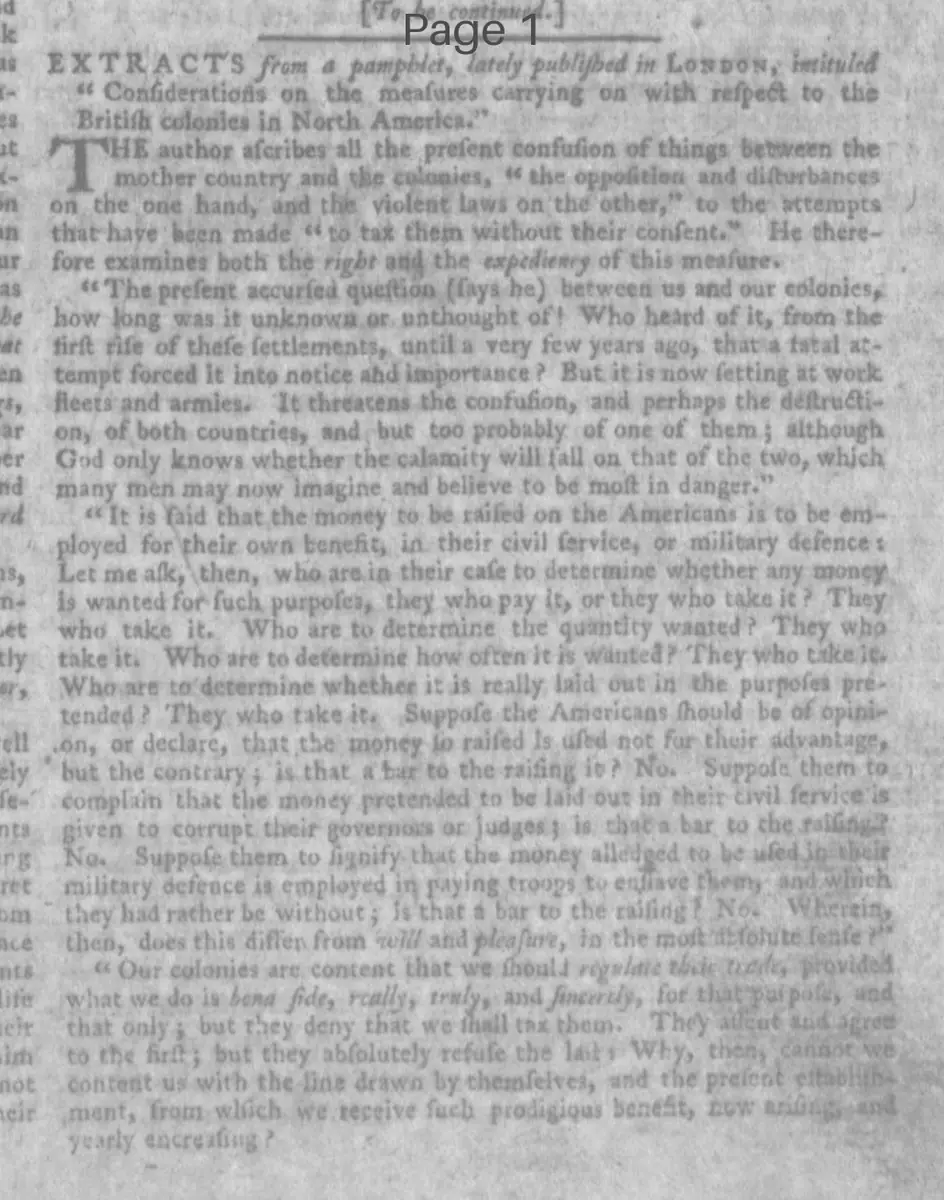
on the one hand, and the violent laws on the other, to the attempts that have been made to tax them without their consent. He therefore examines both the right and the expediency of this measure.
"The present accursed question (says he) between us and our colonies, how long was it unknown or unthought of? Who heard of it, from the first rise of these Settlements, until a very few years ago, that a fatal attempt forced it into notice and importance? But it is now setting at work fleets and armies. It threatens the confusion, and perhaps the destruction, of both countries, and but too probably of one of them; although God only knows whether the calamity will fall on that of the two, which many men may now imagine and believe to be most in danger."
"It is said that the money to be raised on the Americans is to be employed for their own benefit, in their civil service, or military defence: Let me ask, then, who are in their case to determine whether any money is wanted for such purposes, they who pay it, or they who take it? They who take it. Who are to determine the quantity wanted? They who take it. Who are to determine how often it is wanted? They who take it. Who are to determine whether it is really laid out in the purpose pretended? They who take it. Suppose the Americans should be of opinion, or declare, that the money so raised is used not for their advantage, but the contrary; is that a bar to the raising it? No. Suppose them to complain that the money pretended to be laid out in their civil service is given to corrupt their governors or judges; is that a bar to the raising? No. Suppose them to signify that the money alleged to be used in their military defence is employed in paying troops to enslave them, and which they had rather be without; is that a bar to the raising? No. Wherein, then, does this differ from will and pleasure, in the most absolute sense?
"Our colonies are content that we should regulate their trade, provided what we do is bona fide, really, truly, and sincerely, for those purposes, and that only; but they deny that we shall tax them. They assent to the first; but they absolutely refuse the last. Why, then, cannot we content ourselves with the line drawn by themselves, and the present establishment, from which we receive such prodigious benefit, now arising and yearly increasing?"
Of trade also? The course of things, and the flux of years, will certainly produce very many things more extraordinary than this. The whole of our colonies must, no doubt, without force or violence, fall off from the parent state, like ripe fruit in the maturity of time. But why should we be over curious about objects very remote, and disturb ourselves about a futurity which does not affect us, and the distance of which we do not know? Why should we shake the fruit unripe from the tree, because it will of course drop off when it shall be riper? Every time has its own circumstances, according to which the events of it must be provided for, when they happen. That cannot now be done. New and unreasonable demands, injustice, oppression, and violence, on our parts, will hasten these events, even before their time. Let us withhold our hands from these things. We have never yet had reason to boast ourselves of such expedients, nor, let me add, ever to repent us of the contrary conduct.
In answer to what is commonly objected, concerning the expense which the colonies cost the mother country, in their original settlement, as well as their protection afterwards, he writes thus:
But was their history told as it deserves; how they have made these great establishments at their own charge, and with almost no expense of ours; how we have ever had the total command of the produce of that immense country, so as to regulate the commerce and exportation of it, merely according to our own advantage and convenience; that this is grown to be an object of perhaps no less than four millions sterling a year, all turned to our profit; could the extreme benefit be all set forth, which we have by these means received from the first foundation of these colonies to this time, and the cheerfulness, fidelity, and loyalty, wherewith they have submitted to this; the sincere and warm friendship and affection which they have ever borne towards us, while we kept ourselves within these bounds; the assistance which we have received from them in war, as well as the profits in peace; could all these circumstances, with many others favourable to them, be told and represented to each other, in their full light, the story itself would bid fair to not
barh id unmerited acts of parliament drop out of our minds in time.
But is there any medium by which to enforce obedience from our colonies, or to make them free and independent of all allegiance to Great Britain? To which I answer, if there is a medium between Great Britain and Ireland, why may there not also between Great Britain and North America? The claims of the colonies are not higher than those of Ireland: Why should not what the like causes do in the other? How was it there, twenty years ago, before the first of the last of these acts were thought of? All was peace, calm, and content. The repealing the first of them, the rampart, did that do any mischief? Not unless the reconciling, uniting, and connecting again, all the parts of our government be such. There was hardly anywhere to be found a man but who was pleased and happy in the measure, except a minister or two at home, who lost their power and their places on the occasion; and except a few sycophants abroad, who hoped to recommend themselves by traducing and disturbing those to whom they owed assistance and protection, and who desired to fish in troubles which they themselves contributed greatly to create.
What evil star reigns, then, at this period, that these blessings cannot now take place as they formerly did?
In answer to the hopes which some may entertain of a disunion among the colonies themselves, he writes thus:
In the cause of not being taxed by us, it is well understood how much they are united. All accounts and reports from thence, of all men and of all parties, concur in that circumstance: We reckon entirely without our host, if we do not expect to have to do with an union of that continent, or if we depend on any measures insufficient to subdue the whole. Does any one in America or England imagine that all these disputes and feuds are only, at the bottom, about a duty of threepence upon a pound of tea?
He then considers how far it may be practicable to bring America to submit to internal taxation, by armies and fleets. A fleet (says he) cannot sail all over North America. No immediate impression upon Boston, or any of the towns of America (where a fleet can come) will carry the command of the whole continent, or force it to submit to measures so universally against their bent and inclination.
But we will not quote more on this head. The Americans are loyal to their sovereign, and retain the strongest affection to the mother country; and God forbid that ever measures should be persevered in which may drive them to such a state of desperation as might lead them to hazard a contest, which on a their part, would certainly terminate in destructive to both. What fruits (says he) would from provinces mangled and mutilated in their disadvantage, should they at last return to us? I overlook what must be the case should the event terminate against o, and end, after an expense of much treasure and blood, in so fatal and inestimable a loss on our side, as that of these colonies would be. No man knows whither this affair would run in a long trial. We need not be nice in measuring our force against the Americans. The evil of such a day will sufficiently decide the contest.
What sub-type of article is it?
What keywords are associated?
Where did it happen?
Domestic News Details
Primary Location
British Colonies In North America
Event Details
Extracts from a pamphlet published in London discussing the taxation of British colonies in North America without their consent, arguing it differs little from absolute rule, warning of potential conflict involving fleets and armies, emphasizing benefits of regulating trade without taxation, and noting colonies' loyalty and unity against taxation.