Thank you for visiting SNEWPapers!
Sign up free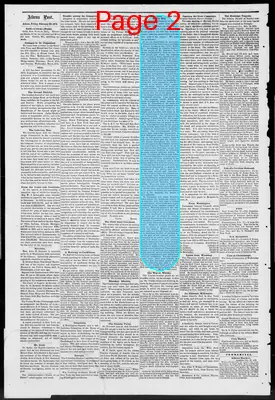
Story
February 20, 1874
The Athens Post
Athens, Mcminn County, Tennessee
What is this article about?
Senator W.G. Brownlow opposes the Civil Rights Bill introduced by Charles Sumner, particularly its mandate for integrated schools and churches in Tennessee, warning it would destroy the state's nascent free school system and advising colored people to seek separate but equal facilities.
Clipping

OCR Quality
98%
Excellent
Full Text
Senator Brownlow on the Civil Rights Bill.
The Knoxville Chronicle of last Friday contained a letter from Senator Brownlow, in which the Civil Rights Bill now pending in Congress is treated. We are glad to see that the venerable Senator takes the conservative and sensible view of the subject. We quote him as follows:
Of no less importance to the people of Tennessee than the currency question, is what is known as the "Civil Rights Bill," introduced by Charles Sumner. To the people of Mr. Sumner's State, where, comparatively, there are no colored people and where the common school system is firmly established, this does not become a question of magnitude. But to the people of Tennessee whose free school system is in its infancy, it is a question of grave magnitude. I don't believe that in any question, upon which I am called to act, I am governed by any hope of political preferment or fear of any party clamor, but not being a candidate for re-election to the Senate and not caring whether my views are popular or not, I have no hesitation in saying that I am opposed to this bill- because of its feature, which compels the education together of white and colored children. I will not waste time in discussing any abstract principle involved in this bill of the great leader of the Liberal-Greeley party in the late Presidential election. I am opposed to it. The practical results which will follow its adoption alone, concern the people of Tennessee of all races and colors. I believe that any attempt to enforce, by arbitrary act of Congress, the attendance of the two races in the schools and churches, will result in the total destruction of the free school system in Tennessee. For the sake of the argument, I admit that this fact is caused by prejudice, but it is a prejudice which Congress has no power to control. It is sufficient that we see a most useful system imperilled by an attempt to reduce an abstraction to immediate practice. The colored people of Tennessee have now a fine opportunity to show their good sense. Upon their action on this question largely depends their own interests and the welfare of their people throughout the country. I would appeal to the common sense of the colored men of Tennessee to say if they believe that their race can get better educational facilities by attending the same schools with the whites. In South Carolina and Mississippi, where the colored population is in the majority, they may not lose anything by the bill now before Congress, but in those States, where they have the power, I do not believe they will subserve their own interests by attempting to enforce the attendance of the whites and blacks in the same schools and churches. Already in those States the colored people, through their State Legislatures, have the power to establish such school regulations as will give their own race equal educational facilities with the whites. When we come to Tennessee where the colored vote is just 40,000 out of 280,000 votes, and the other Southern States where the whites are overwhelmingly in the majority, the matter is quite different. In Tennessee and other Southern States where the whites are largely in the majority, will that state of feeling be engendered which leads men to give generously to the common cause of education? Will the contact of the children thus compelled be such as to encourage the hope of greater attainments and more kindliness of sentiment as they grow up? It should be remembered that the colored race, though large in numbers, constitute a very small minority of the whole people of the United States. However strongly united, they have no power to compel concessions from the whites. Whatever they get must come as a free gift from the whites. It is, therefore, the part of wisdom upon the part of the colored people of Tennessee to be careful upon insisting upon that which can do no practical good to either race, but is sure to bring disaster and ruin to the most useful institution of modern times-free schools. Let the colored people of Tennessee ask Congress to desist from any legislation which enforces mixed schools, and they will have established a new claim to respect and confidence. Let the colored people have their own schools and churches and the white people theirs. Let the colored people have a fair divide of the school fund and they will find their own teachers and preachers.
W. G. BROWNLOW
The Knoxville Chronicle of last Friday contained a letter from Senator Brownlow, in which the Civil Rights Bill now pending in Congress is treated. We are glad to see that the venerable Senator takes the conservative and sensible view of the subject. We quote him as follows:
Of no less importance to the people of Tennessee than the currency question, is what is known as the "Civil Rights Bill," introduced by Charles Sumner. To the people of Mr. Sumner's State, where, comparatively, there are no colored people and where the common school system is firmly established, this does not become a question of magnitude. But to the people of Tennessee whose free school system is in its infancy, it is a question of grave magnitude. I don't believe that in any question, upon which I am called to act, I am governed by any hope of political preferment or fear of any party clamor, but not being a candidate for re-election to the Senate and not caring whether my views are popular or not, I have no hesitation in saying that I am opposed to this bill- because of its feature, which compels the education together of white and colored children. I will not waste time in discussing any abstract principle involved in this bill of the great leader of the Liberal-Greeley party in the late Presidential election. I am opposed to it. The practical results which will follow its adoption alone, concern the people of Tennessee of all races and colors. I believe that any attempt to enforce, by arbitrary act of Congress, the attendance of the two races in the schools and churches, will result in the total destruction of the free school system in Tennessee. For the sake of the argument, I admit that this fact is caused by prejudice, but it is a prejudice which Congress has no power to control. It is sufficient that we see a most useful system imperilled by an attempt to reduce an abstraction to immediate practice. The colored people of Tennessee have now a fine opportunity to show their good sense. Upon their action on this question largely depends their own interests and the welfare of their people throughout the country. I would appeal to the common sense of the colored men of Tennessee to say if they believe that their race can get better educational facilities by attending the same schools with the whites. In South Carolina and Mississippi, where the colored population is in the majority, they may not lose anything by the bill now before Congress, but in those States, where they have the power, I do not believe they will subserve their own interests by attempting to enforce the attendance of the whites and blacks in the same schools and churches. Already in those States the colored people, through their State Legislatures, have the power to establish such school regulations as will give their own race equal educational facilities with the whites. When we come to Tennessee where the colored vote is just 40,000 out of 280,000 votes, and the other Southern States where the whites are overwhelmingly in the majority, the matter is quite different. In Tennessee and other Southern States where the whites are largely in the majority, will that state of feeling be engendered which leads men to give generously to the common cause of education? Will the contact of the children thus compelled be such as to encourage the hope of greater attainments and more kindliness of sentiment as they grow up? It should be remembered that the colored race, though large in numbers, constitute a very small minority of the whole people of the United States. However strongly united, they have no power to compel concessions from the whites. Whatever they get must come as a free gift from the whites. It is, therefore, the part of wisdom upon the part of the colored people of Tennessee to be careful upon insisting upon that which can do no practical good to either race, but is sure to bring disaster and ruin to the most useful institution of modern times-free schools. Let the colored people of Tennessee ask Congress to desist from any legislation which enforces mixed schools, and they will have established a new claim to respect and confidence. Let the colored people have their own schools and churches and the white people theirs. Let the colored people have a fair divide of the school fund and they will find their own teachers and preachers.
W. G. BROWNLOW
What sub-type of article is it?
Historical Event
Biography
What themes does it cover?
Justice
Social Manners
Moral Virtue
What keywords are associated?
Civil Rights Bill
School Integration
Senator Brownlow
Tennessee Education
Racial Prejudice
Separate Schools
What entities or persons were involved?
Senator Brownlow
Charles Sumner
Where did it happen?
Tennessee
Story Details
Key Persons
Senator Brownlow
Charles Sumner
Location
Tennessee
Story Details
Senator Brownlow writes a letter opposing the Civil Rights Bill's integration of schools and churches, arguing it would destroy Tennessee's free school system due to prejudice, and urges separate facilities with equal funding for colored people.