Thank you for visiting SNEWPapers!
Sign up free
Editorial
June 23, 1790
Gazette Of The United States
New York, New York County, New York
What is this article about?
An editorial advocating means to preserve the Union under the U.S. Constitution, including making war debts a common federal charge and allowing federal officials to hold state offices to avoid jealousies between governments. Signed N.W., Hartford, June 12, 1790.
Clipping
OCR Quality
95%
Excellent
Full Text
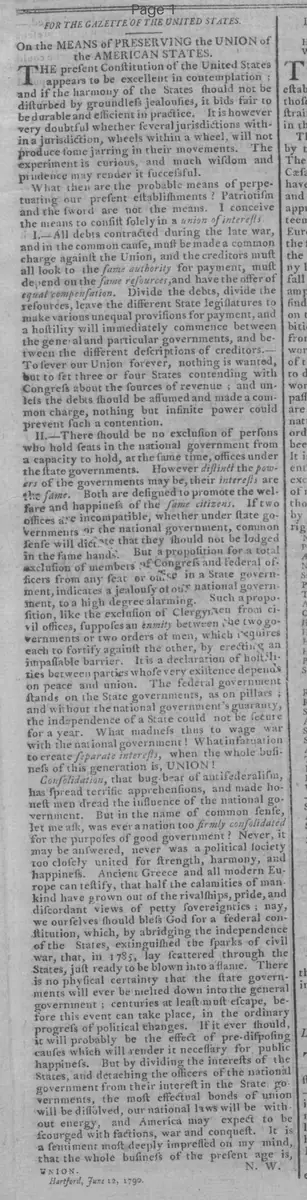
FOR THE GAZETTE OF THE UNITED STATES
On the MEANS of PRESERVING the UNION of
the AMERICAN STATES.
The present Constitution of the United States
appears to be excellent in contemplation;
and if the harmony of the States should not be
disturbed by groundless jealousies, it bids fair to
be durable and efficient in practice. It is however
very doubtful whether several jurisdictions within
a jurisdiction, wheels within a wheel, will not
produce some jarring in their movements. The
experiment is curious, and much wisdom and
prudence may render it successful.
What then are the probable means of perpetuating
our present establishments? Patriotism
and the sword are not the means. I conceive
the means to consist solely in a union of interests.
I. All debts contracted during the late war,
and in the common cause, must be made a common
charge against the Union, and the creditors must
all look to the same authority for payment, must
depend on the same resources, and have the offer of
equal compensation. Divide the debts, divide the
resources, leave the different State legislatures to
make various unequal provisions for payment, and
a hostility will immediately commence between
the general and particular governments, and between
the different descriptions of creditors.—
To sever our Union forever, nothing is wanted,
but to set three or four States contending with
Congress about the sources of revenue; and unless
the debts should be assumed and made a common
charge, nothing but infinite power could
prevent such a contention.
II.—There should be no exclusion of persons
who hold seats in the national government from
a capacity to hold, at the same time, offices under
the state governments. However distinct the powers
of the governments may be, their interests are
the same. Both are designed to promote the welfare
and happiness of the same citizens. If two
offices are incompatible, whether under state governments
or the national government, common
sense will dictate that they should not be lodged
in the same hands. But a proposition for a total
exclusion of members of Congress and Federal officers
from any seat or office in a State government,
indicates a jealousy of our national government,
to a high degree alarming. Such a proposition,
like the exclusion of Clergymen from civil
offices, supposes an enmity between the two governments
or two orders of men, which requires
each to fortify against the other, by erecting an
impassable barrier. It is a declaration of hostilities
between parties whose very existence depends
on peace and union. The federal government
stands on the State governments, as on pillars;
and without the national government's guaranty,
the independence of a State could not be secure
for a year. What madness thus to wage war
with the national government! What infatuation
to create separate interests, when the whole business
of this generation is, UNION!
Consolidation, that bug-bear of anti-federalism,
has spread terrific apprehensions, and made honest
men dread the influence of the national
government. But in the name of common sense,
let me ask, was ever a nation too firmly consolidated
for the purposes of good government? Never, it
may be answered, never was a political society
too closely united for strength, harmony, and
happiness. Ancient Greece and all modern Europe
can testify, that half the calamities of mankind
have grown out of the rivalships, pride, and
discordant views of petty sovereignties; nay,
we ourselves should bless God for a federal constitution,
which, by abridging the independence
of the States, extinguished the sparks of civil
war, that, in 1785, lay scattered through the
States, just ready to be blown into a flame. There
is no physical certainty that the state governments
will ever be melted down into the general
government; centuries at least must elapse, before
this event can take place, in the ordinary
progress of political changes. If it ever should,
it will probably be the effect of predisposing
causes which will render it necessary for public
happiness. But by dividing the interests of the
States, and detaching the officers of the national
government from their interest in the State governments,
the most effectual bonds of union
will be dissolved, our national laws will be without
energy, and America may expect to be
scourged with factions, war and conquest. It is
a sentiment most deeply impressed on my mind
that the whole business of the present age is
UNION.
N. W.
Hartford, June 12, 1790.
On the MEANS of PRESERVING the UNION of
the AMERICAN STATES.
The present Constitution of the United States
appears to be excellent in contemplation;
and if the harmony of the States should not be
disturbed by groundless jealousies, it bids fair to
be durable and efficient in practice. It is however
very doubtful whether several jurisdictions within
a jurisdiction, wheels within a wheel, will not
produce some jarring in their movements. The
experiment is curious, and much wisdom and
prudence may render it successful.
What then are the probable means of perpetuating
our present establishments? Patriotism
and the sword are not the means. I conceive
the means to consist solely in a union of interests.
I. All debts contracted during the late war,
and in the common cause, must be made a common
charge against the Union, and the creditors must
all look to the same authority for payment, must
depend on the same resources, and have the offer of
equal compensation. Divide the debts, divide the
resources, leave the different State legislatures to
make various unequal provisions for payment, and
a hostility will immediately commence between
the general and particular governments, and between
the different descriptions of creditors.—
To sever our Union forever, nothing is wanted,
but to set three or four States contending with
Congress about the sources of revenue; and unless
the debts should be assumed and made a common
charge, nothing but infinite power could
prevent such a contention.
II.—There should be no exclusion of persons
who hold seats in the national government from
a capacity to hold, at the same time, offices under
the state governments. However distinct the powers
of the governments may be, their interests are
the same. Both are designed to promote the welfare
and happiness of the same citizens. If two
offices are incompatible, whether under state governments
or the national government, common
sense will dictate that they should not be lodged
in the same hands. But a proposition for a total
exclusion of members of Congress and Federal officers
from any seat or office in a State government,
indicates a jealousy of our national government,
to a high degree alarming. Such a proposition,
like the exclusion of Clergymen from civil
offices, supposes an enmity between the two governments
or two orders of men, which requires
each to fortify against the other, by erecting an
impassable barrier. It is a declaration of hostilities
between parties whose very existence depends
on peace and union. The federal government
stands on the State governments, as on pillars;
and without the national government's guaranty,
the independence of a State could not be secure
for a year. What madness thus to wage war
with the national government! What infatuation
to create separate interests, when the whole business
of this generation is, UNION!
Consolidation, that bug-bear of anti-federalism,
has spread terrific apprehensions, and made honest
men dread the influence of the national
government. But in the name of common sense,
let me ask, was ever a nation too firmly consolidated
for the purposes of good government? Never, it
may be answered, never was a political society
too closely united for strength, harmony, and
happiness. Ancient Greece and all modern Europe
can testify, that half the calamities of mankind
have grown out of the rivalships, pride, and
discordant views of petty sovereignties; nay,
we ourselves should bless God for a federal constitution,
which, by abridging the independence
of the States, extinguished the sparks of civil
war, that, in 1785, lay scattered through the
States, just ready to be blown into a flame. There
is no physical certainty that the state governments
will ever be melted down into the general
government; centuries at least must elapse, before
this event can take place, in the ordinary
progress of political changes. If it ever should,
it will probably be the effect of predisposing
causes which will render it necessary for public
happiness. But by dividing the interests of the
States, and detaching the officers of the national
government from their interest in the State governments,
the most effectual bonds of union
will be dissolved, our national laws will be without
energy, and America may expect to be
scourged with factions, war and conquest. It is
a sentiment most deeply impressed on my mind
that the whole business of the present age is
UNION.
N. W.
Hartford, June 12, 1790.
What sub-type of article is it?
Constitutional
Economic Policy
Legal Reform
What keywords are associated?
Union Preservation
Federal Debts
State Federal Relations
Constitutional Harmony
Anti Federalism
What entities or persons were involved?
Congress
State Governments
Federal Government
Editorial Details
Primary Topic
Means Of Preserving The Union Through Common Debts And Shared Government Offices
Stance / Tone
Advocacy For Strong Federal State Union Against Jealousies
Key Figures
Congress
State Governments
Federal Government
Key Arguments
Make War Debts A Common Federal Charge To Avoid State Federal Hostilities
No Exclusion Of Federal Officials From State Offices To Maintain Shared Interests
Consolidation Fears Are Unfounded; Disunion Leads To Calamity
Union Of Interests Is Essential For Preserving Establishments