Thank you for visiting SNEWPapers!
Sign up free
Alexandria Advertiser And Commercial Intelligencer
Alexandria, Virginia
What is this article about?
Commentary from a London paper on Bonaparte's diplomatic reversal towards Algiers, shifting from anti-piracy threats to defending the Dey, amid demands for 150 French captives' return, with some deceased; critiques the policy's moral and political implications.
Merged-components note: Text content flows continuously as a single foreign news article from a London paper.
Clipping
OCR Quality
Full Text
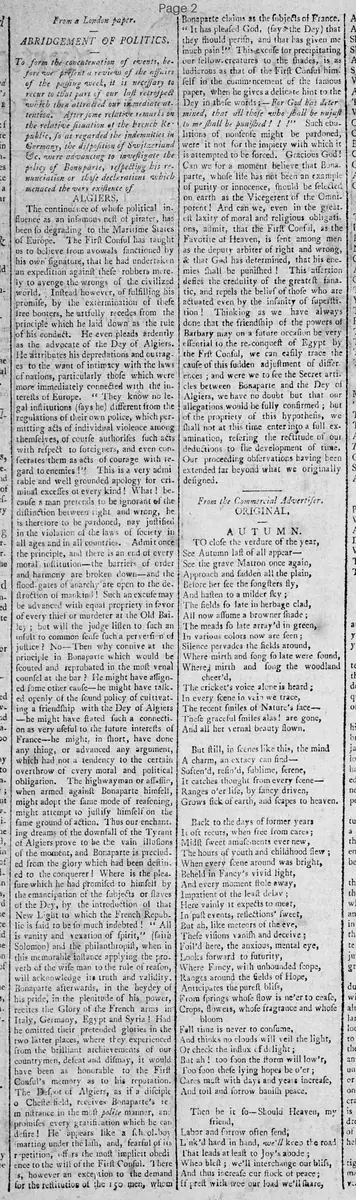
ABRIDGEMENT OF POLITICS.
To form the concatenation of events, before we present a review of the affairs of the passing week, it is necessary to recur to that part of our last retrospect which then attracted our immediate attention. After some relative remarks on the relative situation of the French Republic, so as regarded the indemnities in Germany, the disposition of Switzerland &c. were advancing to investigate the policy of Bonaparte, respecting his renunciation of those declarations which menaced the very existence of ALGIERS.
The continuance of whose political influence as an infamous nest of pirates, has been so degrading to the Maritime States of Europe. The First Consul has taught us to believe from avowals sanctioned by his own signature, that he had undertaken an expedition against these robbers merely to avenge the wrongs of the civilized world. Instead however, of fulfilling his promise, by the extermination of these free booters, he artfully recedes from the principle which he laid down as the rule of his conduct. He even pleads ardently as the advocate of the Dey of Algiers. He attributes his depredations and outrages to the want of intimacy with the laws of nations, particularly those which were more immediately connected with the interests of Europe. "They know no legal institutions (says he) different from the regulations of their own police, which permitting acts of individual violence among themselves, of course authorizes such acts with respect to foreigners, and even consecrates them as acts of courage with regard to enemies!" This is a very admirable and well grounded apology for criminal excesses of every kind! What! because a man pretends to be ignorant of the distinction between right and wrong, he is therefore to be pardoned, nay justified in the violation of the laws of society in all ages and in all countries. Admit once the principle, and there is an end of every moral institution--the barriers of order and harmony are broken down--and the flood-gates of anarchy are open to the destruction of mankind! Such an excuse may be advanced with equal propriety in favor of every thief or murderer at the Old Bailey; but will the judge listen to such an insult to common sense such a perversion of justice? No--Then why connive at the principle in Bonaparte which would be scouted and reprobated in the most venal counsel at the bar? He might have assigned some other cause--he might have talked openly of the sound policy of cultivating a friendship with the Dey of Algiers--he might have stated such a connection as very useful to the future interests of France--he might, in short, have done any thing, or advanced any argument, which had not a tendency to the certain overthrow of every moral and political obligation. The highwayman or assassin, when armed against Bonaparte himself, might adopt the same mode of reasoning, might attempt to justify himself on the same ground of action. Thus our enchanting dreams of the downfall of the Tyrant of Algiers prove to be the vain illusions of the moment, and Bonaparte is precluded from the glory which had been destined to the conqueror! Where is the pleasure which he had promised to himself by the emancipation of the subjects or slaves of the Dey, by the introduction of that New Light to which the French Republic is said to be so much indebted! "All is vanity and vexation of spirit," (saith Solomon) and the philanthropist, when in this memorable instance applying the proverb of the wise man to the rule of reason, will acknowledge its truth and validity. Bonaparte afterwards, in the heyday of his pride, in the plenitude of his power, recites the Glory of the French arms in Italy, Germany, Egypt and Syria! Had he omitted their pretended glories in the two latter places, where they experienced from the brilliant achievements of our countrymen, defeat and dismay, it would have been as honorable to the First Consul's memory as to his reputation. The Dey of Algiers, as if a disciple of Chesterfield, receives Bonaparte's remonstrance in the most polite manner, and promises every gratification which he can desire! He appears like a school-boy smarting under the lash, and, fearful of its repetition, offers the most implicit obedience to the will of the First Consul. There is, however an exception to the demand for the restitution of the 150 men, whom Bonaparte claims as the objects of France.
"It has pleased God, (says the Dey) that they should perish, and that has given me much pain!" This excuse for precipitating our fellow-creatures to the shades, is as ludicrous as that of the First Consul himself in the commencement of the famous paper, when he gives a delicate hint to the Dey in these words:--For God has determined, that all those who shall be unjust to me shall be punished!!! Such ebullitions of nonsense might be pardoned were it not for the impiety with which it is attempted to be forced. Gracious God! Can we for a moment believe that Bonaparte, whose life has not been an example of purity or innocence, should be elected on earth as the Vicegerent of the Omnipotent! And can we, even in the greatest laxity of moral and religious obligations, admit, that the First Consul, as the Favorite of Heaven, is sent among men as the deputy arbiter of right and wrong, & that God has determined, that his enemies shall be punished! This assertion defies the credulity of the greatest fanatic, and repels the belief of those who are actuated even by the insanity of superstition! Thinking as we have always done that the friendship of the powers of Barbary may on a future occasion be very essential to the re-conquest of Egypt by the First Consul, we can easily trace the cause of this sudden adjustment of differences; and were we to see the Secret articles between Bonaparte and the Dey of Algiers, we have no doubt but that our allegations would be fully confirmed; but of the propriety of this hypothesis, we shall not at this time enter into a full examination, referring the rectitude of our deductions to the development of time,
Our preceding observations having been extended far beyond what we originally designed.
What sub-type of article is it?
What keywords are associated?
What entities or persons were involved?
Where did it happen?
Foreign News Details
Primary Location
Algiers
Key Persons
Outcome
demand for restitution of 150 french men, some of whom perished; sudden adjustment of differences between france and algiers.
Event Details
Bonaparte renounces threats against Algiers, defends the Dey's piracy as ignorance of laws, demands return of 150 captives; Dey promises obedience but claims some died; commentary suggests secret alliance for future Egyptian reconquest.