Thank you for visiting SNEWPapers!
Sign up free
Story
August 3, 1835
Lynchburg Virginian
Lynchburg, Virginia
What is this article about?
Publication of General Court evidence on John Randolph of Roanoke's will exposes his insanity, diminishing his public stature as an eloquent oracle into a figure of private madness and eccentricity.
Clipping
OCR Quality
98%
Excellent
Full Text
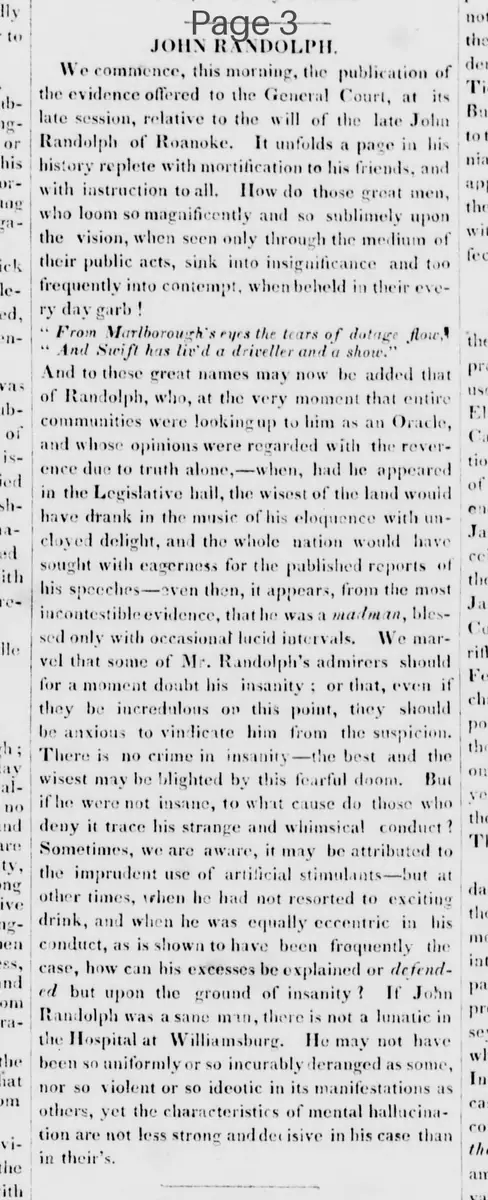
JOHN RANDOLPH
We commence, this morning, the publication of the evidence offered to the General Court, at its late session, relative to the will of the late John Randolph of Roanoke. It unfolds a page in his history replete with mortification to his friends, and with instruction to all. How do those great men, who loom so magnificently and so sublimely upon the vision, when seen only through the medium of their public acts, sink into insignificance and too frequently into contempt, when beheld in their every day garb!
"From Marlborough's eyes the tears of dotage flow,
And Swift has liv'd a driveller and a show."
And to these great names may now be added that of Randolph, who, at the very moment that entire communities were looking up to him as an Oracle, and whose opinions were regarded with the reverence due to truth alone,--when, had he appeared in the Legislative hall, the wisest of the land would have drank in the music of his eloquence with uncloyed delight, and the whole nation would have sought with eagerness for the published reports of his speeches--even then, it appears, from the most incontestible evidence, that he was a madman, blessed only with occasional lucid intervals. We marvel that some of Mr. Randolph's admirers should for a moment doubt his insanity; or that, even if they be incredulous on this point, they should be anxious to vindicate him from the suspicion. There is no crime in insanity--the best and the wisest may be blighted by this fearful doom. But if he were not insane, to what cause do those who deny it trace his strange and whimsical conduct? Sometimes, we are aware, it may be attributed to the imprudent use of artificial stimulants--but at other times, when he had not resorted to exciting drink, and when he was equally eccentric in his conduct, as is shown to have been frequently the case, how can his excesses be explained or defended but upon the ground of insanity? If John Randolph was a sane man, there is not a lunatic in the Hospital at Williamsburg. He may not have been so uniformly or so incurably deranged as some, nor so violent or so idiotic in its manifestations as others, yet the characteristics of mental hallucination are not less strong and decisive in his case than in theirs.
We commence, this morning, the publication of the evidence offered to the General Court, at its late session, relative to the will of the late John Randolph of Roanoke. It unfolds a page in his history replete with mortification to his friends, and with instruction to all. How do those great men, who loom so magnificently and so sublimely upon the vision, when seen only through the medium of their public acts, sink into insignificance and too frequently into contempt, when beheld in their every day garb!
"From Marlborough's eyes the tears of dotage flow,
And Swift has liv'd a driveller and a show."
And to these great names may now be added that of Randolph, who, at the very moment that entire communities were looking up to him as an Oracle, and whose opinions were regarded with the reverence due to truth alone,--when, had he appeared in the Legislative hall, the wisest of the land would have drank in the music of his eloquence with uncloyed delight, and the whole nation would have sought with eagerness for the published reports of his speeches--even then, it appears, from the most incontestible evidence, that he was a madman, blessed only with occasional lucid intervals. We marvel that some of Mr. Randolph's admirers should for a moment doubt his insanity; or that, even if they be incredulous on this point, they should be anxious to vindicate him from the suspicion. There is no crime in insanity--the best and the wisest may be blighted by this fearful doom. But if he were not insane, to what cause do those who deny it trace his strange and whimsical conduct? Sometimes, we are aware, it may be attributed to the imprudent use of artificial stimulants--but at other times, when he had not resorted to exciting drink, and when he was equally eccentric in his conduct, as is shown to have been frequently the case, how can his excesses be explained or defended but upon the ground of insanity? If John Randolph was a sane man, there is not a lunatic in the Hospital at Williamsburg. He may not have been so uniformly or so incurably deranged as some, nor so violent or so idiotic in its manifestations as others, yet the characteristics of mental hallucination are not less strong and decisive in his case than in theirs.
What sub-type of article is it?
Biography
Medical Curiosity
Tragedy
What themes does it cover?
Madness
Misfortune
What keywords are associated?
John Randolph
Insanity
Will
General Court
Eccentric Conduct
What entities or persons were involved?
John Randolph
Where did it happen?
Williamsburg
Story Details
Key Persons
John Randolph
Location
Williamsburg
Event Date
Late Session
Story Details
Evidence from the General Court reveals John Randolph's insanity, contrasting his public eloquence with eccentric private conduct, including mental hallucinations despite occasional lucid intervals.