Thank you for visiting SNEWPapers!
Sign up free
Literary
January 12, 1787
The New York Packet
New York, New York County, New York
What is this article about?
Autobiographical account by Comte de Cagliostro detailing his travels from 1766, including time in Malta, Europe, medical practices in Strasbourg and elsewhere, friendship with Cardinal de Rohan, and unwitting role in the diamond necklace affair, culminating in his 1785 arrest and Bastille imprisonment.
Clipping
OCR Quality
95%
Excellent
Full Text
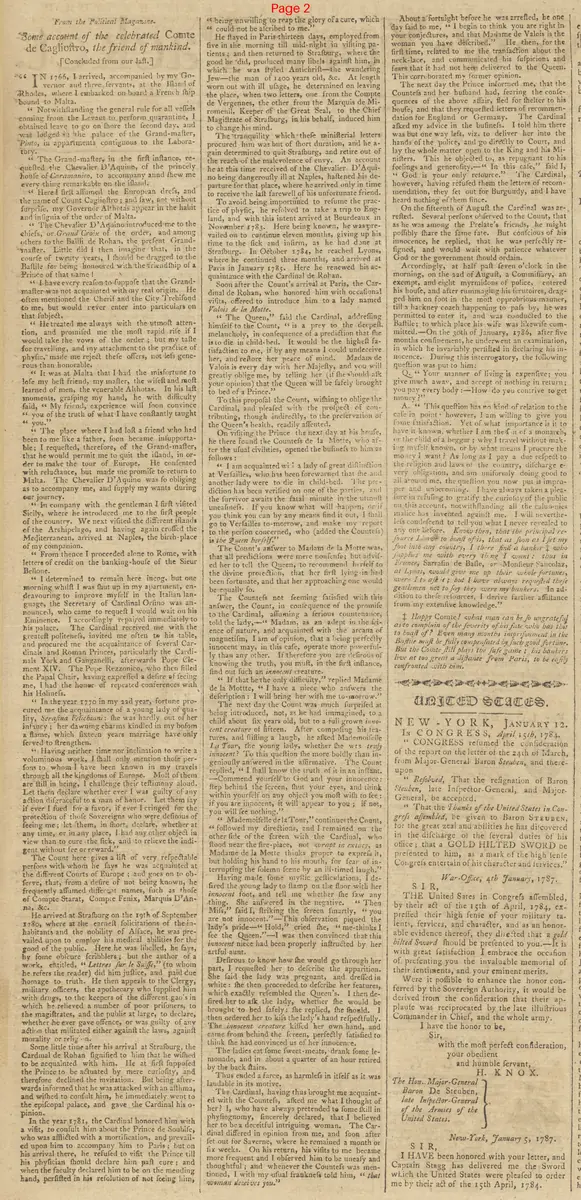
From the Political Magazine.
Some account of the celebrated Comte de Cagliostro, the friend of mankind.
[Concluded from our last.]
In 1766, I arrived, accompanied by my Governor and three servants, at the Island of Rhodes, where I embarked on board a French ship bound to Malta.
Notwithstanding the general rule for all vessels coming from the Levant to perform quarantine, I obtained leave to go on shore the second day, and was lodged in the palace of the Grand-Master, Pinto, in apartments contiguous to the Laboratory.
The Grand-Master, in the first instance, requested the Chevalier D'Aquino, of the princely house of Caramanico, to accompany and shew me every thing remarkable on the island.
Here I first assumed the European dress, and the name of Count Cagliostro: and saw, not without surprise, my Governor Althotas appear in the habit and insignia of the order of Malta.
The Chevalier D'Aquino introduced me to the chiefs, or Grand Croix of the order, and among others to the Bailli de Rohan, the present Grand-Master. Little did I then imagine that, in the course of twenty years, I should be dragged to the Bastile for being honoured with the friendship of a Prince of that name!
I have every reason to suppose that the Grand-Master was not acquainted with my real origin. He often mentioned the Cherif and the City of Trebizond to me, but would never enter into particulars on that subject.
He treated me always with the utmost attention, and promised me the most rapid rise if I would take the vows of the order; but my taste for travelling, and my attachment to the practice of physic, made me reject these offers, not less generous than honorable.
It was at Malta that I had the misfortune to lose my best friend, my master, the wisest and most learned of men, the venerable Althotas. In his last moments, grasping my hand, he with difficulty said, "My friend, experience will soon convince you of the truth of what I have constantly taught you."
The place where I had lost a friend who had been to me like a father, soon became insupportable; I requested, therefore, of the Grand-Master, that he would permit me to quit the island, in order to make the tour of Europe. He consented with reluctance, but made me promise to return to Malta. The Chevalier D'Aquino was so obliging as to accompany me, and supply my wants during our journey.
In company with the gentleman I first visited Sicily, where he introduced me to the first people of the country. We next visited the different islands of the Archipelago, and having again crossed the Mediterranean, arrived at Naples, the birth-place of my companion.
From thence I proceeded alone to Rome, with letters of credit on the banking-house of the Sieur Bellone.
I determined to remain here incog. but one morning whilst I was shut up in my apartment, endeavouring to improve myself in the Italian language, the Secretary of Cardinal Orsini was announced, who came to request I would wait on his Eminence. I accordingly repaired immediately to his palace. The Cardinal received me with the greatest politeness, invited me often to his table, and procured me the acquaintance of several Cardinals and Roman Princes, particularly the Cardinals York and Ganganelli, afterwards Pope Clement XIV. The Pope Rezzonico, who then filled the Papal Chair, having expressed a desire of seeing me, I had the honor of repeated conferences with his Holiness.
In the year 1770, in my 22d year, fortune procured me the acquaintance of a young lady of quality, Serafina Feliciani: she was hardly out of her infancy; her dawning charms kindled in my bosom a flame, which sixteen years marriage have only served to strengthen.
Having neither time nor inclination to write a voluminous work, I shall only mention those persons to whom I have been known in my travels through all the kingdoms of Europe. Most of them are still in being, I challenge their testimony aloud.
Let them declare whether ever I was guilty of any action disgraceful to a man of honor. Let them say if ever I sued for a favor, if ever I cringed for the protection of those Sovereigns who were desirous of seeing me; let them, in short, declare, whether at any time, or in any place, I had any other object in view than to cure the sick, and to relieve the indigent without fee or reward."
The Count here gives a list of very respectable persons with whom he says he was acquainted at the different Courts of Europe; and goes on to observe, that, from a desire of not being known, he frequently assumed different names, such as those of Comte St. Germain, Comte Phenix, Marquis D'Anna, &c.
He arrived at Strasburg on the 19th of September 1780, where at the earnest solicitations of the inhabitants and the nobility of Alsace, he was prevailed upon to employ his medical abilities for the good of the public. Here he was libelled, he says, by some obscure scribblers; but the author of a work, entitled, "Lettres sur le Suisse," (to whom he refers the reader) did him justice, and paid due homage to truth. He then appeals to the Clergy, military officers, the apothecary who supplied him with drugs, to the keepers of the different gaols in which he relieved a number of poor prisoners, to the magistrates, and the public at large, to declare, whether he ever gave offence, or was guilty of any action that militated either against the laws, against morality or religion.
Some little time after his arrival at Strasburg, the Cardinal de Rohan signified to him that he wished to be acquainted with him. He at first supposed the Prince to be actuated by mere curiosity, and therefore declined the invitation. But being afterwards informed that he was attacked with an asthma, and wished to consult him, he immediately went to the episcopal palace, and gave the Cardinal his opinion.
In the year 1781, the Cardinal honored him with a visit, to consult him about the Prince de Soubise, who was afflicted with a mortification, and prevailed upon him to accompany him to Paris: but on his arrival there, he refused to visit the Prince till his physician should declare him past cure; and when the faculty declared him to be on the mending hand, persisted in his resolution of not seeing him, being unwilling to reap the glory of a cure, which could not be ascribed to me.
He stayed in Paris thirteen days, employed from five in the morning till mid-night in visiting patients; and then returned to Strasburg, where the good he did, produced many libels against him, in which he was styled Antichrist-the wandering Jew-the man of 1400 years old, &c. At length worn out with ill usage, he determined on leaving the place, when two letters, one from the Comte de Vergennes, the other from the Marquis de Mironmesnil, Keeper of the Great Seal, to the Chief Magistrate of Strasburg, in his behalf, induced him to change his mind.
The tranquility which these ministerial letters procured him was but of short duration, and he again determined to quit Strasburg, and retire out of the reach of the malevolence of envy. An account he at this time received of the Chevalier D'Aquino being dangerously ill at Naples, hastened his departure for that place, where he arrived only in time to receive the last farewell of his unfortunate friend.
To avoid being importuned to resume the practice of physic, he resolved to take a trip to England, and with this intent arrived at Bourdeaux in November 1783. Here being known, he was prevailed on to continue eleven months, giving up his time to the sick and infirm, as he had done at Strasburg. In October 1784, he reached Lyons, where he continued three months, and arrived at Paris in January 1785. Here he renewed his acquaintance with the Cardinal de Rohan.
Soon after the Count's arrival at Paris, the Cardinal de Rohan, who honored him with occasional visits, offered to introduce him to a lady named Valois de la Motte.
"The Queen," said the Cardinal, addressing himself to the Count, "is a prey to the deepest melancholy, in consequence of a prediction that she is to die in child-bed. It would be the highest satisfaction to me, if by any means I could undeceive her, and restore her peace of mind. Madam de Valois is every day with her Majesty, and you will greatly oblige me, by telling her (if she should ask your opinion) that the Queen will be safely brought to bed of a Prince."
To this proposal the Count, wishing to oblige the Cardinal, and pleased with the prospect of contributing, though indirectly, to the preservation of the Queen's health, readily assented.
On visiting the Prince the next day at his house, he there found the Countess de la Motte, who after the usual civilities, opened the business to him as follows:
"I am acquainted with a lady of great distinction at Versailles, who has been forewarned that she and another lady were to die in child-bed. The prediction has been verified on one of the parties, and the survivor awaits the fatal minute in the utmost uneasiness. If you know what will happen, or if you think you can by any means find it out, I shall go to Versailles to-morrow, and make my report to the person concerned, who (added the Countess) is the Queen herself."
The Count's answer to Madam de la Motte was, that all predictions were mere nonsense; but advised her to tell the Queen, to recommend herself to the divine protection, that her first lying-in had been fortunate, and that her approaching one would be equally so.
The Countess not seeming satisfied with this answer, the Count, in consequence of the promise to the Cardinal, assuming a serious countenance, told the lady,-"Madam, as an adept in the science of nature, and acquainted with the arcana of magnetism, I am of opinion, that a being perfectly innocent may, in this case, operate more powerfully than any other. If therefore you are desirous of knowing the truth, you must, in the first instance, find out such an innocent creature."
"If that be the only difficulty," replied Madame de la Motte, "I have a niece who answers the description: I will bring her with me to-morrow."
The next day the Count was much surprised at being introduced, not, as he had imagined, to a child about six years old, but to a full grown innocent creature of fifteen. After composing his features, and stifling a laugh, he asked Mademoiselle La Tour, the young lady, whether she was truly innocent? To this question she more boldly than ingenuously answered in the affirmative. The Count replied, "I shall know the truth of it in an instant. Commend yourself to God and your innocence: step behind the screen, shut your eyes, and think within yourself on any object you most wish to see: if you are innocent, it will appear to you; if not, you will see nothing."
"Mademoiselle de la Tour," continues the Count, "followed my directions, and I remained on the other side of the screen with the Cardinal, who stood near the fire-place, not rapt in ecstasy, as Madame de la Motte thinks proper to express it, but holding his hand to his mouth, for fear of interrupting the solemn scene by an ill-timed laugh."
Having made some mystic gesticulations, I desired the young lady to stamp on the floor with her innocent foot, and tell me whether she saw any thing. She answered in the negative. "Then Miss," said I, striking the screen smartly, "you are not innocent." This observation piqued the lady's pride-"Hold," cried she, "methinks I see the Queen."-I was then convinced that this innocent niece had been properly instructed by her artful aunt.
Desirous to know how he would go through her part, I requested her to describe the apparition. She said the lady was pregnant, and dressed in white: she then proceeded to describe her features, which exactly resembled the Queen's. I then desired her to ask the lady, whether she would be brought to bed safely: she replied, she should. I then ordered her to kiss the lady's hand respectfully. The innocent creature kissed her own hand, and came from behind the screen, perfectly satisfied to think she had convinced us of her innocence.
The ladies eat some sweet-meats, drank some lemonade, and in about a quarter of an hour retired by the back stairs.
Thus ended a farce, as harmless in itself as it was laudable in its motive.
The Cardinal, having thus brought me acquainted with the Countess, asked me what I thought of her? I, who have always pretended to some skill in physiognomy, sincerely declared, that I believed her to be a deceitful intriguing woman. The Cardinal differed in opinion from me, and soon after set out for Saverne, where he remained a month or six weeks. On his return, his visits to me became more frequent and I observed him to be uneasy and thoughtful; and whenever the Countess was mentioned, I with my usual frankness told him, "that woman deceives you."
About a fortnight before he was arrested, he one day said to me, "I begin to think you are right in your conjectures, and that Madame de Valois is the woman you have described." He then, for the first time, related to me the transaction about the neck-lace, and communicated his suspicions and fears that it had not been delivered to the Queen. This corroborated my former opinion.
The next day the Prince informed me, that the Countess and her husband had, fearing the consequences of the above affair, fled for shelter to his house, and that they requested letters of recommendation for England or Germany. The Cardinal asked my advice in the business. I told him there was but one way left, viz. to deliver her into the hands of the police, and go directly to Court, and lay the whole matter open to the King and his Ministers. This he objected to, as repugnant to his feelings and generosity.-"In this case," said I, "God is your only resource." The Cardinal, however, having refused them the letters of recommendation, they set out for Burgundy, and I have heard nothing of them since.
On the fifteenth of August the Cardinal was arrested. Several persons observed to the Count, that as he was among the Prelate's friends, he might possibly share the same fate. But conscious of his innocence, he replied, that he was perfectly resigned, and would wait with patience whatever God or the government should ordain.
Accordingly, at half past seven o'clock in the morning, on the 22d of August, a Commissary, an exempt, and eight myrmidons of police, entered his house, and after rummaging his escritoires, dragged him on foot in the most opprobrious manner, till a hackney coach happening to pass by, he was permitted to enter it, and was conducted to the Bastile; to which place his wife was likewise committed.-On the 30th of January, 1786, after five months confinement, he underwent an examination, in which he invariably persisted in declaring his innocence. During this interrogatory, the following question was put to him:
Q. "Your manner of living is expensive; you give much away, and accept of nothing in return; you pay every body :-How do you contrive to get money?"
A. "This question has no kind of relation to the case in point· however, I am willing to give you some satisfaction. Yet of what importance is it to have it known, whether I am the son of a monarch, or the child of a beggar; why I travel without making myself known, or by what means I procure the money I want? As long as I pay a due respect to the religion and laws of the country, discharge every obligation, and am uniformly doing good to all around me, the question you now put is improper and unbecoming. I have always taken a pleasure in refusing to gratify the curiosity of the public on this account, notwithstanding all the calumnies malice has invented against me. I will nevertheless condescend to tell you what I never revealed to any one before. Know then, that the principal resource I have to boast of is, that as soon as I set my foot into any country, I there find a banker who supplies me with every thing I want: thus in France, Sarrafin de Bale, or Monsieur Fancolaz, at Lyons, would give me up their whole fortunes, were I to ask it; but I have always requested these gentlemen not to say they were my bankers. In addition to these resources, I derive farther assistance from my extensive knowledge."
Happy Comte! what man can be so ungrateful as to complain of the severity of his fate who has this to boast of? Even six months imprisonment in the Bastile must be fully compensated by such good fortune. But the Comte still plays the safe game; his bankers live at too great a distance from Paris, to be easily confronted with him.
Some account of the celebrated Comte de Cagliostro, the friend of mankind.
[Concluded from our last.]
In 1766, I arrived, accompanied by my Governor and three servants, at the Island of Rhodes, where I embarked on board a French ship bound to Malta.
Notwithstanding the general rule for all vessels coming from the Levant to perform quarantine, I obtained leave to go on shore the second day, and was lodged in the palace of the Grand-Master, Pinto, in apartments contiguous to the Laboratory.
The Grand-Master, in the first instance, requested the Chevalier D'Aquino, of the princely house of Caramanico, to accompany and shew me every thing remarkable on the island.
Here I first assumed the European dress, and the name of Count Cagliostro: and saw, not without surprise, my Governor Althotas appear in the habit and insignia of the order of Malta.
The Chevalier D'Aquino introduced me to the chiefs, or Grand Croix of the order, and among others to the Bailli de Rohan, the present Grand-Master. Little did I then imagine that, in the course of twenty years, I should be dragged to the Bastile for being honoured with the friendship of a Prince of that name!
I have every reason to suppose that the Grand-Master was not acquainted with my real origin. He often mentioned the Cherif and the City of Trebizond to me, but would never enter into particulars on that subject.
He treated me always with the utmost attention, and promised me the most rapid rise if I would take the vows of the order; but my taste for travelling, and my attachment to the practice of physic, made me reject these offers, not less generous than honorable.
It was at Malta that I had the misfortune to lose my best friend, my master, the wisest and most learned of men, the venerable Althotas. In his last moments, grasping my hand, he with difficulty said, "My friend, experience will soon convince you of the truth of what I have constantly taught you."
The place where I had lost a friend who had been to me like a father, soon became insupportable; I requested, therefore, of the Grand-Master, that he would permit me to quit the island, in order to make the tour of Europe. He consented with reluctance, but made me promise to return to Malta. The Chevalier D'Aquino was so obliging as to accompany me, and supply my wants during our journey.
In company with the gentleman I first visited Sicily, where he introduced me to the first people of the country. We next visited the different islands of the Archipelago, and having again crossed the Mediterranean, arrived at Naples, the birth-place of my companion.
From thence I proceeded alone to Rome, with letters of credit on the banking-house of the Sieur Bellone.
I determined to remain here incog. but one morning whilst I was shut up in my apartment, endeavouring to improve myself in the Italian language, the Secretary of Cardinal Orsini was announced, who came to request I would wait on his Eminence. I accordingly repaired immediately to his palace. The Cardinal received me with the greatest politeness, invited me often to his table, and procured me the acquaintance of several Cardinals and Roman Princes, particularly the Cardinals York and Ganganelli, afterwards Pope Clement XIV. The Pope Rezzonico, who then filled the Papal Chair, having expressed a desire of seeing me, I had the honor of repeated conferences with his Holiness.
In the year 1770, in my 22d year, fortune procured me the acquaintance of a young lady of quality, Serafina Feliciani: she was hardly out of her infancy; her dawning charms kindled in my bosom a flame, which sixteen years marriage have only served to strengthen.
Having neither time nor inclination to write a voluminous work, I shall only mention those persons to whom I have been known in my travels through all the kingdoms of Europe. Most of them are still in being, I challenge their testimony aloud.
Let them declare whether ever I was guilty of any action disgraceful to a man of honor. Let them say if ever I sued for a favor, if ever I cringed for the protection of those Sovereigns who were desirous of seeing me; let them, in short, declare, whether at any time, or in any place, I had any other object in view than to cure the sick, and to relieve the indigent without fee or reward."
The Count here gives a list of very respectable persons with whom he says he was acquainted at the different Courts of Europe; and goes on to observe, that, from a desire of not being known, he frequently assumed different names, such as those of Comte St. Germain, Comte Phenix, Marquis D'Anna, &c.
He arrived at Strasburg on the 19th of September 1780, where at the earnest solicitations of the inhabitants and the nobility of Alsace, he was prevailed upon to employ his medical abilities for the good of the public. Here he was libelled, he says, by some obscure scribblers; but the author of a work, entitled, "Lettres sur le Suisse," (to whom he refers the reader) did him justice, and paid due homage to truth. He then appeals to the Clergy, military officers, the apothecary who supplied him with drugs, to the keepers of the different gaols in which he relieved a number of poor prisoners, to the magistrates, and the public at large, to declare, whether he ever gave offence, or was guilty of any action that militated either against the laws, against morality or religion.
Some little time after his arrival at Strasburg, the Cardinal de Rohan signified to him that he wished to be acquainted with him. He at first supposed the Prince to be actuated by mere curiosity, and therefore declined the invitation. But being afterwards informed that he was attacked with an asthma, and wished to consult him, he immediately went to the episcopal palace, and gave the Cardinal his opinion.
In the year 1781, the Cardinal honored him with a visit, to consult him about the Prince de Soubise, who was afflicted with a mortification, and prevailed upon him to accompany him to Paris: but on his arrival there, he refused to visit the Prince till his physician should declare him past cure; and when the faculty declared him to be on the mending hand, persisted in his resolution of not seeing him, being unwilling to reap the glory of a cure, which could not be ascribed to me.
He stayed in Paris thirteen days, employed from five in the morning till mid-night in visiting patients; and then returned to Strasburg, where the good he did, produced many libels against him, in which he was styled Antichrist-the wandering Jew-the man of 1400 years old, &c. At length worn out with ill usage, he determined on leaving the place, when two letters, one from the Comte de Vergennes, the other from the Marquis de Mironmesnil, Keeper of the Great Seal, to the Chief Magistrate of Strasburg, in his behalf, induced him to change his mind.
The tranquility which these ministerial letters procured him was but of short duration, and he again determined to quit Strasburg, and retire out of the reach of the malevolence of envy. An account he at this time received of the Chevalier D'Aquino being dangerously ill at Naples, hastened his departure for that place, where he arrived only in time to receive the last farewell of his unfortunate friend.
To avoid being importuned to resume the practice of physic, he resolved to take a trip to England, and with this intent arrived at Bourdeaux in November 1783. Here being known, he was prevailed on to continue eleven months, giving up his time to the sick and infirm, as he had done at Strasburg. In October 1784, he reached Lyons, where he continued three months, and arrived at Paris in January 1785. Here he renewed his acquaintance with the Cardinal de Rohan.
Soon after the Count's arrival at Paris, the Cardinal de Rohan, who honored him with occasional visits, offered to introduce him to a lady named Valois de la Motte.
"The Queen," said the Cardinal, addressing himself to the Count, "is a prey to the deepest melancholy, in consequence of a prediction that she is to die in child-bed. It would be the highest satisfaction to me, if by any means I could undeceive her, and restore her peace of mind. Madam de Valois is every day with her Majesty, and you will greatly oblige me, by telling her (if she should ask your opinion) that the Queen will be safely brought to bed of a Prince."
To this proposal the Count, wishing to oblige the Cardinal, and pleased with the prospect of contributing, though indirectly, to the preservation of the Queen's health, readily assented.
On visiting the Prince the next day at his house, he there found the Countess de la Motte, who after the usual civilities, opened the business to him as follows:
"I am acquainted with a lady of great distinction at Versailles, who has been forewarned that she and another lady were to die in child-bed. The prediction has been verified on one of the parties, and the survivor awaits the fatal minute in the utmost uneasiness. If you know what will happen, or if you think you can by any means find it out, I shall go to Versailles to-morrow, and make my report to the person concerned, who (added the Countess) is the Queen herself."
The Count's answer to Madam de la Motte was, that all predictions were mere nonsense; but advised her to tell the Queen, to recommend herself to the divine protection, that her first lying-in had been fortunate, and that her approaching one would be equally so.
The Countess not seeming satisfied with this answer, the Count, in consequence of the promise to the Cardinal, assuming a serious countenance, told the lady,-"Madam, as an adept in the science of nature, and acquainted with the arcana of magnetism, I am of opinion, that a being perfectly innocent may, in this case, operate more powerfully than any other. If therefore you are desirous of knowing the truth, you must, in the first instance, find out such an innocent creature."
"If that be the only difficulty," replied Madame de la Motte, "I have a niece who answers the description: I will bring her with me to-morrow."
The next day the Count was much surprised at being introduced, not, as he had imagined, to a child about six years old, but to a full grown innocent creature of fifteen. After composing his features, and stifling a laugh, he asked Mademoiselle La Tour, the young lady, whether she was truly innocent? To this question she more boldly than ingenuously answered in the affirmative. The Count replied, "I shall know the truth of it in an instant. Commend yourself to God and your innocence: step behind the screen, shut your eyes, and think within yourself on any object you most wish to see: if you are innocent, it will appear to you; if not, you will see nothing."
"Mademoiselle de la Tour," continues the Count, "followed my directions, and I remained on the other side of the screen with the Cardinal, who stood near the fire-place, not rapt in ecstasy, as Madame de la Motte thinks proper to express it, but holding his hand to his mouth, for fear of interrupting the solemn scene by an ill-timed laugh."
Having made some mystic gesticulations, I desired the young lady to stamp on the floor with her innocent foot, and tell me whether she saw any thing. She answered in the negative. "Then Miss," said I, striking the screen smartly, "you are not innocent." This observation piqued the lady's pride-"Hold," cried she, "methinks I see the Queen."-I was then convinced that this innocent niece had been properly instructed by her artful aunt.
Desirous to know how he would go through her part, I requested her to describe the apparition. She said the lady was pregnant, and dressed in white: she then proceeded to describe her features, which exactly resembled the Queen's. I then desired her to ask the lady, whether she would be brought to bed safely: she replied, she should. I then ordered her to kiss the lady's hand respectfully. The innocent creature kissed her own hand, and came from behind the screen, perfectly satisfied to think she had convinced us of her innocence.
The ladies eat some sweet-meats, drank some lemonade, and in about a quarter of an hour retired by the back stairs.
Thus ended a farce, as harmless in itself as it was laudable in its motive.
The Cardinal, having thus brought me acquainted with the Countess, asked me what I thought of her? I, who have always pretended to some skill in physiognomy, sincerely declared, that I believed her to be a deceitful intriguing woman. The Cardinal differed in opinion from me, and soon after set out for Saverne, where he remained a month or six weeks. On his return, his visits to me became more frequent and I observed him to be uneasy and thoughtful; and whenever the Countess was mentioned, I with my usual frankness told him, "that woman deceives you."
About a fortnight before he was arrested, he one day said to me, "I begin to think you are right in your conjectures, and that Madame de Valois is the woman you have described." He then, for the first time, related to me the transaction about the neck-lace, and communicated his suspicions and fears that it had not been delivered to the Queen. This corroborated my former opinion.
The next day the Prince informed me, that the Countess and her husband had, fearing the consequences of the above affair, fled for shelter to his house, and that they requested letters of recommendation for England or Germany. The Cardinal asked my advice in the business. I told him there was but one way left, viz. to deliver her into the hands of the police, and go directly to Court, and lay the whole matter open to the King and his Ministers. This he objected to, as repugnant to his feelings and generosity.-"In this case," said I, "God is your only resource." The Cardinal, however, having refused them the letters of recommendation, they set out for Burgundy, and I have heard nothing of them since.
On the fifteenth of August the Cardinal was arrested. Several persons observed to the Count, that as he was among the Prelate's friends, he might possibly share the same fate. But conscious of his innocence, he replied, that he was perfectly resigned, and would wait with patience whatever God or the government should ordain.
Accordingly, at half past seven o'clock in the morning, on the 22d of August, a Commissary, an exempt, and eight myrmidons of police, entered his house, and after rummaging his escritoires, dragged him on foot in the most opprobrious manner, till a hackney coach happening to pass by, he was permitted to enter it, and was conducted to the Bastile; to which place his wife was likewise committed.-On the 30th of January, 1786, after five months confinement, he underwent an examination, in which he invariably persisted in declaring his innocence. During this interrogatory, the following question was put to him:
Q. "Your manner of living is expensive; you give much away, and accept of nothing in return; you pay every body :-How do you contrive to get money?"
A. "This question has no kind of relation to the case in point· however, I am willing to give you some satisfaction. Yet of what importance is it to have it known, whether I am the son of a monarch, or the child of a beggar; why I travel without making myself known, or by what means I procure the money I want? As long as I pay a due respect to the religion and laws of the country, discharge every obligation, and am uniformly doing good to all around me, the question you now put is improper and unbecoming. I have always taken a pleasure in refusing to gratify the curiosity of the public on this account, notwithstanding all the calumnies malice has invented against me. I will nevertheless condescend to tell you what I never revealed to any one before. Know then, that the principal resource I have to boast of is, that as soon as I set my foot into any country, I there find a banker who supplies me with every thing I want: thus in France, Sarrafin de Bale, or Monsieur Fancolaz, at Lyons, would give me up their whole fortunes, were I to ask it; but I have always requested these gentlemen not to say they were my bankers. In addition to these resources, I derive farther assistance from my extensive knowledge."
Happy Comte! what man can be so ungrateful as to complain of the severity of his fate who has this to boast of? Even six months imprisonment in the Bastile must be fully compensated by such good fortune. But the Comte still plays the safe game; his bankers live at too great a distance from Paris, to be easily confronted with him.
What sub-type of article is it?
Essay
Prose Fiction
What themes does it cover?
Political
Moral Virtue
Friendship
What keywords are associated?
Cagliostro
Travels
Malta
Rohan
Diamond Necklace
Bastille
Medical Practice
Friendship
What entities or persons were involved?
Comte De Cagliostro
Literary Details
Title
Some Account Of The Celebrated Comte De Cagliostro, The Friend Of Mankind.
Author
Comte De Cagliostro
Subject
Autobiographical Travels And Defense Against Accusations
Form / Style
First Person Narrative Memoir
Key Lines
My Friend, Experience Will Soon Convince You Of The Truth Of What I Have Constantly Taught You.
Let Them Declare Whether Ever I Was Guilty Of Any Action Disgraceful To A Man Of Honor.
Thus Ended A Farce, As Harmless In Itself As It Was Laudable In Its Motive.
God Is Your Only Resource.
Know Then, That The Principal Resource I Have To Boast Of Is, That As Soon As I Set My Foot Into Any Country, I There Find A Banker Who Supplies Me With Every Thing I Want