Thank you for visiting SNEWPapers!
Sign up free
Gazette Of The United States
New York, New York County, New York
What is this article about?
A letter from Edinburgh discusses the poor state of roads north of the Forth in Scotland and advocates for turnpike roads, citing historical improvements in travel, agriculture, and commerce between Glasgow and Edinburgh since the first turnpike act, contrasting with the more expensive and difficult journey to Aberdeen without turnpikes.
Clipping
OCR Quality
Full Text
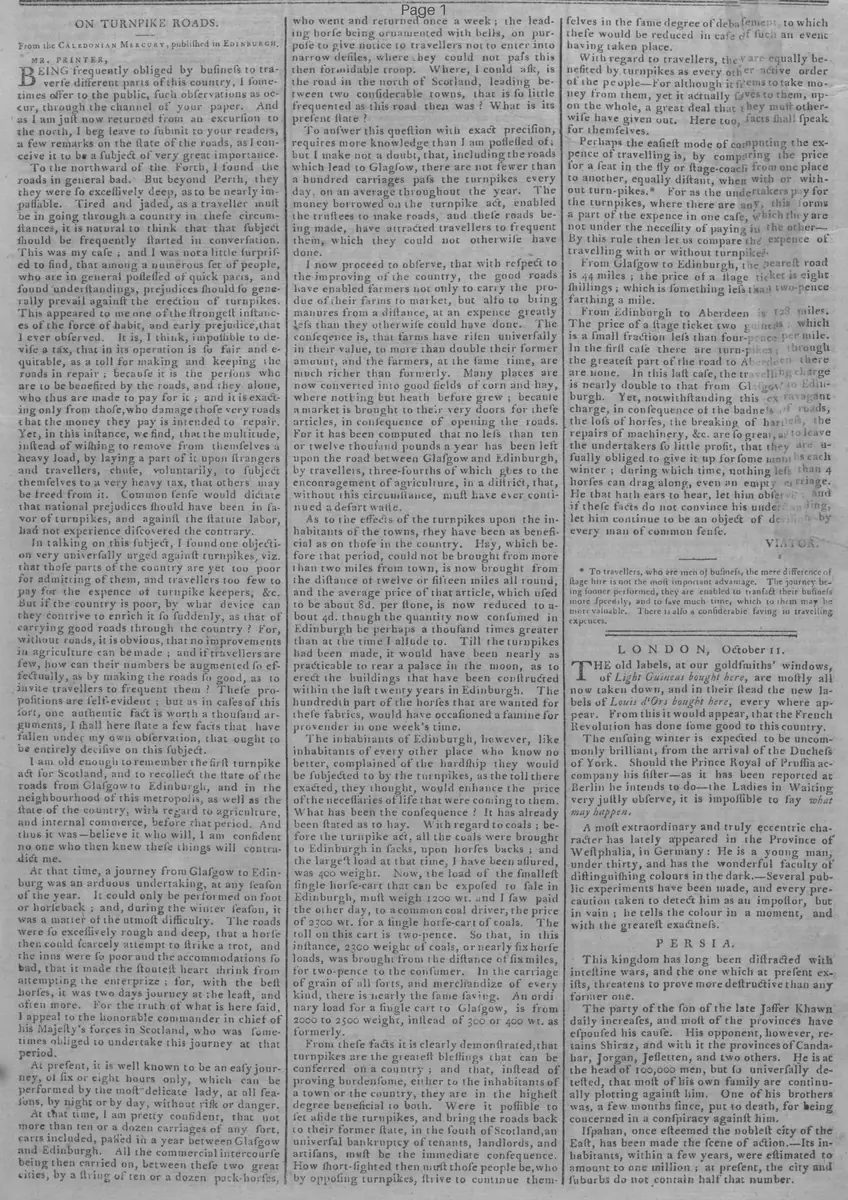
From the Caledonian Mercury, published in Edinburgh.
MR. PRINTER,
BEING frequently obliged by business to travel different parts of this country, I sometimes offer to the public, such observations as occur, through the channel of your paper. And as I am just now returned from an excursion to the north, I beg leave to submit to your readers, a few remarks on the state of the roads, as I conceive it to be a subject of very great importance.
To the northward of the Forth. I found the roads in general bad. But beyond Perth, they were so excessively deep, as to be nearly impassable. Tired and jaded, as a traveller must be in going through a country in these circumstances, it is natural to think that that subject should be frequently started in conversation. This was my case; and I was not a little surprised to find, that among a numerous set of people, who are in general possessed of quick parts, and sound understandings, prejudices should so generally prevail against the erection of turnpikes. This appeared to me one of the strongest instances of the force of habit, and early prejudice, that I ever observed. It is, I think, impossible to devise a tax, that in its operation is so fair and equitable, as a toll for making and keeping the roads in repair; because it is the persons who are to be benefited by the roads, and they alone, who thus are made to pay for it; and it is exacting only from those, who damage those very roads that the money they pay is intended to repair. Yet, in this instance, we find, that the multitude, instead of wishing to remove from themselves a heavy load, by laying a part of it upon strangers and travellers, choose, voluntarily, to subject themselves to a very heavy tax, that others may be freed from it. Common sense would dictate that national prejudices should have been in favor of turnpikes, and against the statute labor, had not experience discovered the contrary.
In talking on this subject, I found one objection very universally urged against turnpikes, viz. that those parts of the country are yet too poor for admitting of them, and travellers too few to pay for the expense of turnpike keepers, &c. But if the country is poor, by what device can they contrive to enrich it so suddenly, as that of carrying good roads through the country? For, without roads, it is obvious, that no improvements in agriculture can be made; and if travellers are few, how can their numbers be augmented so effectually, as by making the roads so good, as to invite travellers to frequent them? These propositions are self-evident; but as in cases of this sort, one authentic fact is worth a thousand arguments, I shall here state a few facts that have fallen under my own observation, that ought to be entirely decisive on this subject.
I am old enough to remember the first turnpike act for Scotland, and to recollect the state of the roads from Glasgow to Edinburgh, and in the neighbourhood of this metropolis, as well as the state of the country, with regard to agriculture, and internal commerce, before that period. And thus it was—believe it who will, I am confident no one who then knew these things will contradict me.
At that time, a journey from Glasgow to Edinburgh was an arduous undertaking, at any season of the year. It could only be performed on foot or horseback; and, during the winter season, it was a matter of the utmost difficulty. The roads were so excessively rough and deep, that a horse there could scarcely attempt to strike a trot, and the inns were so poor and the accommodations so bad, that it made the stoutest heart shrink from attempting the enterprise; for, with the best horses, it was two days journey at the least, and often more. For the truth of what is here said, I appeal to the honorable commander in chief of his Majesty's forces in Scotland, who was sometimes obliged to undertake this journey at that period.
At present, it is well known to be an easy journey, of six or eight hours only, which can be performed by the most delicate lady, at all seasons, by night or by day, without risk or danger. At that time, I am pretty confident, that not more than ten or a dozen carriages of any sort, carts included, passed in a year between Glasgow and Edinburgh. All the commercial intercourse being then carried on, between these two great cities, by a string of ten or a dozen pack-horses, who went and returned once a week; the leading horse being ornamented with bells, on purpose to give notice to travellers not to enter into narrow defiles, where they could not pass this then formidable troop. Where, I could ask, is the road in the north of Scotland, leading between two considerable towns, that is so little frequented as this road then was? What is its present state?
To answer this question with exact precision, requires more knowledge than I am possessed of; but I make not a doubt, that, including the roads which lead to Glasgow, there are not fewer than a hundred carriages pass the turnpikes every day, on an average throughout the year. The money borrowed on the turnpike act, enabled the trustees to make roads, and these roads being made, have attracted travellers to frequent them, which they could not otherwise have done.
I now proceed to observe, that with respect to the improving of the country, the good roads have enabled farmers not only to carry the produce of their farms to market, but also to bring manures from a distance, at an expense greatly less than they otherwise could have done. The consequence is, that farms have risen universally in their value, to more than double their former amount, and the farmers, at the same time, are much richer than formerly. Many places are now converted into good fields of corn and hay, where nothing but heath before grew; because a market is brought to their very doors for these articles, in consequence of opening the roads. For it has been computed that no less than ten or twelve thousand pounds a year has been left upon the road between Glasgow and Edinburgh, by travellers, three-fourths of which goes to the encouragement of agriculture, in a district, that, without this circumstance, must have ever continued a desert waste.
As to the effects of the turnpikes upon the inhabitants of the towns, they have been as beneficial as on those in the country. Hay, which before that period, could not be brought from more than two miles from town, is now brought from the distance of twelve or fifteen miles all round, and the average price of that article, which used to be about 8d. per ton, is now reduced to about 4d. though the quantity now consumed in Edinburgh be perhaps a thousand times greater than at the time I allude to. Till the turnpikes had been made, it would have been nearly as practicable to rear a palace in the moon, as to erect the buildings that have been constructed within the last twenty years in Edinburgh. The hundredth part of the horses that are wanted for these fabrics, would have occasioned a famine for provender in one week's time.
The inhabitants of Edinburgh, however, like inhabitants of every other place who know no better, complained of the hardship they would be subjected to by the turnpikes, as the toll there exacted, they thought, would enhance the price of the necessaries of life that were coming to them. What has been the consequence? It has already been stated as to hay. With regard to coals; before the turnpike act, all the coals were brought to Edinburgh in sacks, upon horses backs; and the largest load at that time, I have been assured, was 400 weight. Now, the load of the smallest single horse-cart that can be exposed to sale in Edinburgh, must weigh 1200 wt. and I saw paid the other day, to a common coal driver, the price of 2300 wt. for a single horse-cart of coals. The toll on this cart is two-pence. So that, in this instance, 2300 weight of coals, or nearly six horse loads, was brought from the distance of six miles, for two-pence to the consumer. In the carriage of grain of all sorts, and merchandise of every kind, there is nearly the same saving. An ordinary load for a single cart to Glasgow, is from 2000 to 2500 weight, instead of 300 or 400 wt. as formerly.
From these facts it is clearly demonstrated, that turnpikes are the greatest blessings that can be conferred on a country; and that, instead of proving burdensome, either to the inhabitants of a town or the country, they are in the highest degree beneficial to both. Were it possible to set aside the turnpikes, and bring the roads back to their former state, in the south of Scotland, an universal bankruptcy of tenants, landlords, and artisans, must be the immediate consequence. How short-sighted then must those people be, who by opposing turnpikes, strive to continue themselves in the same degree of debasement, to which these would be reduced in case of such an event having place.
With regard to travellers, they are equally benefited by turnpikes as every other active order of the people—For although it seems to take money from them, yet it actually saves to them, upon the whole, a great deal that they must otherwise have given out. Here too, facts shall speak for themselves.
Perhaps the easiest mode of computing the expense of travelling is, by comparing the price for a seat in the fly or stage-coach from one place to another, equally distant, when with or without turn-pikes.* For as the undertakers pay for the turnpikes, where there are any, this forms a part of the expense in one case, which they are not under the necessity of paying in the other.
By this rule then let us compare the expense of travelling with or without turnpikes.
From Glasgow to Edinburgh, the nearest road is 44 miles; the price of a stage ticket is eight shillings; which is something less than two-pence farthing a mile.
From Edinburgh to Aberdeen is 123 miles. The price of a stage ticket two guineas, which is a small fraction less than four-pence per mile.
In the first case there are turn-pikes; through the greatest part of the road to Aberdeen there are none. In this last case, the travelling charge is nearly double to that from Glasgow to Edinburgh. Yet, notwithstanding this extravagant charge, in consequence of the badness of roads, the loss of horses, the breaking of harness, the repairs of machinery, &c. are so great, as to leave the undertakers so little profit, that they are usually obliged to give it up for some months each winter; during which time, nothing less than 4 horses can drag along, even an empty carriage.
He that hath ears to hear, let him observe and if these facts do not convince his understanding, let him continue to be an object of derision by every man of common sense.
VIATOR.
* To travellers, who are men of business, the mere difference of stage hire is not the most important advantage. The journey being sooner performed, they are enabled to transact their business more speedily, and to save much time, which to them may be more valuable. There is also a considerable saving in travelling expenses.
What sub-type of article is it?
What keywords are associated?
Where did it happen?
Foreign News Details
Primary Location
Scotland
Outcome
turnpikes have improved road conditions, reduced travel times and costs, doubled farm values, enhanced agriculture and commerce, lowered prices of goods like hay and coals, and enabled urban development in edinburgh; opposition to turnpikes in the north persists despite these benefits.
Event Details
A traveler reports poor road conditions north of the Forth and beyond Perth, nearly impassable, and notes widespread prejudice against turnpikes among locals. He argues turnpikes are equitable and beneficial, countering objections of poverty and few travelers by citing self-evident economic gains. He recalls pre-turnpike era: arduous Glasgow-Edinburgh journey by foot or horse taking two days, limited commerce by pack-horses; now easy 6-8 hour trip with 100 daily carriages. Good roads have boosted agriculture, farm values, markets; benefited towns with cheaper hay and coals via larger loads; compares cheaper stage fares on turnpike roads (Glasgow-Edinburgh) vs. higher on poor roads (Edinburgh-Aberdeen). Concludes turnpikes are a great blessing, removing them would cause bankruptcy.