Thank you for visiting SNEWPapers!
Sign up free
Alexandria Gazette, Commercial And Political
Alexandria, Virginia
What is this article about?
On March 27, 1816, a U.S. House committee reported on its investigation into the General Post Office, prompted by rumors of misconduct. It examined nine charges against officials like Abraham and Phineas Bradley, finding most unsubstantiated or explained, and recommended discharging the committee.
Clipping
OCR Quality
Full Text
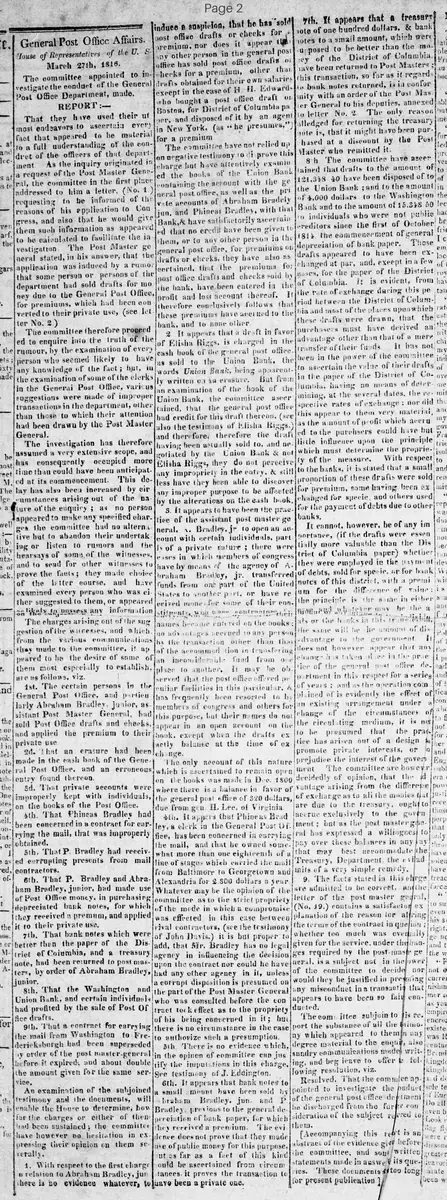
House of Representatives of the U. S.
March 27th, 1816.
The committee appointed to investigate the conduct of the General Post Office Department, made
REPORT:--
That they have used their utmost endeavors to ascertain every fact that appeared to be material to a full understanding of the conduct of the officers of that department. As the inquiry originated in a request of the Post Master General, the committee in the first place addressed to him a letter, (No. 1.) requesting to be informed of the reasons of his application to Congress, and also that he would give them such information as appeared to be calculated to facilitate the investigation. The Post Master General stated, in his answer, that the application was induced by a rumor that some person or persons of the department had sold drafts for money due to the General Post Office, for premiums, which had been converted to their private use, (see letter No. 2.)
The committee therefore proceeded to enquire into the truth of the rumour, by the examination of every person who seemed likely to have any knowledge of the fact; but, in the examination of some of the clerks in the General Post Office, various suggestions were made of improper transactions in the department, other than those to which their attention had been drawn by the Post Master General.
The investigation has therefore assumed a very extensive scope, and has consequently occupied more time than could have been anticipated at its commencement. This delay has also been increased by circumstances arising out of the nature of the enquiry; as no person appeared to make any specified charges, the committee had no alternative but to abandon their undertaking or listen to rumors and the hearsays of some of the witnesses, and to send for other witnesses to prove the facts; they made choice of the latter course, and have examined every person who was either suggested to them, or appeared as likely to possess any information.
The charges arising out of the suggestion of the witnesses, and which, from the various communications they made to the committee, it appeared to be the desire of some of them most especially to establish, are as follows, viz.
1st. That certain persons in the General Post Office, and particularly Abraham Bradley, junior, assistant Post Master General, had sold Post Office drafts and checks, and applied the premium to their private use
2d. That an erasure had been made in the cash book of the General Post Office, and an erroneous entry found thereon.
3d. That private accounts were improperly kept with individuals, on the books of the Post Office.
4th. That Phineas Bradley had been concerned in a contract for carrying the mail, that was improperly obtained.
5th. That P. Bradley had received corrupting presents from mail contractors.
6th. That P. Bradley and Abraham Bradley, junior, had made use of Post Office money, in purchasing depreciated bank notes, for which they received a premium, and applied it to their private use.
7th. That bank notes which were better than the paper of the District of Columbia, and a treasury note, had been returned to post masters, by order of Abraham Bradley, junior.
8th. That the Washington and Union Bank, and certain individuals had profited by the sale of Post Office drafts.
9th. That a contract for carrying the mail from Washington to Fredericksburg had been superseded by order of the post master-general before it expired, and about double the amount given for the same service.
An examination of the subjoined testimony and the documents, will enable the House to determine, how far the charges or either of them had been sustained: the committee have however no hesitation in expressing their opinion on them severally.
1. With respect to the first charge in relation to Abraham Bradley, jun. there is no evidence whatever, to induce a suspicion, that he has sold post office drafts or checks for a premium, nor does it appear that any other person in the general post office has sold post office drafts or checks for a premium, other than drafts obtained for their own salaries except in the case of H. H. Edwards who bought a post office draft on Boston, for District of Columbia paper, and disposed of it by an agent in New York, (as he presumes,) for a premium
The committee have not relied upon negative testimony to disprove this charge but have attentively examined the books of the Union Bank containing the account with the general post office, as well as the private accounts of Abraham Bradley jun, and Phineas Bradley, with that Bank.& have satisfactorily ascertained that no credits have been given to them, or to any other person in the general post office, for premiums on drafts or checks, they have also ascertained, that the premiums for post office drafts and checks sold by the bank, have been entered in the profit and loss account thereof. It therefore conclusively follows that these premiums have accrued to the bank, and to none other
2. It appears that a draft in favor of Elisha Riggs, is charged in the cash book of the general post office, as sold to the Union Bank, the words Union Bank, being apparently written on an erasure. But from an examination of the book of the Union Bank, the committee ascertained, that the general post office had credit for this draft thereon, (see also the testimony of Elisha Riggs.) and therefore, the draft having been actually sold to, and negotiated by the Union Bank & not Elisha Riggs, they do not perceive any impropriety in the entry. & still less have they been able to discover any improper purpose to be effected by the alterations on the cash book.
3. It appears to have been the practice of the assistant post master general, A. Bradley, jr to open an account with certain individuals, partly of a private nature; there were cases in which members of congress have by means of the agency of Abraham Bradley, jr. transferred funds from one part of the United States to another part, or have received money for some of their constituents. and want generally the names became entered on the books: no advantage accrued to any person by the transaction other than that of the accommodation in transferring a inconsiderable fund from one place to another. It may be observed that the post office offered one peculiar facilities in this particular. & has frequently been resorted to by members of congress and others for this purpose, but their names do not appear in an open account on the book, except when the drafts exactly balance at the time of exchange.
The only account of this nature which is ascertained to remain open on the books was made in Dec. 1800 where there is a balance in favor of the general post office of 320 dollars, due from gen. H. Lee. of Virginia
4th. It appears that Phineas Bradley. a clerk in the General Post Office, has been concerned in carrying the mail, and that he owned somewhat more than one eighteenth of a line of stages which carried the mail from Baltimore to Georgetown and Alexandria for 2500 dollars a year
Whatever may be the opinion of the committee as to the strict propriety of the mode in which a compromise was effected in this case between rival contractors, (see the testimony of John Davis.) it is but proper to add, that Mr. Bradley has no legal agency in influencing the decision upon the contract nor could he have had any other agency in it, unless a corrupt disposition is presumed on the part of the Post Master General who was consulted before the contract took effect as to the propriety of his being concerned in it; but there is no circumstance in the case to authorize such a presumption.
5th. There is no evidence which, in the opinion of committee can justify the imputations in this charge. See testimony of J. Edgington.
6th. It appears that bank notes to a small amount have been sold by Abraham Bradley. jun. and P. Bradley. previous to the general depreciation of bank paper, for which they received a premium. The evidence does not prove that they made use of public money for this purpose, but as far as a fact of this kind could be ascertained from circumstances.it proves the transaction to have been a private one.
7th. It appears that a treasury note of one hundred dollars. & bank notes to a small amount, which were supposed to be better than the money of the District of Columbia. Have been returned to Post Masters : this transaction, so far as it regards to bank notes returned, is in conformity with an order of the Post Master General to his deputies, annexed to letter No. 2. The only reason alledged for returning the treasury note is, that it might have been purchased at a discount by the Post Master who remitted it.
8th The committee have ascertained that drafts to the amount of $13,818 40 have been disposed of to the Union Bank ;and to the amount of 5,000 dollars to the Washington Bank and to the amount of $15,318 50 to individuals who were not public creditors since the first of October 1814 the commencement of general depreciation of bank paper. Those drafts appeared to have been exchanged at par, and, except in a few cases, for the paper of the District of Columbia. It is evident, from the rate of exchange during this period between the District of Columbia and most of the places upon which these drafts were drawn, that the purchasers must have derived an advantage other than that of a mere transfer of their funds It has not been in the power of the committee to ascertain the value of their drafts in the paper of the District of Columbia. having no means of determining. at the several dates, the respective rates of exchange : nor did this appear to them very material. as the amount of profit which accrued to the purchasers could have but little influence upon the principle which must determine the propriety of the measure.
With respect to the banks. it is stated that a small proportion of these drafts were sold for premium, some having been exchanged for specie. and others used for the payment of debts due to other banks.
It cannot, however. be of any importance, (if the drafts were essentially more valuable than the District of Columbia paper) whether they were employed in the payment of debts, sold for specie. or for bank notes of this district. with a premium for the difference of value: the principle is the same in either case, and the same will be the amount of disadvantage to the government. It does not however appear that any change has taken place in the practice of the general post office department in this respect for a series of years : and as the operation complained of is evidently the effect of an existing arrangement under a change of the circumstances of the circulating medium, it is not to be presumed that the practice has arisen out of a design to promote private interests, or to prejudice the interest of the government The committee are however decidedly of opinion. that the advantage arising from the difference of exchange as to all the monies that are due to the treasury. ought to accrue exclusively to the government ; but as the post master general has expressed a willingness to pay over these balances in any way that may best accommodate the Treasury, Department. the evil admits of a very simple remedy.
9. The facts stated in this charge are admitted to be correct. and the letter of the post master general, (No. 19.) contains a satisfactory explanation of the reason for altering the terms of the contract in question : whether too much was eventually given for the service, under the stages required by the post-master general, is a subject not in the power of the committee to decide nor would they be justified in presuming any misconduct in a transaction that appears to have been so fairly conducted.
The committee subjoin to this report the substance of all the testimony which appeared to them in any degree material to the enquiry, also sundry communications made in writing, and beg leave to offer the following resolution, viz.
Resolved. That the committee appointed to investigate the conduct of the general post office department be discharged from the further consideration of the subject referred to them.
[Accompanying this report is an abstract of the evidence given before the committee, and some written statements made in answer to its queries.
These documents stand too long for present publication ]
What sub-type of article is it?
What keywords are associated?
What entities or persons were involved?
Where did it happen?
Domestic News Details
Primary Location
Washington
Event Date
March 27th, 1816
Key Persons
Outcome
most charges unsubstantiated or explained; committee recommends discharge from further investigation; no misconduct found in key allegations.
Event Details
U.S. House committee investigates General Post Office conduct based on rumors of draft sales for premiums and other improprieties, examines nine specific charges against officials, reviews testimony and documents, and concludes with opinions clearing most accusations.