Thank you for visiting SNEWPapers!
Sign up free
Letter to Editor
July 2, 1850
The Arkansas Banner
Little Rock, Pulaski County, Arkansas
What is this article about?
Senator D. S. Dickinson of New York accepts an invitation to a complimentary public dinner from Democratic Republicans in New York City and adjoining counties on June 17, 1850. He reflects on his efforts to resist sectionalism, preserve the Union, and uphold national institutions amid recent extraordinary events and divisions.
Clipping
OCR Quality
98%
Excellent
Full Text
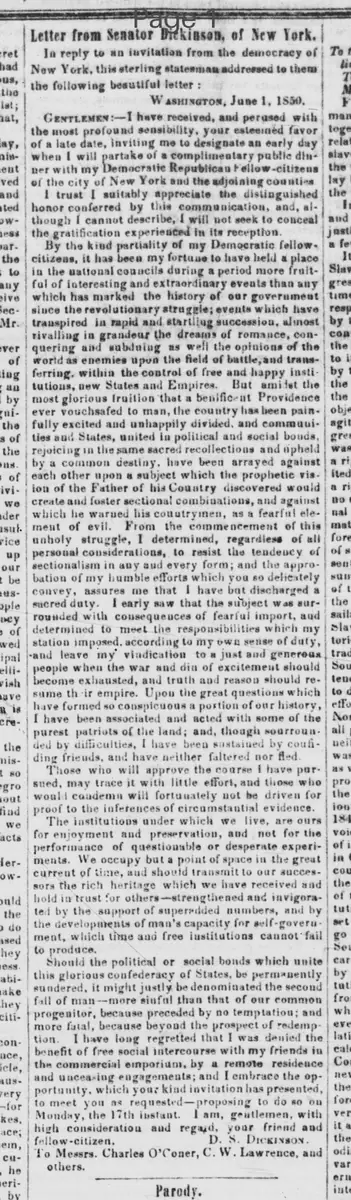
Letter from Senator Dickinson, of New York.
In reply to an invitation from the democracy of New York, this sterling statesman addressed to them the following beautiful letter:
WASHINGTON, June 1, 1850.
Gentlemen:—I have received, and perused with the most profound sensibility, your esteemed favor of a late date, inviting me to designate an early day when I will partake of a complimentary public dinner with my Democratic Republican Fellow-citizens of the city of New York and the adjoining counties. I trust I suitably appreciate the distinguished honor conferred by this communication, and, although I cannot describe, I will not seek to conceal the gratification experienced in its reception.
By the kind partiality of my Democratic fellow-citizens, it has been my fortune to have held a place in the national councils during a period more fruitful of interesting and extraordinary events than any which has marked the history of our government since the revolutionary struggle; events which have transpired in rapid and startling succession, almost rivalling in grandeur the dreams of romance, conquering and subduing as well the opinions of the world as enemies upon the field of battle, and transferring, within the control of free and happy institutions, new States and Empires. But amidst the most glorious fruition that a beneficent Providence ever vouchsafed to man, the country has been painfully excited and unhappily divided, and communities and States, united in political and social bonds, rejoicing in the same sacred recollections and upheld by a common destiny, have been arrayed against each other upon a subject which the prophetic vision of the Father of his Country discovered would create and foster sectional combinations, and against which he warned his countrymen, as a fearful element of evil. From the commencement of this unholy struggle, I determined, regardless of all personal considerations, to resist the tendency of sectionalism in any and every form; and the approbation of my humble efforts which you so delicately convey, assures me that I have but discharged a sacred duty. I early saw that this subject was surrounded with consequences of fearful import, and determined to meet the responsibilities which my station imposed, according to my own sense of duty,—and leave my vindication to a just and generous people when the war and din of excitement should become exhausted, and truth and reason should resume their empire. Upon the great questions which have formed so conspicuous a portion of our history, I have been associated and acted with some of the purest patriots of the land; and, though surrounded by difficulties, I have been sustained by confiding friends, and have neither faltered nor fled. Those who will approve the course I have pursued, may trace it with little effort, and those who would condemn will fortunately not be driven for proof to the inferences of circumstantial evidence.
The institutions under which we live, are ours for enjoyment and preservation, and not for the performance of questionable or desperate experiments. We occupy but a point of space in the great current of time, and should transmit to our successors the rich heritage which we have received and hold in trust for others—strengthened and invigorated by the support of superadded numbers, and by the developments of man's capacity for self-government, which time and free institutions cannot fail to produce.
Should the political or social bonds which unite this glorious confederacy of States, be permanently sundered, it might justly be denominated the second fall of man—more sinful than that of our common progenitor, because preceded by no temptation; and more fatal, because beyond the prospect of redemption. I have long regretted that I was denied the benefit of free social intercourse with my friends in the commercial emporium, by a remote residence and unceasing engagements; and I embrace the opportunity, which your kind invitation has presented, to meet you as requested—proposing to do so on Monday, the 17th instant. I am, gentlemen, with high consideration and regard, your friend and fellow-citizen,
D. S. DICKINSON.
To Messrs. Charles O'Conor, C. W. Lawrence, and others.
In reply to an invitation from the democracy of New York, this sterling statesman addressed to them the following beautiful letter:
WASHINGTON, June 1, 1850.
Gentlemen:—I have received, and perused with the most profound sensibility, your esteemed favor of a late date, inviting me to designate an early day when I will partake of a complimentary public dinner with my Democratic Republican Fellow-citizens of the city of New York and the adjoining counties. I trust I suitably appreciate the distinguished honor conferred by this communication, and, although I cannot describe, I will not seek to conceal the gratification experienced in its reception.
By the kind partiality of my Democratic fellow-citizens, it has been my fortune to have held a place in the national councils during a period more fruitful of interesting and extraordinary events than any which has marked the history of our government since the revolutionary struggle; events which have transpired in rapid and startling succession, almost rivalling in grandeur the dreams of romance, conquering and subduing as well the opinions of the world as enemies upon the field of battle, and transferring, within the control of free and happy institutions, new States and Empires. But amidst the most glorious fruition that a beneficent Providence ever vouchsafed to man, the country has been painfully excited and unhappily divided, and communities and States, united in political and social bonds, rejoicing in the same sacred recollections and upheld by a common destiny, have been arrayed against each other upon a subject which the prophetic vision of the Father of his Country discovered would create and foster sectional combinations, and against which he warned his countrymen, as a fearful element of evil. From the commencement of this unholy struggle, I determined, regardless of all personal considerations, to resist the tendency of sectionalism in any and every form; and the approbation of my humble efforts which you so delicately convey, assures me that I have but discharged a sacred duty. I early saw that this subject was surrounded with consequences of fearful import, and determined to meet the responsibilities which my station imposed, according to my own sense of duty,—and leave my vindication to a just and generous people when the war and din of excitement should become exhausted, and truth and reason should resume their empire. Upon the great questions which have formed so conspicuous a portion of our history, I have been associated and acted with some of the purest patriots of the land; and, though surrounded by difficulties, I have been sustained by confiding friends, and have neither faltered nor fled. Those who will approve the course I have pursued, may trace it with little effort, and those who would condemn will fortunately not be driven for proof to the inferences of circumstantial evidence.
The institutions under which we live, are ours for enjoyment and preservation, and not for the performance of questionable or desperate experiments. We occupy but a point of space in the great current of time, and should transmit to our successors the rich heritage which we have received and hold in trust for others—strengthened and invigorated by the support of superadded numbers, and by the developments of man's capacity for self-government, which time and free institutions cannot fail to produce.
Should the political or social bonds which unite this glorious confederacy of States, be permanently sundered, it might justly be denominated the second fall of man—more sinful than that of our common progenitor, because preceded by no temptation; and more fatal, because beyond the prospect of redemption. I have long regretted that I was denied the benefit of free social intercourse with my friends in the commercial emporium, by a remote residence and unceasing engagements; and I embrace the opportunity, which your kind invitation has presented, to meet you as requested—proposing to do so on Monday, the 17th instant. I am, gentlemen, with high consideration and regard, your friend and fellow-citizen,
D. S. DICKINSON.
To Messrs. Charles O'Conor, C. W. Lawrence, and others.
What sub-type of article is it?
Political
Reflective
Persuasive
What themes does it cover?
Politics
Constitutional Rights
What keywords are associated?
Sectionalism
Union Preservation
Democratic Republicans
New York
Washington Warning
National Councils
What entities or persons were involved?
D. S. Dickinson
Messrs. Charles O'conor, C. W. Lawrence, And Others
Letter to Editor Details
Author
D. S. Dickinson
Recipient
Messrs. Charles O'conor, C. W. Lawrence, And Others
Main Argument
the writer accepts the invitation to a public dinner on june 17, 1850, and affirms his commitment to resisting sectionalism to preserve the union, viewing its potential dissolution as a catastrophic 'second fall of man'.
Notable Details
References Washington's Warning Against Sectional Combinations
Mentions Revolutionary Struggle And Recent Extraordinary Events
Emphasizes Duty To Preserve Institutions Without Experiments