Thank you for visiting SNEWPapers!
Sign up free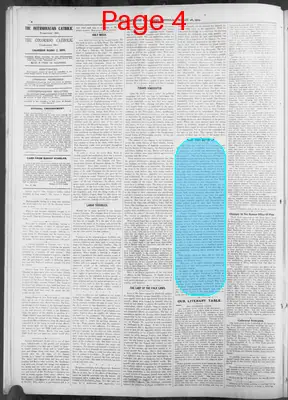
Editorial
March 26, 1904
The Intermountain Catholic
Salt Lake City, Salt Lake County, Utah
What is this article about?
Editorial discusses the decline of prejudice against Catholics in America, citing supportive editorials from newspapers like the Cincinnati Times-Star, St. Louis Republic, and Chicago Tribune on issues such as public school funding, divorce, and the Catholic Church's fearless stance against societal evils like socialism and godless industrialism.
Clipping
OCR Quality
98%
Excellent
Full Text
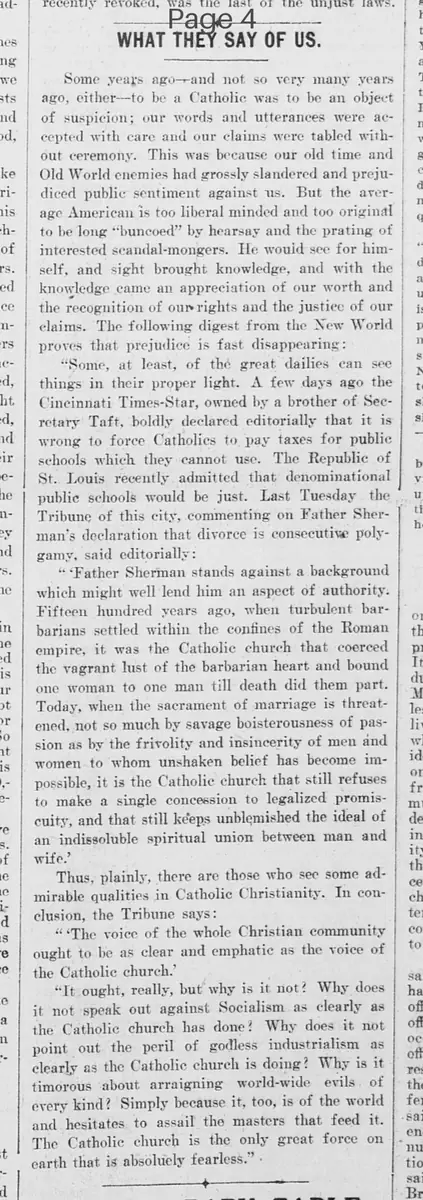
WHAT THEY SAY OF US.
Some years ago—and not so very many years ago, either—to be a Catholic was to be an object of suspicion: our words and utterances were accepted with care and our claims were tabled without ceremony. This was because our old time and Old World enemies had grossly slandered and prejudiced public sentiment against us. But the average American is too liberal minded and too original to be long "buncoed" by hearsay and the prating of interested scandal-mongers. He would see for himself, and sight brought knowledge, and with the knowledge came an appreciation of our worth and the recognition of our rights and the justice of our claims. The following digest from the New World proves that prejudice is fast disappearing:
"Some, at least, of the great dailies can see things in their proper light. A few days ago the Cincinnati Times-Star, owned by a brother of Secretary Taft, boldly declared editorially that it is wrong to force Catholics to pay taxes for public schools which they cannot use. The Republic of St. Louis recently admitted that denominational public schools would be just. Last Tuesday the Tribune of this city, commenting on Father Sherman's declaration that divorce is consecutive polygamy, said editorially:
"Father Sherman stands against a background which might well lend him an aspect of authority. Fifteen hundred years ago, when turbulent barbarians settled within the confines of the Roman empire, it was the Catholic church that coerced the vagrant lust of the barbarian heart and bound one woman to one man till death did them part. Today, when the sacrament of marriage is threatened, not so much by savage boisterousness of passion as by the frivolity and insincerity of men and women to whom unshaken belief has become impossible, it is the Catholic church that still refuses to make a single concession to legalized promiscuity, and that still keeps unblemished the ideal of an indissoluble spiritual union between man and wife."
Thus, plainly, there are those who see some admirable qualities in Catholic Christianity. In conclusion, the Tribune says:
"The voice of the whole Christian community ought to be as clear and emphatic as the voice of the Catholic church.
"It ought, really, but why is it not? Why does it not speak out against Socialism as clearly as the Catholic church has done? Why does it not point out the peril of godless industrialism as clearly as the Catholic church is doing? Why is it timorous about arraigning world-wide evils of every kind? Simply because it, too, is of the world and hesitates to assail the masters that feed it. The Catholic church is the only great force on earth that is absolutely fearless."
Some years ago—and not so very many years ago, either—to be a Catholic was to be an object of suspicion: our words and utterances were accepted with care and our claims were tabled without ceremony. This was because our old time and Old World enemies had grossly slandered and prejudiced public sentiment against us. But the average American is too liberal minded and too original to be long "buncoed" by hearsay and the prating of interested scandal-mongers. He would see for himself, and sight brought knowledge, and with the knowledge came an appreciation of our worth and the recognition of our rights and the justice of our claims. The following digest from the New World proves that prejudice is fast disappearing:
"Some, at least, of the great dailies can see things in their proper light. A few days ago the Cincinnati Times-Star, owned by a brother of Secretary Taft, boldly declared editorially that it is wrong to force Catholics to pay taxes for public schools which they cannot use. The Republic of St. Louis recently admitted that denominational public schools would be just. Last Tuesday the Tribune of this city, commenting on Father Sherman's declaration that divorce is consecutive polygamy, said editorially:
"Father Sherman stands against a background which might well lend him an aspect of authority. Fifteen hundred years ago, when turbulent barbarians settled within the confines of the Roman empire, it was the Catholic church that coerced the vagrant lust of the barbarian heart and bound one woman to one man till death did them part. Today, when the sacrament of marriage is threatened, not so much by savage boisterousness of passion as by the frivolity and insincerity of men and women to whom unshaken belief has become impossible, it is the Catholic church that still refuses to make a single concession to legalized promiscuity, and that still keeps unblemished the ideal of an indissoluble spiritual union between man and wife."
Thus, plainly, there are those who see some admirable qualities in Catholic Christianity. In conclusion, the Tribune says:
"The voice of the whole Christian community ought to be as clear and emphatic as the voice of the Catholic church.
"It ought, really, but why is it not? Why does it not speak out against Socialism as clearly as the Catholic church has done? Why does it not point out the peril of godless industrialism as clearly as the Catholic church is doing? Why is it timorous about arraigning world-wide evils of every kind? Simply because it, too, is of the world and hesitates to assail the masters that feed it. The Catholic church is the only great force on earth that is absolutely fearless."
What sub-type of article is it?
Moral Or Religious
Social Reform
What keywords are associated?
Catholic Prejudice
Public Schools
Divorce
Catholic Church
Socialism
Industrialism
Marriage Sacrament
What entities or persons were involved?
Catholic Church
Father Sherman
Cincinnati Times Star
Secretary Taft
Republic Of St. Louis
Tribune
Editorial Details
Primary Topic
Decline Of Prejudice Against Catholics
Stance / Tone
Appreciative Of Changing Public Sentiment Towards Catholicism
Key Figures
Catholic Church
Father Sherman
Cincinnati Times Star
Secretary Taft
Republic Of St. Louis
Tribune
Key Arguments
Prejudice Against Catholics Stemmed From Slanders By Old Enemies But Is Fading Due To Americans' Liberal Mindedness
Newspapers Like Cincinnati Times Star Oppose Forcing Catholics To Fund Unusable Public Schools
St. Louis Republic Admits Justice In Denominational Public Schools
Tribune Praises Catholic Church's Historical And Current Stance Against Divorce As Legalized Promiscuity
Catholic Church Maintains Ideal Of Indissoluble Marriage
Other Christian Communities Fail To Speak Clearly Against Socialism And Godless Industrialism
Catholic Church Is The Only Fearless Force Against Worldly Evils