Thank you for visiting SNEWPapers!
Sign up free
The Rhode Island Republican
Newport, Newport County, Rhode Island
What is this article about?
Account of the 1814 Battle of Niagara at Lundy's Lane, where U.S. forces captured British guns in fierce combat. British burned American dead in retaliation, leaving remains exposed until Col. Robert Carr covered them with stones recently.
Clipping
OCR Quality
Full Text
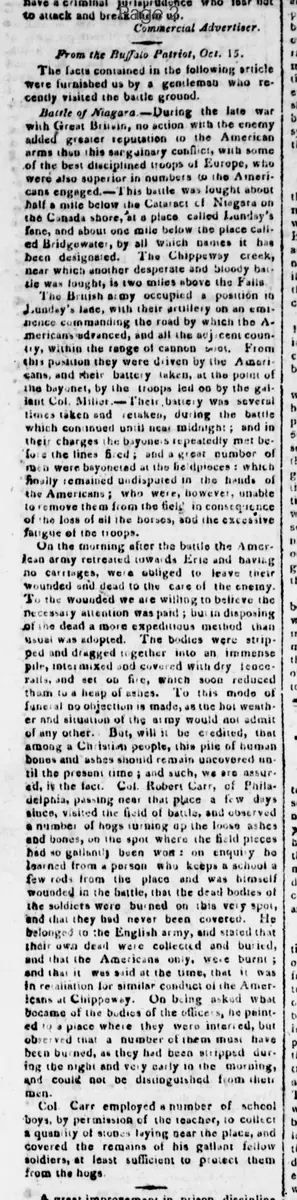
From the Buffalo Patriot, Oct. 15.
The facts contained in the following article were furnished us by a gentleman who recently visited the battle ground.
Battle of Niagara.—During the late war with Great Britain, no action with the enemy added greater reputation to the American arms than this sanguinary conflict, with some of the best disciplined troops of Europe, who were also superior in numbers to the Americans engaged.—This battle was fought about half a mile below the Cataract of Niagara on the Canada shore, at a place called Lundy's Lane, and about one mile below the place called Bridgewater, by all which names it has been designated. The Chippeway creek, near which another desperate and bloody battle was fought, is two miles above the Falls.
The British army occupied a position at Lundy's Lane, with their artillery on an eminence commanding the road by which the Americans advanced, and all the adjacent country, within the range of cannon shot. From this position they were driven by the Americans, and their battery taken, at the point of the bayonet, by the troops led on by the gallant Col. Miller.—Their battery was several times taken and retaken, during the battle which continued until near midnight; and in their charges the bayonets repeatedly met before the lines fled; and a great number of men were bayoneted at the field pieces; which finally remained undisputed in the hands of the Americans; who were, however, unable to remove them from the field in consequence of the loss of all the horses, and the excessive fatigue of the troops.
On the morning after the battle the American army retreated towards Erie and having no carriages, were obliged to leave their wounded and dead to the care of the enemy. To the wounded we are willing to believe the necessary attention was paid; but in disposing of the dead a more expeditious method than usual was adopted. The bodies were stripped and dragged together into an immense pile, intermixed and covered with dry fence rails, and set on fire, which soon reduced them to a heap of ashes. To this mode of funeral no objection is made, as the hot weather and situation of the army would not admit of any other. But, will it be credited, that among a Christian people, this pile of human bones and ashes should remain uncovered until the present time; and such, we are assured, is the fact. Col. Robert Carr, of Philadelphia, passing near that place a few days since, visited the field of battle, and observed a number of hogs turning up the loose ashes and bones, on the spot where the field pieces had so gallantly been won: on enquiry he learned from a person who keeps a school a few rods from the place and was himself wounded in the battle, that the dead bodies of the soldiers were burned on this very spot, and that they had never been covered. He belonged to the English army, and stated that their own dead were collected and buried, and that the Americans only, were burnt; and that it was said at the time, that it was in retaliation for similar conduct of the Americans at Chippeway. On being asked what became of the bodies of the officers, he pointed to a place where they were interred, but observed that a number of them must have been burned, as they had been stripped during the night and very early in the morning, and could not be distinguished from the men.
Col. Carr employed a number of school boys, by permission of the teacher, to collect a quantity of stones laying near the place, and covered the remains of his gallant fellow soldiers, at least sufficient to protect them from the hogs.
What sub-type of article is it?
What themes does it cover?
What keywords are associated?
What entities or persons were involved?
Where did it happen?
Story Details
Key Persons
Location
Lundy's Lane, Canada Shore, Near Niagara Falls
Event Date
During The Late War With Great Britain
Story Details
During the War of 1812, Americans under Col. Miller captured British artillery at Lundy's Lane after intense bayonet fighting lasting until midnight. The next day, they retreated, leaving wounded and dead. British burned American dead on a pyre of bodies and fence rails, leaving ashes uncovered until Col. Carr recently covered them with stones to protect from hogs.