Thank you for visiting SNEWPapers!
Sign up free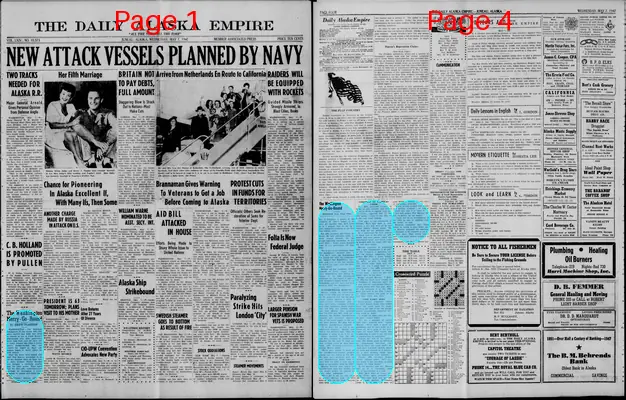
The Daily Alaska Empire
Juneau, Juneau County, Alaska
What is this article about?
Drew Pearson reports on tense secret AFL-CIO meetings in Washington aimed at labor unity amid anti-labor legislation threats. Leaders like Phil Murray, John L. Lewis, Bill Green, and others debate proposals but fail to reach agreement, with Lewis clashing notably.
Merged-components note: These components form the complete 'Washington Merry-Go-Round' column, continued across pages 1 and 4 with sequential reading order and matching text content.
Clippings
1 of 2
OCR Quality
Full Text
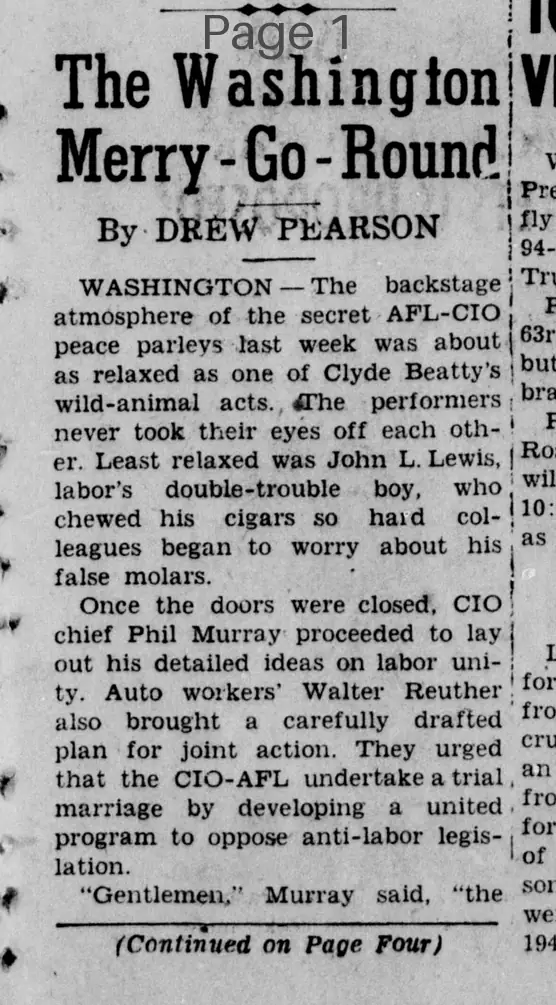
By DREW PEARSON
WASHINGTON - The backstage atmosphere of the secret AFL-CIO peace parleys last week was about as relaxed as one of Clyde Beatty's wild-animal acts. The performers never took their eyes off each other. Least relaxed was John L. Lewis, labor's double-trouble boy, who chewed his cigars so hard colleagues began to worry about his false molars.
Once the doors were closed, CIO chief Phil Murray proceeded to lay out his detailed ideas on labor unity. Auto workers' Walter Reuther also brought a carefully drafted plan for joint action. They urged that the CIO-AFL undertake a trial marriage by developing a united program to oppose anti-labor legislation.
"Gentlemen," Murray said, "the fire of Congress is licking at the outskirts of labor's house. If we can't get together now, we'll never do it. I propose that we set up a joint legislative program as the first step toward unity."
But AFL president Bill Green objected. He said sufficient unity already existed between the two groups regarding legislation. At this point John L. Lewis nearly knocked some of the performers off their seats.
"We've got to do something about this legislation," boomed John L. "You can't trust the Republicans. I've found out that the industrialists bought the Republican party body and soul in the last election. Of course you can't trust the Democrats, either."
Several of the conferees leaned forward at Lewis' angry words. They remembered that during the climax of the 1940 presidential campaign he had staged a nationwide broadcast urging defeat of the Democrats, and ever since had been working with the Republicans.
JURISDICTIONAL DISPUTES
Murray turned the conversation back to the CIO plan of labor unity. He proposed that the two labor groups jointly sponsor a series of coast-to-coast broadcasts plus a large advertising campaign to block anti-labor legislation. Green replied that the AFL was already doing just that. Murray then proposed that the CIO and AFL work out a program for ending jurisdictional disputes and secondary boycotts, two of the sorest points in the entire labor picture. His plan was to arbitrate jurisdictional disputes.
"If we don't put an end to jurisdictional disputes," Murray said with a rich Scottish burr, "then the Congress is going to do it for us."
Green observed that the AFL had been troubled by jurisdictional disputes for the past 75 years and that nothing could be done about them. AFL secretary-treasurer George Meany added:
"We've been unable to work out the jurisdictional-dispute problem among our own unions in the AFL. We have more problems with our own jurisdictional fights than we have with the CIO, so how can we make an agreement with the CIO?"
Murray warned that unless the jurisdictional mess was settled, the way would always be opened for nasty labor legislation.
"We've got to put our own house in order," Murray said, "or we'll have to face the fire from Congress with little help."
CONGRESS OF AMERICAN LABOR
The AFL conferees refused to budge on this, however, and turned to the problem of organic labor unity. Green suggested that all the CIO unions return to the AFL on a full and equal footing.
"You come to our convention in October. We'll give each of your unions a vote and we'll all be one happy family." Green urged. "We can work out our problems then."
As a concession he then offered to hand over to the CIO the AFL textile and auto unions, which are numerically small, and which could be merged with the larger CIO textile and auto unions.
Murray countered by proposing that a new organization to be called the "Congress of American Labor" be formed comprising both groups. But John L. Lewis balked.
"Speaking for myself, and not for the AFL," he said, "I think the CIO should come back into the AFL, the way I came back in. I came back to the AFL convention and took my chances on being treated fairly. I don't see why you fellows don't do the same."
"John," argued Murray, "I don't see why you don't favor setting up a 'Congress of American labor' as a new over-all organization. There's nothing wrong with that plan. After all, you proposed it to the AFL when you were in the CIO. I don't see where there's less good to it now than there was then."
SAVE UNION DUES
Broad-gauge teamsters union president Daniel Tobin then talked about the great need for unity, pointing out that if the two groups united, considerable financial savings could be made.
"It would cut down your per capita dues," argued Tobin.
"It's not a question of saving dues that's involved here." replied Murray. "We've built a great organization and we have pride in it. Above all, we've pride in the principles for which CIO stands. Our membership is glad to pay the cost of maintaining its principles."
Toward the end of the conference, Bill Green stood up, delivered an impassioned half-hour talk. Moving about the room, Green became more and more excited, waved his arms and shouted as if addressing a mass meeting rather than nine experienced trade unionists.
Finally, AFL secretary George Meany jokingly asked, "isn't anyone going to pay attention or show respect for these words?"
At the meeting next day, Murray was all set to "Gromyko"-walk out of the meeting in a huff.
After more than an hour's haggling, Green again proposed that the CIO come back into the AFL as a junior partner. Whereupon John L. Lewis, who had been on good behavior during the two days of conferring, exploded.
"We're fooling around with words and getting nowhere." he fumed. "Either you take it or leave it."
The soft-spoken Phil Murray began to gather up his papers.
"There will be no intimidation of the CIO by you or anybody else, Mr. Lewis." he said.
However, teamsters' Dan Tobin called on Lewis to pipe down. Later, Murray proposed the meetings be recessed, to be resumed at an indefinite date. That ended labor's latest and most serious attempt at unity.
(COPYRIGHT, 1947, BELL SYNDICATE, INC)
What sub-type of article is it?
What themes does it cover?
What keywords are associated?
What entities or persons were involved?
Where did it happen?
Story Details
Key Persons
Location
Washington
Event Date
1947
Story Details
Secret AFL-CIO meetings discuss labor unity proposals to counter anti-labor legislation, including joint programs, ending jurisdictional disputes, and forming a new 'Congress of American Labor'. Debates lead to clashes, especially by Lewis, and the talks end without agreement.