Thank you for visiting SNEWPapers!
Sign up free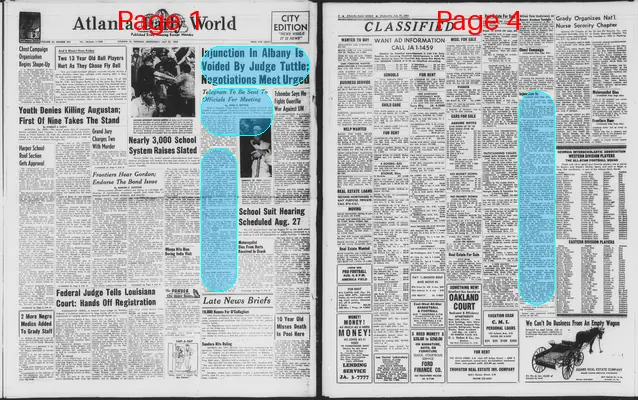
Atlanta Daily World
Atlanta, Fulton County, Georgia
What is this article about?
Federal judge voids injunction against Albany, GA civil rights protests led by MLK Jr., urging negotiations; city officials resist, warning of violence. (148 characters)
Merged-components note: Continuation of Injunction in Albany story from page 1 to page 4.
Clippings
1 of 2
OCR Quality
Full Text
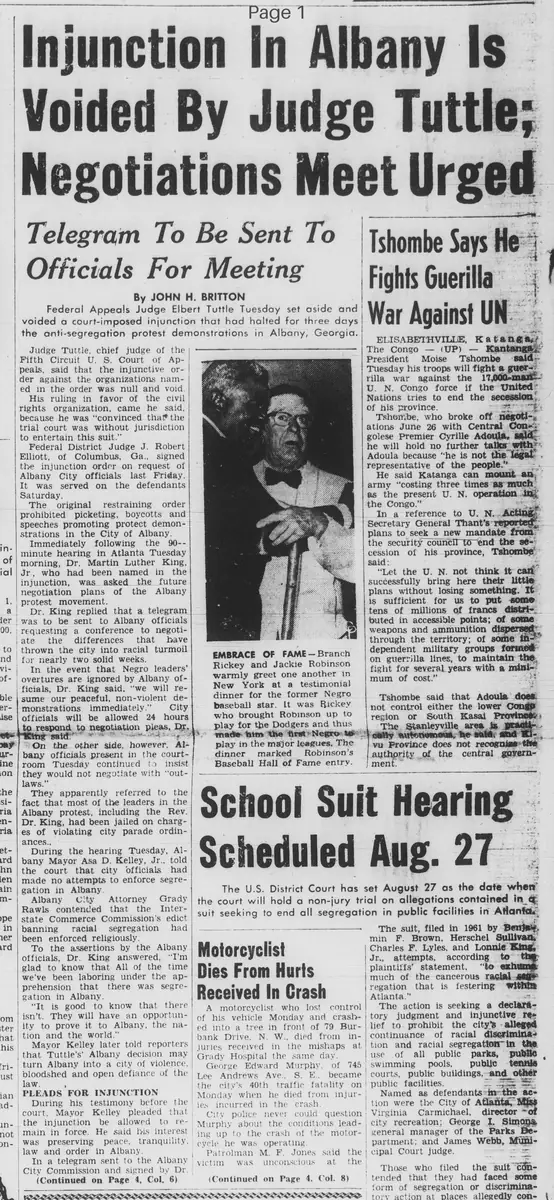
Telegram To Be Sent To Officials For Meeting
By JOHN H. BRITTON
Federal Appeals Judge Elbert Tuttle Tuesday set aside and voided a court-imposed injunction that had halted for three days the anti-segregation protest demonstrations in Albany, Georgia.
Judge Tuttle, chief judge of the Fifth Circuit U. S. Court of Appeals, said that the injunctive order against the organizations named in the order was null and void.
His ruling in favor of the civil rights organization, came he said, because he was "convinced that the trial court was without jurisdiction to entertain this suit."
The original restraining order prohibited picketing, boycotts and speeches promoting protest demonstrations in the City of Albany.
Immediately following the 60-minute hearing in Atlanta Tuesday morning, Dr. Martin Luther King, Jr. who had been named in the injunction, was asked the future negotiation plans of the Albany protest movement.
Dr. King replied that a telegram was to be sent to Albany officials requesting a conference to negotiate the differences that have thrown the city into racial turmoil for nearly two solid weeks.
In the event that Negro leaders' overtures are ignored by Albany officials, Dr. King said, we will resume our peaceful, non-violent demonstrations immediately."
City officials will be allowed 24 hours to respond to negotiation pleas, Dr. King said."
On the other side, however, Albany officials present in the courtroom Tuesday continued to insist they would not negotiate with "outsiders."
They apparently referred to the fact that most of the leaders in the Albany protest, including the Rev. Dr. King, had been jailed on charges of violating city parade ordinances.
During the hearing Tuesday, Albany Mayor Asa D. Kelley, Jr., told the court that city officials had made no attempts to enforce segregation in Albany.
Albany City Attorney Grady Rawls contended that the Interstate Commerce Commission's edict banning racial segregation had been enforced religiously.
To the assertions by the Albany officials, Dr. King answered, "I'm glad to know that All of the time we've been laboring under the apprehension that there was segregation in Albany.
"It is good to know that there isn't. They will have an opportunity to prove it to Albany, the nation and the world."
Mayor Kelley later told reporters that Tuttle's Albany decision may turn Albany into a city of violence, bloodshed and open defiance of the law.
PLEADS FOR INJUNCTION
During his testimony before the court, Mayor Kelley pleaded that the injunction be allowed to remain in force. He said his interest was preserving peace, tranquility, law and order in Albany.
In a telegram sent to the Albany City Commission and signed by Dr
(Continued Page 4 Col 6)
Injunction In
(Continued from Page One)
King. Dr. W. G. Anderson, Albany
Movement president, and Slater
King. they said:
"We do not consider the lifting
of the injunction a victory. We feel
that it is a sober and sound de-
cision on the part of U. S. Appeals
Judge Elbert Tuttle to preserve ba-
sic constitutional rights.
"The real victory will come when
we, as brothers, sit down and dis-
cuss ways and means to grant cit-
izenship rights that can no longer
be postponed."
NO CLEAR RIGHT
The leaders said their real aim
was to meet with city officials and
discuss ending segregation barriers
in that South Georgia city.
Judge Tuttle's decision to over-
turn the injunction was based pri-
marily on a constitutional techni-
cality that the judge interpreted to
mean that Elliott had no clear
right to issue the broad, sweeping
injunction.
Judge Tuttle said he was "so
firmly convinced" that he felt it
was "useless" to allow the injunc-
tion to remain in force. He said
there was no use in delaying the
matter further.
Tuttle's action, he pointed out,
does not interfere with the sched-
uled hearing by Judge Elliott next
Monday on the injunction proceed-
ing.
A battery of civil rights lawyers
based their arguments on the broad
general tones of the injunction,
citing several required rules of pro-
cedure that had been omitted in
the petition for a restraining order.
The lawvers. led by Mrs. Constance
Baker Motley, of the NAACP, and
William Kunstler. of the American
Civil Liberties Union. included At-
lanta Atty. Horace T. Ward. Al-
bany Atty. C. B. King, and How-
ard Moore.
On the opposite side of the ta-
ble were Grady Rawls, Albany City
Attorney; Mayor Kelley and Free-
man Leverett, representing the City
of Albany, on loan from his posi-
tion as special counsel with the
state. law department.
BROAD INJUNCTION
Judge Tuttle was especially con-
cerning with the broadness of the
injunction. He asked several times
of Mr. Leverett whether the in-
junction was meant to cover every
member of every organization nam-
ed in the injunction.
Judge Tuttle was ,at first, also
concerned about whether or not he
had the power to sit in the case.
The binding order was first desig-
nated as an unappealable restrain-
ing order.
But because Judge Elliott left the
state within 24 hours after he
granted orders, and because no oth-
er judge could be located to hear
the order on two-day notice, the
order had the effect and force of a
temporary injunction
The judge ruled that he had the
power and was qualified as a cir-
cuit judge to hear and rule on the
appeal from a temporary injunc-
tion.
Following the hearing, Dr. King
and the Rev. Ralph Abernatby,
King's chief lieutenant, were re-
portedly questioned at length by
agents for the Federal Bureau of
Investigation here,
The line of questioning. accord-
ing to a reliable source, centered
around whether or not a contempt
of court order would be justified
since some Albany citizens had dis-
regarded Judge Elliott's order be-
fore Judge Tuttle ruled Tuesday.
Following the conference with
FBI men, Dr. King left the city
immediately and went back to Al-
bany.
What sub-type of article is it?
What themes does it cover?
What keywords are associated?
What entities or persons were involved?
Where did it happen?
Story Details
Key Persons
Location
Albany, Georgia; Atlanta
Event Date
Tuesday
Story Details
Federal Appeals Judge Elbert Tuttle voids an injunction halting anti-segregation protests in Albany, Georgia, ruling the trial court lacked jurisdiction. Civil rights leaders, including Dr. Martin Luther King Jr., plan to negotiate with city officials, resuming demonstrations if ignored. Albany officials refuse to negotiate with 'outsiders' and warn of potential violence.