Thank you for visiting SNEWPapers!
Sign up free
Daily Richmond Whig
Richmond, Virginia
What is this article about?
Eyewitness account from Salem, August 3, 1830, of the trial opening for Knapp brothers and George Crowninshield on murder charges linked to deceased Richard Crowninshield. Details crowd fervor, prisoner looks, lawyers like Webster prosecuting, and jury selection amid press critique.
Clipping
OCR Quality
Full Text
Salem, 3d August, 1830.
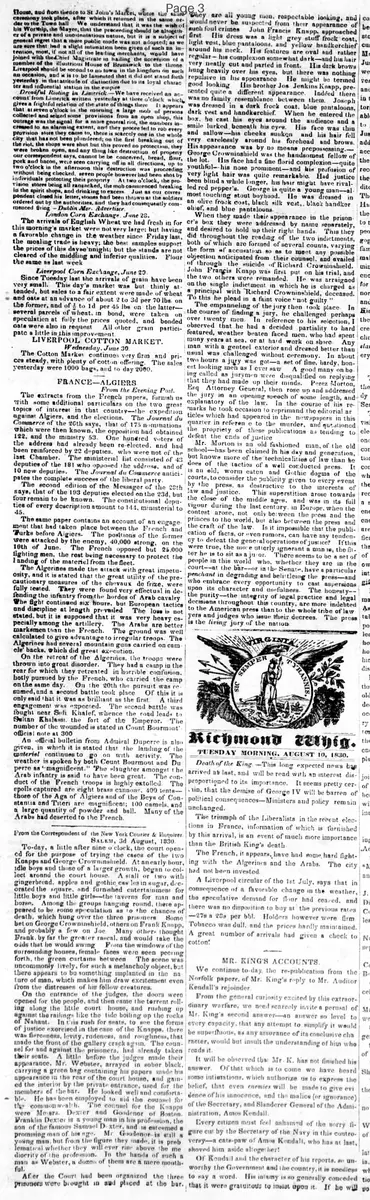
To-day, a little after nine o'clock, the court opened for the purpose of trying the cases of the two Knapps and George Crowninshield. At an early hour, idle boys and those of a larger growth, began to collect around the court house. A stall or two with gingerbread, apples and gothic castles in sugar, decorated the square, and furnished entertainment for little boys and little girls—the taverns for man and horse. Among the groups hanging round, there appeared to be some speculation as to the chances of death, which hung over the three prisoners. Some bet on George Crowninshield, others on Frank Knapp, and probably a few on Joe. Many others thought Knapp, by far the greater rascal, and would take the odds that he would swing. From the windows of the surrounding houses, female faces were seen peering forth, the green curtains between. The scene was uncommonly lively, for such a melancholy object, but there appears to be something implanted in the nature of man, which makes him draw excitement even from the distresses of his fellow creatures.
On the entrance of the judges, the doors were opened for the people, and then came the torrent rolling along the little court house, and rushing up against the railings like the tide boiling up the rocks of Nahant. In this rush for seats, to see the forms of justice exercised in the case of the Knapps, there was fierceness, levity, rudeness, and roughness, that made the front of the gallery crack again. The counsel for and against the prisoners, had already taken their seats. A little before the judges made their appearance, Mr. Webster, arrayed in sober black, carrying a green bag containing his papers made his appearance in the rear of the court house, and gained the interior by the private entrance, used for the members of the bar. He looked well and comfortable. He has been employed to aid the counsel for the commonwealth. The counsel for the Knapps were Messrs. Dexter and Goodridge of Boston. Franklin Dexter is a young man in his profession, the son of the famous Samuel Dexter, and is esteemed a promising man of his age; Mr. Goodridge is still a young man, but from the figure they made, it is problematical whether they will ever rise above the mediocrity of the profession. In the hands of such a man as Webster, a dozen of them are a mere mouthful.
After the Court had been organized the three prisoners were brought in and placed at the bar.
They are all young men, respectable looking, and would never be suspected from their appearance of such foul crimes. John Francis Knapp approached first. His dress was a light grey stuff frock coat, light vest, blue pantaloons, and yellow handkerchief around his neck. His features are oval and rather regular—his complexion somewhat dark—and his hair very neatly cut and parted in front. His dark brows hung heavily over his eyes, but there was nothing repulsive in his appearance. He might be termed good looking. His brother Jos. Jenkins Knapp, presented quite a different appearance. Indeed there was no family resemblance between them. Joseph was dressed in a dark frock coat, blue pantaloons, dark vest and handkerchief. When he entered the box, he cast his eyes around the audience and a smile lurked beneath his eyes. His face was thin and sallow—his cheeks sunken and his hair fell very carelessly around his forehead and brows. His appearance was by no means prepossessing.
George Crowninshield was the handsomest fellow of the lot. His face had a fine florid complexion—quite youthful—his nose prominent—and his profusion of very light hair was quite remarkable. Had justice been blind a while longer, his hair might have rivalled red pepper's. George is quite a young man—almost touching stout boyhood. He was dressed in an olive frock coat, black silk vest, black handkerchief, and blue pantaloons.
When they made their appearance in the prisoner's box they were addressed by name separately, and desired to hold up their right hands. This they did throughout the reading of the two indictments, both of which are formed of several counts, varying the form of accusation so as to meet any possible objection anticipated from their counsel, and availed of through the suicide of Richard Crowninshield.
John Francis Knapp was first put on his trial, and the two others were remanded. He was arraigned on the single indictment in which he is charged as a principal with Richard Crowninshield, deceased. To this he plead in a faint voice not guilty.
The empaneling of the jury then took place. In the course of finding a jury, he challenged perhaps over twenty men. In reference to his selection, I observed that he had a decided partiality to hard featured, weather beaten faced men, who had spent many years at sea, or at hard work on shore. Any man with a genteel exterior and dressed better than usual was challenged without ceremony. In about two hours a jury was got—a set of fine, hardy, honest looking men as I ever saw. A good many on being called as jurymen were disqualified on replying that they had made up their minds. Perez Morton, Esq. Attorney General, then rose up and addressed the jury in an opening speech of some length, and explanatory of the law. In the course of his remarks he took occasion to reprimand the editorial articles which had appeared in the newspapers in this quarter in reference to the murder, and questioned the propriety of these publications as tending to defeat the ends of justice.
Mr. Morton is an old fashioned man, of the old school—has been celebrated in his day and generation, but knows more of the technicalities of law than he does of the tactics of a well conducted press. It is an old, worm eaten and Gothic dogma of the courts, to consider the publicity given to every event by the press, as destructive to the interests of law and justice. This superstition arose towards the close of the middle ages, and was in its full vigour during the last century in Europe, when the contest arose, not only between the press and the princes of the world, but also between the press and the craft of the law. Is it impossible that the publication of facts, or even rumors, can have any tendency to defeat the general operations of justice? If this were true, the more utterly ignorant a man is, the fitter he is to sit as a juror. There seems to be a set of people in this world who, whether they are in the court—at the bar—or in the Senate, have a particular penchant in degrading and belittling the press—and who embrace every opportunity to cast aspersions upon its character and usefulness. The honesty—the purity—the integrity of legal practice and legal decisions throughout this country, are more indebted to the American press than to the whole tribe of lawyers and judges who issue their decrees. The press is the living jury of the nation.
What sub-type of article is it?
What themes does it cover?
What keywords are associated?
What entities or persons were involved?
Where did it happen?
Story Details
Key Persons
Location
Salem
Event Date
1830 08 03
Story Details
Opening of the murder trial in Salem on August 3, 1830, for John Francis Knapp, Joseph Jenkins Knapp, and George Crowninshield, involving the deceased Richard Crowninshield. Describes public excitement, prisoner appearances, counsel including Webster for prosecution and Dexter and Goodridge for defense, arraignment of J.F. Knapp, and jury empaneling with his challenges favoring hardy men.