Thank you for visiting SNEWPapers!
Sign up free
Virginia Argus
Richmond, Virginia
What is this article about?
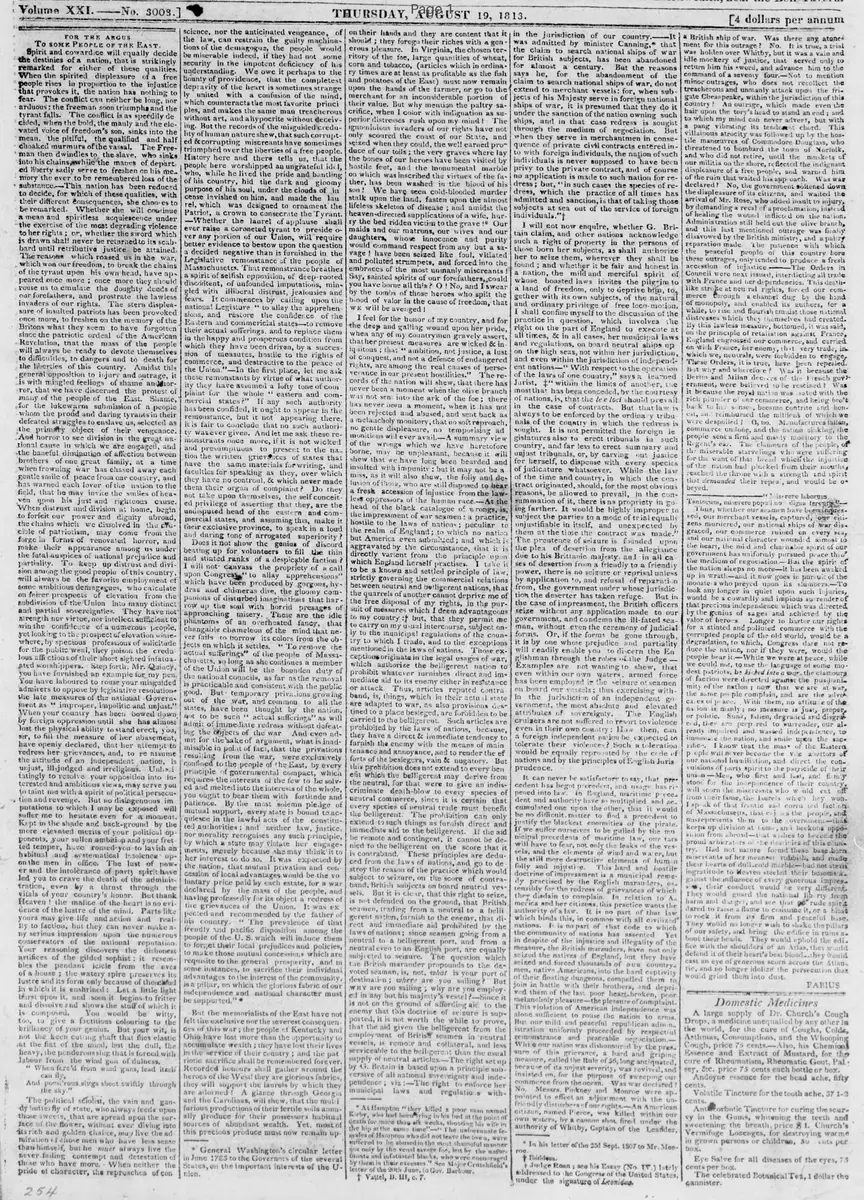
This editorial, signed 'FABIUS,' passionately defends the War of 1812 against British aggressions like impressment and naval attacks, criticizing New England opposition led by figures like Mr. Quincy for fostering division and undermining national unity during the conflict.
Merged-components note: Merged multiple sequential components that form a single long editorial article titled 'FOR THE ARGUS TO SOME PEOPLE OF THE EAST.', including the related footnote which provides contextual details referenced in the main text.
Clipping
OCR Quality
Full Text
TO SOME PEOPLE OF THE EAST.
Spirit and cowardice will equally decide the destinies of a nation, that is strikingly remarked for either of these qualities. When the spirited displeasure of a free people rises in proportion to the injustice that provokes it, the nation has nothing to fear. The conflict can neither be long, nor arduous: the freeman soon triumphs and the tyrant falls. The conflict is as speedily decided, when the bold, the manly and the elevated voice of freedom's son, sinks into the mean, the pitiful, the qualified and half choaked murmurs of the vassal. The Freeman then dwindles to the slave, who sinks into his chains, while the manes of departed liberty sadly serve to freshen on his memory the ever to be remembered loss of the substance.--This nation has been reduced to decide, for which of these qualities, with their different consequences, she chooses to be remarked. Whether she will continue a mean and spiritless acquiescence under the exercise of the most degrading violence to her rights; or, whether the sword which is drawn shall never be returned to its scabbard until retributive justice be attained. The reasons which roused us in the war, which won our freedom, to break the chains of the tyrant upon his own head, have appeared once more; once more they should rouse us to emulate the doughty deeds of our forefathers, and prostrate the lawless invaders of our rights. The stern displeasure of insulted patriots has been provoked once more, to freshen on the memory of the Britons what they seem to have forgotten since the patriotic ordeal of the American Revolution, that the mass of the people will always be ready to devote themselves to difficulties, to dangers and to death for the liberties of this country. Amidst this general opposition to injury and outrage, it is with mingled feelings of shame and horror, that we have discerned the protest of many of the people of the East. Shame, for the lukewarm submission of a people whom the proud and daring tyrants in their defeated struggles to enslave us, selected as the primary object of their vengeance. And horror to see division in the great national cause in which we are engaged, and the baneful diminution of affection between brothers of one great family, at a time when frowning war has chased away each gentle smile of peace from our country, and has warned each lover of the nation to the field, that he may invite the smiles of heaven upon his just and righteous cause. When distrust and division at home, begin to forfeit our power and dignity abroad, the chains which we dissolved in the crucible of patriotism, may come from the forge in forms of renovated horror, and make their appearance among us under the fatal auspices of national prejudice and partiality. To keep up distrust and division among the good people of this country, will always be the favorite employment of some ambitious demagogues, who calculate on fairer prospects of elevation from the subdivision of the Union into many distinct and partial sovereignties. They have not strength nor virtue, nor intellect sufficient to win the confidence of a numerous people, yet looking to the prospect of elevation somewhere, by specious professions of solicitude for the public weal, they poison the credulous affections of their short sighted infatuated worshippers. Step forth, Mr. Quincy, you have furnished an example for my pen. You have laboured to rouse your misguided admirers to oppose by legislative resolutions the late measures of the national Government as "improper, impolitic and unjust." When your country has been bowed down by foreign oppression until she has almost lost the physical ability to stand erect, you, sir, to fill the measure of her abasement, have openly declared, that her attempt to redress her grievances, and, to reassume the attitude of an independent nation, is unjust, illjudged and irreligious. Unwillingly to resolve your opposition into interested and ambitious views, may serve you to taint me with a spirit of political persecution and revenge. But no disingenuous imputations to which I may be exposed will suffer me to hesitate even for a moment. Kept in the shade and back-ground by the more elevated merits of your political opponents, your sullen ambition and your fretted temper, have roused you to lavish an habitual and systematical insolence upon the men in office. The lust of power and the intolerance of party spirit have led you to crave the death of the administration, even by a thrust through the vitals of your country's honor. But thank Heaven! the malice of the heart is no evidence of the lustre of the mind. Parts like yours may give life and action and reality to faction, but they can never make any serious impression upon the numerous conservators of the national reputation. Your reasoning discovers the dishonest artifices of the gilded sophist: it resembles the pendant icicle from the eaves of a house; the watery spire preserves its lustre and its form only because of the cold in which it is enshrined: Let a little light burst upon it, and soon it begins to fritter and dissolve and shows the stuff of which it is composed. You would be witty, too, to give a factitious colouring to the brilliancy of your genius. But your wit, is not the keen cutting shaft that flies elastic at the fiat of the mind, but the dull, the heavy, the ponderous slug that is forced with labour from the wind gun of dulness.
"When freed from wind guns, lead itself can fly,
And pond'rous slugs shoot swiftly through the sky."
The political sciolist, the vain and gaudy butterfly of state, who always feeds upon those sweets, that are spread upon the surface of the flower, without ever diving into its rich and golden chalice, may live the admiration of those men who have less sense than himself, but he must always live the never-failing contempt and detestation of those who have more. - When neither the pride of character, the reproaches of conscience, nor the anticipated vengeance, of
the law, can restrain the guilty machinations of the demagogus, the people would be miserable indeed, if they had not some security in the impotent deficiency of his understanding. We owe it perhaps to the bounty of providence, that the completest depravity of the heart is sometimes strangely united with a confusion of the mind, which counteracts the most favorite principles, and makes the same man treacherous without art, and a hypocrite without deceiving. But the records of the misguided credulity of human nature shew, that such corrupted & corrupting miscreants have sometimes triumphed over the liberties of a free people. History here and there tells us, that the people have worshipped an ungrateful idol, who, while he lived the pride and darling of his country, hid the dark and gloomy purpose of his soul, under the clouds of incense lavished on him, and made the laurel, which was designed to ornament the Patriot, a crown to consecrate the Tyrant. -Whether the laurel of applause shall ever raise a coroneted tyrant to preside over any portion of our Union, will require better evidence to bestow upon the question a decided negative than is furnished in the Legislative remonstrance of the people of Massachusetts. That remonstrance breathes a spirit of selfish opposition, of deep-rooted discontent, of unfounded imputations, mingled with illiberal distrust, jealousies and fears. It commences by calling upon the national Legislature "to allay the apprehensions, and restore the confidence of the Eastern and commercial states-to remove their actual sufferings, and to replace them in the happy and prosperous condition from which they have been driven, by a succession of measures, hostile to the rights of commerce, and destructive to the peace of the Union." In the first place, let me ask these remonstrants by virtue of what authority they have assumed a lofty tone of complaint for the whole "eastern and commercial states?" If any such authority has been confided, it ought to appear in the remonstrance, but it not appearing there, it is fair to conclude that no such authority was ever given. And let me ask these remonstrants once more, if it is not wicked and presumptuous to present to the nation the written grievances of states that have the same materials for writing, and faculties for speaking as they, over which they have no controul, & which never made them their organ of complaint? Do they not take upon themselves, the selfconceited privilege of asserting that they, are the undisputed head of the eastern and commercial states, and assuming this, make it their exclusive province, to speak in a loud and daring tone of arrogated superiority? Does it not show the genius of discord beating up for volunteers to fill the thin and stinted ranks of a despicable faction? I will not canvass the propriety of a call upon Congress "to allay apprehensions" which have been produced by gorgons, hydras and chimeras dire, the gloomy companions of disturbed imaginations that harrow up the soul with horrid presages of approaching misery. These are the idle phantoms of an overheated fancy, that changable chameleon of the mind that never fails to borrow its colors from the objects on which it settles. "To remove the actual sufferings" of the people of Massachusetts, so long as she continues a member of the Union will be the bounden duty of the national councils, as far as the removal is practicable and consistent with the public good. But temporary privations growing out of the war, and common to all the states, have been thought by the nation, not to be such "actual sufferings" as will admit of immediate redress without defeating the objects of the war. And even admit for the sake of argument, what is inadmissible in point of fact, that the privations resulting from the war, were exclusively confined to the people of the East, by every principle of governmental compact, which requires the interests of the few to be solved and melted into the interests of the whole, you ought to bear them with fortitude and patience. By the most solemn pledge of mutual support, every state is bound to acquiesce in the lawful acts of the constituted authorities: and neither law, justice, nor morality recognises any such principle, by which a state may violate her engagements, merely because she may think it to her interest to do so. It was expected by the nation, that mutual privation and concession of local advantages would be the voluntary price paid by each state, for a war declared by the mass of the people, and having professedly for its object a redress of the grievances of the Union. It was expected and recommended by the father of his country. "The prevalence of that friendly and pacific disposition among the people of the U. S. which will induce them to forget their local prejudices and policies, to make those mutual concessions which are requisite to the general prosperity, and in some instances, to sacrifice their individual advantages to the interest of the community, is a pillar, on which the glorious fabric of our independence and national character must be supported." *
But the memorialists of the East have not felt the exclusive nor the severest consequences of this war; the people of Kentucky and Ohio have lost more than the opportunity to accumulate wealth: they have lost their lives in the service of their Country; and the patriotic sacrifice shall be remembered forever. Recorded honours shall gather around the heroes of the West! they are glorious fabrics, they will support the laurels by which they are adorned! A glance through Georgia and the Carolinas, will shew, that the multifarious productions of their fertile soils annually produce for their possessors habitual sources of abundant wealth. Yet, most of this precious produce must now remain up-
on their hands and they are content that it should; they forego their riches with a generous pleasure. In Virginia, the chosen territory of the foe, large quantities of wheat, corn and tobacco, (articles which in ordinary times are at least as profitable as the fish and potatoes of the East) must now remain upon the hands of the farmer, or go to the merchant for an inconsiderable portion of their value. But why mention the paltry sacrifice, when I glow with indignation as superior distresses rush upon my mind! The ignominious invaders of our rights have not only scoured the coast of our State, and seized when they could, the well earned produce of our toils; the very graves where lay the bones of our heroes have been visited by hostile feet, and the monumental marble on which was inscribed the virtues of the father, has been washed in the blood of his son! We have seen cold-blooded murder stalk upon the land, fasten upon the almost lifeless skeleton of disease; and amidst the heaven-directed supplications of a wife, hurry the bed ridden victim to the grave! * Our maids and our matrons, our wives and our daughters, whose innocence and purity would command respect from any but a savage! have been seized like foul, vitiated and polluted strumpets, and forced into the embraces of the most unmanly miscreants! Say, sainted spirits of our forefathers, could you have borne all this? O! No, and I swear by the tombs of those heroes who spilt the blood of valor in the cause of freedom, that we will be avenged! I feel for the honor of my country, and for the deep and galling wound upon her pride, when any of my countrymen gravely assert, that her present measures are wicked & iniquitous; that "ambition, not justice, a lust of conquest, and not a defence of endangered rights, are among the real causes of perseverance in our present hostilities." The records of the nation will shew, that there has never been a moment when the olive branch was not sent into the ark of the foe; there has never been a moment, when it has not been rejected and abused, and sent back as a melancholy monitory, that no soft reproach, no gentle displeasure, no temporising admonitions will ever avail. -A summary view of the wrongs which we have heretofore borne, may be unpleasant, because it will shew that we have long been bearded and insulted with impunity: but it may not be amiss, as it will also shew, the folly and delusion of those, who are still disposed to hear a fresh accession of injustice from the lawless oppressors of the human race.--At the head of the black catalogue of wrongs, is, the impressment of our seamen; a practice, hostile to the laws of nations; peculiar to the realm of England; to which no nation but America even submitted: and which is aggravated by the circumstance, that it is directly variant from the principle upon which England herself practices. I take it to be a known and settled principle of law, strictly governing the commercial relations between neutral and belligerent nations, that the quarrels of another cannot deprive me of the free disposal of my rights, in the pursuit of measures which I deem advantageous to my country: but, that they permit me to carry on my usual intercourse, subject only to the municipal regulations of the country to which I trade, and to the exceptions mentioned in the laws of nations. Those exceptions originate in the legal usages of war, which authorize the belligerent nation to prohibit whatever furnishes direct and immediate aid to its enemy either in resistance or attack. Thus, articles reputed contraband, is, things, which in their actual state are adapted to war, as also provisions destined to a place besieged, are forbidden to be carried to the belligerent. Such articles are prohibited by the laws of nations, because, they have a direct & immediate tendency to furnish the enemy with the means of maintenance and annoyance, and to render the efforts of the besiegers, vain & nugatory. But this prohibition does not extend to every benefit which the belligerent may derive from the neutral, for that were to give an indiscriminate death-blow to every species of neutral commerce, since it is certain that every species of neutral trade must benefit the belligerent. The prohibition can only extend to such things as furnish direct and immediate aid to the belligerent. If the aid be remote and contingent, it cannot be denied to the belligerent on the score that it is contraband. These principles are deduced from the laws of nations, and go to destroy the reason of the practice which would subject to seizure, on the score of contraband, British subjects on board neutral vessels. But it is clear, that this right to seize, is not defended on the ground, that British seamen, trading from a neutral to a belligerent nation, furnish to the enemy, that direct and immediate aid prohibited by the laws of nations; since seamen going from a neutral to a belligerent port, and from a neutral even to an English port, are equally subjected to seizure. The question which the British marauder propounds to the devoted seaman, is, not, what is your port of destination; where are you sailing? But why are you sailing; why are you employed in any but his majesty's vessel?—Since it is not on the ground of affording aid to the enemy that this doctrine of seizure is supported, it is not worth the while to prove, that the aid given the belligerent from the employment of British seamen in neutral vessels, is remote and collateral, and less serviceable to the belligerent than the usual supply of neutral articles.—The right set up by G. Britain is based upon a principle subversive of all national sovereignty and independence; viz: -The right to enforce her municipal laws and regulations with-
At Hampton "they killed a poor man named Kirby, who had been lying in his bed at the point of death for more than six weeks, shooting his wife in the hip at the same time"—"The unfortunate females of Hampton who did not leave the town, were suffered to be abused in the most shameful manner not only by the venal savage foe, but by the unfortunate and infatuated blacks, who were encouraged by them in their excesses." See Major Crutchfield's letter of the 20th June, to Gov. Barbour.
t. Vattel U. II s.7
in the jurisdiction of our country.--It was admitted by minister Canning,* that the claim to search national ships of war for British subjects, has been abandoned for almost a century. But the reasons says he, for the abandonment of the claim to search national ships of war, do not extend to merchant vessels: for, when subjects of his Majesty serve in foreign national ships of war, it is presumed that they do it under the sanction of the nation owning such ships, and in that case redress is sought through the medium of negociation. But when they serve in merchantmen in consequence of private civil contracts entered into with foreign individuals, the nation of such individuals is never supposed to have been privy to the private contract, and of course no application is made to such nation for redress; but, "in such cases the species of redress, which the practice of all times has admitted and sanctioned, is that of taking those subjects at sea out of the service of foreign individuals." † I will not now enquire, whether G. Britain claim, and other nations acknowledge such a right of property in the persons of those born her subjects, as shall authorize her to seize them, wherever they shall be found; and whether it be fair and honest in a nation, the mild and merciful spirit of whose boasted laws invites the pilgrim to a land of freedom, only to deprive him, together with its own subjects, of the natural and ordinary privilege of free locomotion. I shall confine myself to the discussion of the practice in question, which involves the right on the part of England to execute at all times, & in all cases, her municipal laws and regulations, on board neutral ships upon the high seas, not within her jurisdiction, and even within the jurisdiction of independent nations—"With respect to the operation of the laws of one country," says a learned Jurist, "within the limits of another, the most that has been conceded, by the courtesy of nations, is, that the lex loci should prevail in the case of contracts. But that law is always to be enforced by the ordinary tribunals of the country in which the redress is sought. It is not permitted the foreign legislatures also to erect tribunals in such country, and far less to erect summary and unjust tribunals, or, by carving out justice for herself, to dispense with every species of judicature whatsoever. While the law of the time and country, in which the contract originated, should, for the most obvious reasons, be allowed to prevail, in the consummation of it, there is no propriety in going farther. It would be highly improper to subject the parties to a mode of trial equally unjustifiable in itself, and unexpected by them at the time the contract was made." The pretence of seizure is founded upon the plea of desertion from the allegiance due to his Britannic majesty. and in all cases of desertion from a friendly to a friendly power, there is no seizure or reprisal unless by application to, and refusal of reparation from, the government under whose jurisdiction the deserter has taken refuge. But in the case of impressment, the British officers seize without any application made to our government, and condemn the ill-fated seaman, without even the ceremony of judicial forms. Or, if the forms be gone through, it is by one whose prejudice and partiality will readily enable you to discern the Englishman through the robes of the Judge - Examples are not wanting to shew, that even within our own waters, armed force has been employed in the seizure of seamen on board our vessels: thus exercising within the jurisdiction of an independent government, the most absolute and elevated attributes of sovereignty. The English cruizers are not suffered to resort to violence even in their own Country: How then, Can a foreign independent nation be expected to tolerate their violences? Such a toleration would be equally reprobated by the code of nations and by the principles of English Jurisprudence. It can never be satisfactory to say, that precedent has begot precedent, and usage has ripened into law. in England, maritime precedent and authority have so multiplied and accumulated one upon the other, that it would be no difficult matter to find a precedent to justify the blackest enormities of the pirate. If we suffer ourselves to be gulled by the municipal precedents of maritime law, our tars will have to fear, not only the leaks of the vessels, and the elements of wind and water, but the still more destructive elements of human folly and injustice. This hard and hostile doctrine of impressment is a municipal remedy practised by the English marauders, ostensibly for the redress of grievances of which they disdain to complain. In relation to America and her citizens. this practice wants the authority of a law. It is no part of that law which binds this, in common with all civilized nations. It is no part of that code to which the community of nations has assented. Yet in despite of the injustice and illegality of the measure, the British marauders, have not only seized the natives of England, but they have seized and forced thousands of our countrymen, native Americans, into the hard captivity of their floating dungeons, compelled them to join in battle with their brothers, and deprived them of the last poor heart-broken, poor melancholy pleasure-the pleasure of complaint. This violation of American independence was alone sufficient to rouse the nation to arms. But our mild and peaceful republican administration uniformly proceeded by respectful remonstrance and peaceable negociation.— While our nation was dishonoured by the pressure of this grievance, a hard and griping measure, called the Rule of 56, long antiquated, because of its unjust severity, was revived, and insisted on, for the purpose of sweeping our commerce from the ocean. Was war declared? No. Messrs. Pinkney and Monroe were appointed to effect an adjustment with the unfriendly disturbers of our rights.-An American Citizen, named Perce, was killed within our own waters, by a cannon shot fired under the authority of Whitby, Captain of the Leopard, In his letter of the 23d Sept. 1807 to Mr. Monroe. † Judge Roan ; see his Essay No. IV.) Lately addressed to the Congress of the United States, under the signature of Leonidas.
4 dollars per annum a British ship of war. Was there any atonement for this outrage? No. It is true, a trial was holden over Whitby, but it was a vain and idle mockery of justice, that served only to return him his sword, and advance him to the command of a seventy four.-Not to mention minor outrages, who does not recollect the treacherous and unmanly attack upon the frigate Chesapeake, within the jurisdiction of this country? An outrage, which made even the hair upon the tory's head to stand an end; and to which my mind can never advert, but with a pang vibrating its tenderest chord. This villainous atrocity was followed up by the hostile manoeuvres of Commodore Douglass, who threatened to bombard the town of Norfolk, and who did not retire, until the muskets of our militia on the shore, reflected the indignant displeasure of a free people. and warned him of the ruin that waited his approach. Was war declared? No, the government softened down the displeasure of its citizens, and waited the arrival of Mr. Rose, who added insult to injury, by demanding a recall of a proclamation, instead of healing the wound inflicted on the nation. Administration still held out the olive branch, and this last mentioned outrage was finally disavowed by the British ministry, and a paltry reparation made The patience with which the peaceful people of this country bore these outrages, only tended to produce a fresh accession of injustice The Orders in Council were next issued, interdicting all trade with France and her dependencies. This death-like stroke at neutral rights, forced our commerce through a channel dug by the hand of monopoly, and enabled its authors, for a while, to rise and flourish amidst those national distresses which they themselves had created. By this lawless measure, bottomed, it was said, on the principle of retaliation against France, England engrossed our commerce, and carried on with France, her enemy, that very trade, in which we, neutrals, were forbidden to engage. These Orders, it is true, have been repealed. But why and wherefore? Was it because the Berlin and Milan decrees of the French government, were believed to be rescinded? Was it because the royal nation was sated with the rich plunder of our commerce, and being brought back to her senses, became contrite and honest, and reimbursed the millions of which we were despoiled? O, no. Manufactures at a stand, commerce undone, and the nation sinking, the people sent a firm and manly monitory to the Regent's ear. The clamours of the people, of the miserable starvelings who were suffering for the want of that bread which the injustice of the nation had plucked from their mouths, reached the throne with a strength and spirit that demanded their repeal, and would be obeyed.
"Risere laborum Tantorum, miserere populi no digna terry"
Thus, whether our seamen have been impressed, our merchant vessels, captured, our citizens murdered, our national ships of war disgraced, our commerce ruined on every sea, and our national character wounded almost to the heart, the mild and charitable spirit of our government has uniformly pursued peace through the medium of negociation.-But the spirit of the nation sleeps no more—it has been awaked up in wrath-and it now goes in pursuit of the monsters who preyed upon its slumbers.-To look any longer in quiet upon such injuries, would be a cowardly and impious surrender of that precious independence which was directed by the genius of sages and achieved by the valor of heroes Longer to barter our rights for a stinted and polluted commerce with the corrupted people of the old world, would be a degradation, to which, Congress dare not reduce the nation, nor if they were, would the people bear it.-While we were at peace, while we could not, to use the language of some modest patriots, be kicked into a war, the clamours of faction were directed against the pusillanimity of the nation; now that we are at war, the same people complain, and are the advocates of peace. With them, no attitude of the nation is manly; no measure is just, proper, or politic. Sunk, fallen, degraded and disgraced, they are prepared to surrender, our already impaired and wasted independence, to immolate the nation, and smile upon the sacrifice. I know that the mass of the Eastern people will never become the vile abettors of our national humiliation, and direct the convulsions of party spirit to the patricide of their Union-Men, who first and last, and firmly stood for the independence of their country, will scorn the miscreants who would cut off from their fame, the laurels which they won. I speak of that frantic and corrupted faction of Massachusetts, that ejects the people, and misrepresents them to the government-that keeps up division at home, and beckons opposition from abroad-that wishes to become the proud arbiters of the destinies of this country. Had not nature formed these base-born miscreants of her meanest rubbish, and made their hearts of dull-cold marble-had not ingratitude to Heaven steeled their bosoms against the influence of every generous impression, their conduct would be very different. They would guard the national liberty from harm and danger, and see that no rude spirit dared to raise a flame to consume it, or a blast to rock it from its firm and peaceful base. They would no longer wish to shake the pillars of our safety, and bring the edifice in ruins about their heads. They would uphold the edifice with the shoulders of an Atlas, they would defend it with their heart's best blood. they would cast an eye of generous scorn across the Atlantic, and no longer idolize the persecution that would grind them into dust.
FABIUS
What sub-type of article is it?
What keywords are associated?
What entities or persons were involved?
Editorial Details
Primary Topic
Defense Of The War Of 1812 Against Eastern Opposition
Stance / Tone
Strongly Pro War Patriotic Exhortation Criticizing Division
Key Figures
Key Arguments