Thank you for visiting SNEWPapers!
Sign up free
Editorial
April 9, 1803
The Recorder
Richmond, Virginia
What is this article about?
Editorial denounces violent behavior by Lewis and John Harvie towards Col. John Mayo during Charter Officers election in Richmond's upper ward on the 6th inst., blaming Democratic party protection and warning against political lawlessness.
Clipping
OCR Quality
95%
Excellent
Full Text
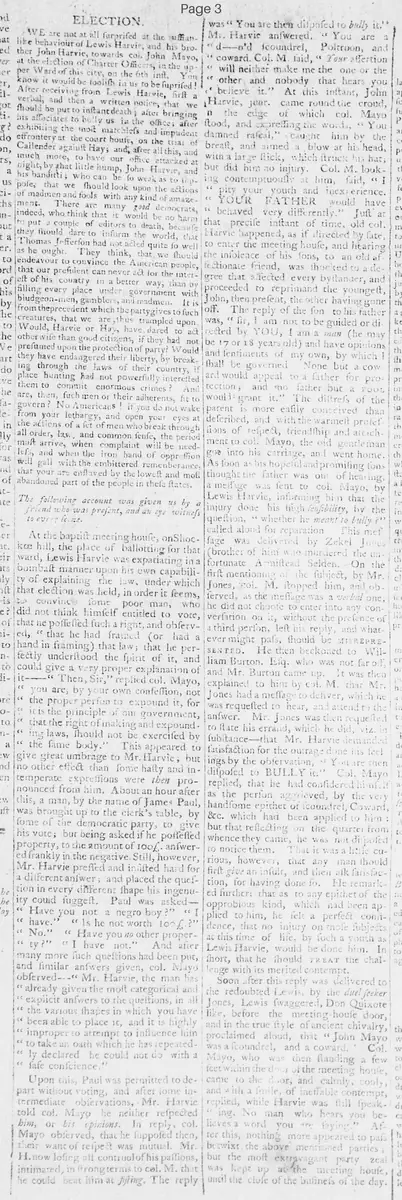
ELECTION.
We are not at all surprised at the ruffian-like behaviour of Lewis Harvie, and his brother John Harvie, towards col. John Mayo, at the election of Charter Officers, in the upper Ward of this city, on the 6th inst. You know it would be foolish in us to be surprised! After receiving from Lewis Harvie, first a verbal, and then a written notice, that we should be put to instant death; after bringing his associates to bully us in the office; after exhibiting the most matchless and impudent effrontery at the court house, on the trial of Callender against Hay; and, after all this, and much more, to have our office attacked at night, by that little hump, John Harvie, and his banditti; who can be so weak as to suppose; that we should look upon the actions of madmen and fools with any kind of amazement. There are many good democrats, indeed, who think that it would be no harm to put a couple of editors to death, because they should dare to inform the world, that Thomas Jefferson had not acted quite so well as he ought. They think, that, we should endeavour to convince the American people, that our president can never act for the interest of his country in a better way, than by filling every place under government with bludgeon-men, gamblers, and madmen. It is from the precedent which the party gives to such creatures, that we are, thus trampled upon. Would, Harvie or Haw, have dared to act otherwise than good citizens, if they had not presumed upon the protection of party? Would they have endangered their liberty, by breaking through the laws of their country, if place hunting had not powerfully interested them to commit enormous crimes? And are, then, such men or their adherents, fit to govern? No Americans! if you do not wake from your lethargy, and open your eyes at the actions of a set of men who break through all order, law, and common sense, the period must arrive, when complaint will be needless, and when the iron hand of oppression will gall with the embittered remembrance, that you are enslaved by the lowest and most abandoned part of the people in these states.
The following account was given us by a friend who was present, and an eye witness to every scene.
At the baptist meeting house, on Shockoe hill, the place of balloting for that ward, Lewis Harvie was expatiating in a bombast manner upon his own capability of explaining the law, under which that election was held, in order it seems, to convince some poor man, who did not think himself entitled to vote, that he possessed such a right, and observed, "that he had framed (or had a hand in framing) that law; that he perfectly understood the spirit of it, and could give a very proper explanation of it--" Then, Sir," replied col. Mayo, "you are, by your own confession, not the proper person to expound it, for it is the principle of our government, that the right of making and expounding laws, should not be exercised by the same body." This appeared to give great umbrage to Mr. Harvie; but no other effect than some hasty and intemperate expressions were then pronounced from him. About an hour after this, a man, by the name of James Paul was brought up to the clerk's table, by some of the democratic party, to give his vote; but being asked if he possessed property, to the amount of 100l. answered frankly in the negative. Still, however, Mr. Harvie pressed and insisted hard for a different answer, and placed the question in every different shape his ingenuity could suggest. Paul was asked-- "Have you not a negro boy?" "I have." "Is he not worth 100l.?" "No." "Have you no other property?" "I have not." And after many more such questions had been put, and similar answers given, col. Mayo observed--." Mr. Harvie, the man has already given the most categorical and explicit answers to the questions, in all the various shapes in which you have been able to place it, and it is highly improper to attempt to influence him to take an oath which he has repeatedly declared he could not do with a safe conscience." Upon this, Paul was permitted to depart without voting, and after some intermediate observations, Mr. Harvie told col. Mayo he neither respected him, or his opinions. In reply, col. Mayo observed, that he supposed then, their want of respect was mutual. Mr. H. now losing all control of his passions, intimated, in strong terms to col. M. that he could beat him at fisting. The reply was "You are then disposed to bully it."
Mr. Harvie answered, "You are a d--n'd scoundrel, poltroon, and coward." Col. M. said, "Your assertion will neither make me the one or the other and nobody that hears you believes it." At this instant, John Harvie, junr. came round the crowd, on the edge of which col. Mayo stood, and exclaiming the words, "You damned rascal," caught him by the breast, and aimed a blow at his head, with a large stick, which struck his hat; but did him no injury. Col. M. looking contemptuously at him, said, "I pity your youth and inexperience. YOUR FATHER would have behaved very differently." Just at that precise instant of time, old col. Harvie happened, as if directed by fate, to enter the meeting house, and hearing the insolence of his sons, to an old and affectionate friend, was shocked to a degree that affected every bystander, and proceeded to reprimand the youngest, John, then present, the other having gone off. The reply of the son to his father was, "Sir, I am not to be guided or directed by YOU, I am a man (he may be 17 or 18 years old) and have opinions and sentiments of my own, by which I shall be governed. None but a coward would appeal to a father for protection; and no father but a fool would grant it." The distress of the parent is more easily conceived than described, and with the warmest professions of respect, friendship and attachment to col. Mayo, the old gentleman got into his carriage, and went home. As soon as his hopeful and promising sons thought the father was out of hearing, a message was sent to col. Mayo, by Lewis Harvie, informing him that the injury done his high sensibility, by the question. "whether he meant to bully?" called aloud for reparation. This message was delivered by Zekel Jones (brother of him who murdered the unfortunate Amstead Selden.) On the first mentioning of the subject, by Mr. Jones, col. M. stopped him, and observed, as the message was a verbal one, he did not choose to enter into any conversation on it, without the presence of a third person, lest his reply, and whatever might pass, should be MISREPRESENTED. He then beckoned to William Burton, Esq. who was not far off and Mr. Burton came up. It was then explained to him by col. M. that Mr. Jones had a message to deliver, which he was requested to hear, and attend to the answer. Mr. Jones was then requested to state his errand, which he did, viz. in substance--that Mr. Harvie demanded satisfaction for the outrage done his feelings by the observation, "You are then disposed to BULLY it." Col. Mayo replied, that he had considered himself as the person aggrieved, by the very handsome epithet of scoundrel, coward, &c. which had been applied to him: but that reflecting on the quarter from whence they came, he was not disposed to notice them. That it was a little curious, however, that any man should first give an insult, and then ask satisfaction, for having done so. He remarked further; that as to any epithet of the opprobrious kind, which had been applied to him, he felt a perfect confidence, that no injury on those subjects at this time of life, by such a youth as Lewis Harvie, would be done him. In short, that he should TREAT the challenge with its merited contempt. Soon after this reply was delivered to the redoubted Lewis, by the duel seeker Jones, Lewis swaggered, Don Quixote like, before the meeting house door. and in the true style of ancient chivalry, proclaimed aloud, that "John Mayo was a scoundrel, and a coward." Col. Mayo, who was then standing a few feet within the door of the meeting house, came to the door, and calmly, cooly, and with a smile, of ineffable contempt, replied, while Harvie was still speaking, "No man who hears you believes a word you are saying." After this, nothing more appeared to pass betwixt the above mentioned parties, but the most extravagant party zeal was kept up at the meeting house, until the close of the business of the day.
We are not at all surprised at the ruffian-like behaviour of Lewis Harvie, and his brother John Harvie, towards col. John Mayo, at the election of Charter Officers, in the upper Ward of this city, on the 6th inst. You know it would be foolish in us to be surprised! After receiving from Lewis Harvie, first a verbal, and then a written notice, that we should be put to instant death; after bringing his associates to bully us in the office; after exhibiting the most matchless and impudent effrontery at the court house, on the trial of Callender against Hay; and, after all this, and much more, to have our office attacked at night, by that little hump, John Harvie, and his banditti; who can be so weak as to suppose; that we should look upon the actions of madmen and fools with any kind of amazement. There are many good democrats, indeed, who think that it would be no harm to put a couple of editors to death, because they should dare to inform the world, that Thomas Jefferson had not acted quite so well as he ought. They think, that, we should endeavour to convince the American people, that our president can never act for the interest of his country in a better way, than by filling every place under government with bludgeon-men, gamblers, and madmen. It is from the precedent which the party gives to such creatures, that we are, thus trampled upon. Would, Harvie or Haw, have dared to act otherwise than good citizens, if they had not presumed upon the protection of party? Would they have endangered their liberty, by breaking through the laws of their country, if place hunting had not powerfully interested them to commit enormous crimes? And are, then, such men or their adherents, fit to govern? No Americans! if you do not wake from your lethargy, and open your eyes at the actions of a set of men who break through all order, law, and common sense, the period must arrive, when complaint will be needless, and when the iron hand of oppression will gall with the embittered remembrance, that you are enslaved by the lowest and most abandoned part of the people in these states.
The following account was given us by a friend who was present, and an eye witness to every scene.
At the baptist meeting house, on Shockoe hill, the place of balloting for that ward, Lewis Harvie was expatiating in a bombast manner upon his own capability of explaining the law, under which that election was held, in order it seems, to convince some poor man, who did not think himself entitled to vote, that he possessed such a right, and observed, "that he had framed (or had a hand in framing) that law; that he perfectly understood the spirit of it, and could give a very proper explanation of it--" Then, Sir," replied col. Mayo, "you are, by your own confession, not the proper person to expound it, for it is the principle of our government, that the right of making and expounding laws, should not be exercised by the same body." This appeared to give great umbrage to Mr. Harvie; but no other effect than some hasty and intemperate expressions were then pronounced from him. About an hour after this, a man, by the name of James Paul was brought up to the clerk's table, by some of the democratic party, to give his vote; but being asked if he possessed property, to the amount of 100l. answered frankly in the negative. Still, however, Mr. Harvie pressed and insisted hard for a different answer, and placed the question in every different shape his ingenuity could suggest. Paul was asked-- "Have you not a negro boy?" "I have." "Is he not worth 100l.?" "No." "Have you no other property?" "I have not." And after many more such questions had been put, and similar answers given, col. Mayo observed--." Mr. Harvie, the man has already given the most categorical and explicit answers to the questions, in all the various shapes in which you have been able to place it, and it is highly improper to attempt to influence him to take an oath which he has repeatedly declared he could not do with a safe conscience." Upon this, Paul was permitted to depart without voting, and after some intermediate observations, Mr. Harvie told col. Mayo he neither respected him, or his opinions. In reply, col. Mayo observed, that he supposed then, their want of respect was mutual. Mr. H. now losing all control of his passions, intimated, in strong terms to col. M. that he could beat him at fisting. The reply was "You are then disposed to bully it."
Mr. Harvie answered, "You are a d--n'd scoundrel, poltroon, and coward." Col. M. said, "Your assertion will neither make me the one or the other and nobody that hears you believes it." At this instant, John Harvie, junr. came round the crowd, on the edge of which col. Mayo stood, and exclaiming the words, "You damned rascal," caught him by the breast, and aimed a blow at his head, with a large stick, which struck his hat; but did him no injury. Col. M. looking contemptuously at him, said, "I pity your youth and inexperience. YOUR FATHER would have behaved very differently." Just at that precise instant of time, old col. Harvie happened, as if directed by fate, to enter the meeting house, and hearing the insolence of his sons, to an old and affectionate friend, was shocked to a degree that affected every bystander, and proceeded to reprimand the youngest, John, then present, the other having gone off. The reply of the son to his father was, "Sir, I am not to be guided or directed by YOU, I am a man (he may be 17 or 18 years old) and have opinions and sentiments of my own, by which I shall be governed. None but a coward would appeal to a father for protection; and no father but a fool would grant it." The distress of the parent is more easily conceived than described, and with the warmest professions of respect, friendship and attachment to col. Mayo, the old gentleman got into his carriage, and went home. As soon as his hopeful and promising sons thought the father was out of hearing, a message was sent to col. Mayo, by Lewis Harvie, informing him that the injury done his high sensibility, by the question. "whether he meant to bully?" called aloud for reparation. This message was delivered by Zekel Jones (brother of him who murdered the unfortunate Amstead Selden.) On the first mentioning of the subject, by Mr. Jones, col. M. stopped him, and observed, as the message was a verbal one, he did not choose to enter into any conversation on it, without the presence of a third person, lest his reply, and whatever might pass, should be MISREPRESENTED. He then beckoned to William Burton, Esq. who was not far off and Mr. Burton came up. It was then explained to him by col. M. that Mr. Jones had a message to deliver, which he was requested to hear, and attend to the answer. Mr. Jones was then requested to state his errand, which he did, viz. in substance--that Mr. Harvie demanded satisfaction for the outrage done his feelings by the observation, "You are then disposed to BULLY it." Col. Mayo replied, that he had considered himself as the person aggrieved, by the very handsome epithet of scoundrel, coward, &c. which had been applied to him: but that reflecting on the quarter from whence they came, he was not disposed to notice them. That it was a little curious, however, that any man should first give an insult, and then ask satisfaction, for having done so. He remarked further; that as to any epithet of the opprobrious kind, which had been applied to him, he felt a perfect confidence, that no injury on those subjects at this time of life, by such a youth as Lewis Harvie, would be done him. In short, that he should TREAT the challenge with its merited contempt. Soon after this reply was delivered to the redoubted Lewis, by the duel seeker Jones, Lewis swaggered, Don Quixote like, before the meeting house door. and in the true style of ancient chivalry, proclaimed aloud, that "John Mayo was a scoundrel, and a coward." Col. Mayo, who was then standing a few feet within the door of the meeting house, came to the door, and calmly, cooly, and with a smile, of ineffable contempt, replied, while Harvie was still speaking, "No man who hears you believes a word you are saying." After this, nothing more appeared to pass betwixt the above mentioned parties, but the most extravagant party zeal was kept up at the meeting house, until the close of the business of the day.
What sub-type of article is it?
Partisan Politics
Crime Or Punishment
Moral Or Religious
What keywords are associated?
Election Violence
Harvie Brothers
Col. Mayo
Democratic Party
Political Intimidation
Richmond Election
Charter Officers
What entities or persons were involved?
Lewis Harvie
John Harvie
Col. John Mayo
Thomas Jefferson
Democratic Party
Zekel Jones
William Burton
Old Col. Harvie
Editorial Details
Primary Topic
Violent Intimidation By Harvie Brothers At Charter Officers Election
Stance / Tone
Strongly Critical Of Democratic Party And Political Violence
Key Figures
Lewis Harvie
John Harvie
Col. John Mayo
Thomas Jefferson
Democratic Party
Zekel Jones
William Burton
Old Col. Harvie
Key Arguments
Party Protection Enables Lawless Behavior By Figures Like Harv Ies
Jefferson's Administration Fills Government With Unfit Men Like Bludgeon Men And Gamblers
Americans Must Wake From Lethargy To Prevent Oppression By The Lowest Elements
Detailed Account Of Harv Ies' Threats, Insults, And Attempted Assault On Mayo During Election
Mayo's Refusal To Duel, Treating Challenge With Contempt