Thank you for visiting SNEWPapers!
Sign up free
Fowle's New Hampshire Gazette And General Advertiser
Portsmouth, Rockingham County, New Hampshire
What is this article about?
Continuation of an address to the Pennsylvania Assembly defending the Bank of North America against abolition. It argues the bank's role in supporting public credit, commerce, and government finances, counters objections on foreign ownership and specie exportation, using analogies to mills and farming.
Merged-components note: This is a continuation of the editorial piece on the Bank of North-America, split across pages due to space constraints. The second component was incorrectly labeled as foreign_news, but the content is opinionated discourse on policy, fitting editorial.
Clippings
1 of 2
OCR Quality
Full Text
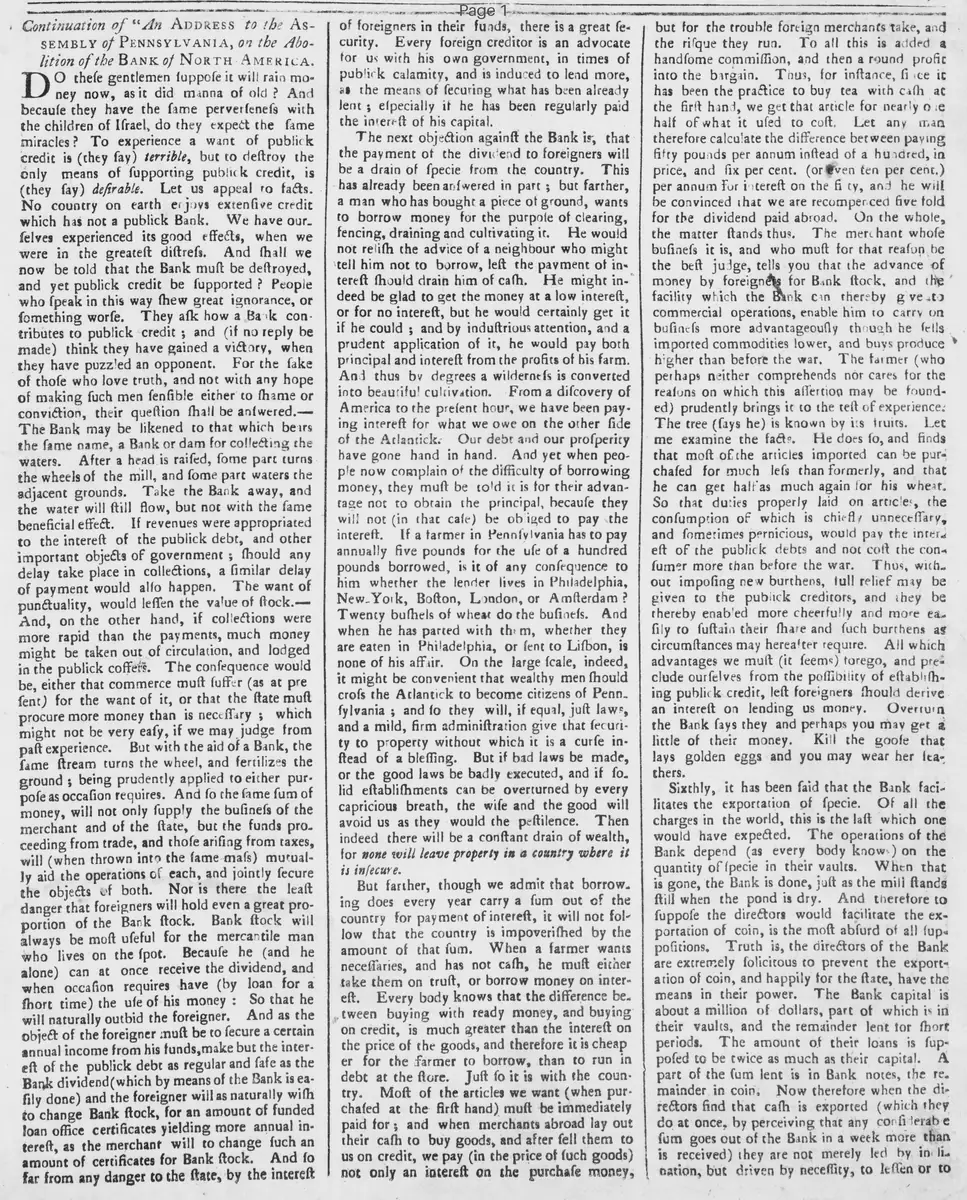
Do these gentlemen suppose it will rain money now, as it did manna of old? And because they have the same perverseness with the children of Israel, do they expect the same miracles? To experience a want of publick credit is (they say) terrible, but to destroy the only means of supporting publick credit, is (they say) desirable. Let us appeal to facts.
No country on earth enjoys extensive credit which has not a publick Bank. We have our selves experienced its good effects, when we were in the greatest distress. And shall we now be told that the Bank must be destroyed, and yet publick credit be supported? People who speak in this way shew great ignorance, or something worse. They ask how a Bank contributes to publick credit; and (if no reply be made) think they have gained a victory, when they have puzzled an opponent. For the sake of those who love truth, and not with any hope of making such men sensible either to shame or conviction, their question shall be answered.—
The Bank may be likened to that which bears the same name, a Bank or dam for collecting the waters. After a head is raised, some part turns the wheels of the mill, and some part waters the adjacent grounds. Take the Bank away, and the water will still flow, but not with the same beneficial effect. If revenues were appropriated to the interest of the publick debt, and other important objects of government; should any delay take place in collections, a similar delay of payment would also happen. The want of punctuality, would lessen the value of stock.— And, on the other hand, if collections were more rapid than the payments, much money might be taken out of circulation, and lodged in the publick coffers. The consequence would be, either that commerce must suffer (as at present) for the want of it, or that the state must procure more money than is necessary; which might not be very easy, if we may judge from past experience. But with the aid of a Bank, the same stream turns the wheel, and fertilizes the ground; being prudently applied to either purpose as occasion requires. And so the same sum of money, will not only supply the business of the merchant and of the state, but the funds proceeding from trade, and those arising from taxes, will (when thrown into the same mass) mutually aid the operations of each, and jointly secure the objects of both. Nor is there the least danger that foreigners will hold even a great proportion of the Bank stock. Bank stock will always be most useful for the mercantile man who lives on the spot. Because he (and he alone) can at once receive the dividend, and when occasion requires have (by loan for a short time) the use of his money: So that he will naturally outbid the foreigner.
And as the object of the foreigner must be to secure a certain annual income from his funds, make but the interest of the publick debt as regular and safe as the Bank dividend (which by means of the Bank is easily done) and the foreigner will as naturally wish to change Bank stock, for an amount of funded loan office certificates yielding more annual interest, as the merchant will to change such an amount of certificates for Bank stock. And so far from any danger to the state, by the interest of foreigners in their funds, there is a great security. Every foreign creditor is an advocate for us with his own government, in times of publick calamity, and is induced to lend more, as the means of securing what has been already lent; especially if he has been regularly paid the interest of his capital.
The next objection against the Bank is, that the payment of the dividend to foreigners will be a drain of specie from the country. This has already been answered in part; but farther, a man who has bought a piece of ground, wants to borrow money for the purpose of clearing, fencing, draining and cultivating it. He would not relish the advice of a neighbour who might tell him not to borrow, lest the payment of interest should drain him of cash. He might indeed be glad to get the money at a low interest, or for no interest, but he would certainly get it if he could: and by industrious attention, and a prudent application of it, he would pay both principal and interest from the profits of his farm. And thus by degrees a wilderness is converted into beautiful cultivation. From a discovery of America to the present hour, we have been paying interest for what we owe on the other side of the Atlantick: Our debt and our prosperity have gone hand in hand. And yet when people now complain of the difficulty of borrowing money, they must be told it is for their advantage not to obtain the principal, because they will not (in that case) be obliged to pay the interest. If a farmer in Pennsylvania has to pay annually five pounds for the use of a hundred pounds borrowed, is it of any consequence to him whether the lender lives in Philadelphia, New York, Boston, London, or Amsterdam? Twenty bushels of wheat do the business. And when he has parted with them, whether they are eaten in Philadelphia, or sent to Lisbon, is none of his affair. On the large scale, indeed, it might be convenient that wealthy men should cross the Atlantick to become citizens of Pennsylvania; and so they will, if equal, just laws, and a mild, firm administration give that security to property without which it is a curse instead of a blessing. But if bad laws be made, or the good laws be badly executed, and if solid establishments can be overturned by every capricious breath, the wise and the good will avoid us as they would the pestilence. Then indeed there will be a constant drain of wealth, for none will leave property in a country where it is insecure.
But farther, though we admit that borrowing does every year carry a sum out of the country for payment of interest, it will not follow that the country is impoverished by the amount of that sum. When a farmer wants necessaries, and has not cash, he must either take them on trust, or borrow money on interest. Every body knows that the difference between buying with ready money, and buying on credit, is much greater than the interest on the price of the goods, and therefore it is cheaper for the farmer to borrow, than to run in debt at the store. Just so it is with the country. Most of the articles we want (when purchased at the first hand) must be immediately paid for; and when merchants abroad lay out their cash to buy goods, and after sell them to us on credit, we pay (in the price of such goods) not only an interest on the purchase money, but for the trouble foreign merchants take, and the risque they run. To all this is added a handsome commission, and then a round profit into the bargain. Thus, for instance, since it has been the practice to buy tea with cash at the first hand, we get that article for nearly one half of what it used to cost. Let any man therefore calculate the difference between paying fifty pounds per annum instead of a hundred, in price, and six per cent. (or even ten per cent.) per annum for interest on the fifty, and he will be convinced that we are recompensed five fold for the dividend paid abroad. On the whole, the matter stands thus. The merchant whose business it is, and who must for that reason be the best judge, tells you that the advance of money by foreigners for Bank stock, and the facility which the Bank can thereby give to commercial operations, enable him to carry on business more advantageously though he sells imported commodities lower, and buys produce higher than before the war. The farmer (who perhaps neither comprehends nor cares for the reasons on which this assertion may be founded) prudently brings it to the test of experience: The tree (says he) is known by its fruits. Let me examine the facts. He does so, and finds that most of the articles imported can be purchased for much less than formerly, and that he can get half as much again for his wheat. So that duties properly laid on articles, the consumption of which is chiefly unnecessary, and sometimes pernicious, would pay the interest of the publick debts and not cost the consumer more than before the war. Thus, without imposing new burthens, full relief may be given to the publick creditors, and they be thereby enabled more cheerfully and more easily to sustain their share and such burthens as circumstances may hereafter require. All which advantages we must (it seems) forego, and preclude ourselves from the possibility of establishing publick credit, lest foreigners should derive an interest on lending us money.
Overrun the Bank says they and perhaps you may get a little of their money. Kill the goose that lays golden eggs and you may wear her feathers.
Sixthly, it has been said that the Bank facilitates the exportation of specie. Of all the charges in the world, this is the last which one would have expected. The operations of the Bank depend (as every body knows) on the quantity of specie in their vaults. When that is gone, the Bank is done, just as the mill stands still when the pond is dry. And therefore to suppose the directors would facilitate the exportation of coin, is the most absurd of all suppositions. Truth is, the directors of the Bank are extremely solicitous to prevent the exportation of coin, and happily for the state, have the means in their power. The Bank capital is about a million of dollars, part of which is in their vaults, and the remainder lent for short periods. The amount of their loans is supposed to be twice as much as their capital. A part of the sum lent is in Bank notes, the remainder in coin. Now therefore when the directors find that cash is exported (which they do at once, by perceiving that any considerable sum goes out of the Bank in a week more than is received) they are not merely led by inclination, but driven by necessity, to lessen or to
stop their discounts, according to the nature of the case and the degree of the evil. This stoppage has the effect; for not only the money is prevented from going abroad, but if the stoppage continue, it is brought in from every quarter. The operation is so powerful, that on one occasion many thousand dollars were brought to the Bank and there taken out of those packages in which they were (next morning) to have been shipped for London.
(Want of room obliges us to omit the remainder 'till our next.)
What sub-type of article is it?
What keywords are associated?
What entities or persons were involved?
Editorial Details
Primary Topic
Defense Against Abolition Of The Bank Of North America
Stance / Tone
Strongly Pro Bank, Refuting Objections
Key Figures
Key Arguments