Thank you for visiting SNEWPapers!
Sign up free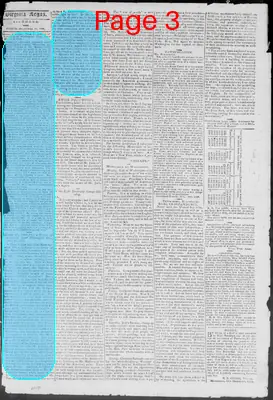
Virginia Argus
Richmond, Virginia
What is this article about?
Extract of a letter from a U.S. Congressman in Washington City, dated December 23, 1809, critiquing Mr. Macon's Bill as an ineffective non-intercourse measure that fails to protect American vessels and commerce, while questioning Macon's qualifications for chairing the Foreign Relations Committee.
Clipping
OCR Quality
Full Text
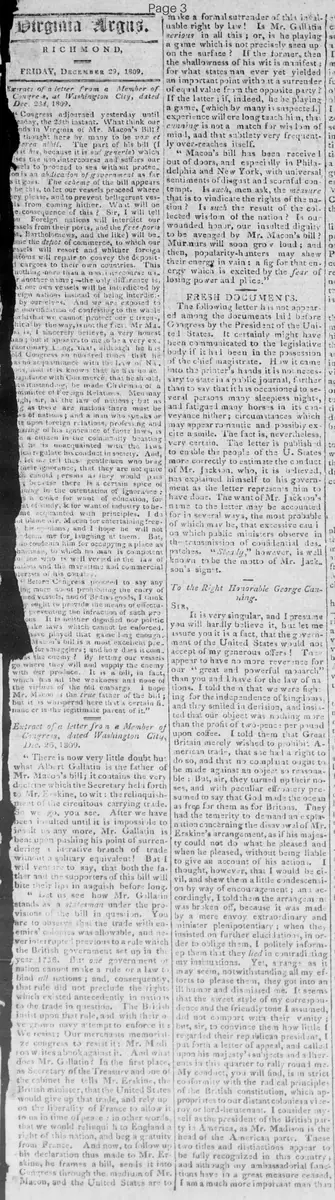
"Congress adjourned yesterday until Monday, the 25th instant. What think our friends in Virginia of Mr. Macon's Bill? Thought here by many to be var et terea nihil. The part of his bill (I write thus, because it is sui generis) which raises the non intercourse and suffers our vessels to proceed to sea without protection, is an abdication of government as far as it goes. The scheme of the bill appears to be this, to let our vessels proceed where they please, and to prevent belligerent vessels from coming hither. What will be the consequence of this? Sir, I will tell you. Foreign nations will interdict our vessels from their ports, and the free ports (St. Bartholomews, and the like) will be the depot of commerce, to which our vessels will resort and whither foreign nations will repair to convey the deposited cargoes to their own countries. This is nothing more than a non intercourse under another name; -the only difference is, that our own vessels will be interdicted by foreign nations instead of being interdicted by ourselves. And we are exposed to the mortification of confessing to the world that we cannot protect our citizen, which by the way, is not the fact. Mr. Macon is, I sincerely believe, a very honest man; but it appears to me to be a very extraordinary thing, that, although he has told Congress an hundred times that he has no acquaintance with the law of nations, and it is known that he has no acquaintance with commerce, that he should, notwithstanding, be made Chairman of a committee of Foreign Relations. Men may laugh, sir, at the law of nations; but as long as there are nations there must be laws of nations; and a man who speaks or votes upon foreign relations, professing and parading of his ignorance of those laws, is like a citizen in the community boasting that he is unacquainted with the laws which regulate his conduct in society. And, let me tell these gentlemen who brag their ignorance, that they are not quite such candid persons as they would please us to believe; because there is a certain spice of cunning in the ostentation of ignorance: it is a cloak for want of education, for want of study, & for want of industry to become acquainted with principles. I do not blame Mr. Macon for entertaining free notions; and I hope he will not condemn me for laughing at them. But, I do condemn him for occupying a place as chairman, to which no man is competent who is not well versed in the law of nations and the maritime and commercial interests of his country.
Before Congress proceed to say any thing more about prohibiting the entry of armed vessels, and of British goods, I think they ought to provide the means of effectually preventing the infraction of such prohibitions. It is neither dignified nor politic to make laws which cannot be enforced. We have played that game long enough. Macon's bill is a most excellent provision against smugglers; and how does it come at the enemy? By letting our vessels go where they will and supply the enemy with our produce. It is a bill, in fact, which has all the weakness and none of the virtues of the old embargo. I hope Mr. Macon is the true father of the bill; but it is whispered here that a certain financier is the legitimate parent of it."
What sub-type of article is it?
What keywords are associated?
What entities or persons were involved?
Where did it happen?
Domestic News Details
Primary Location
Washington City
Event Date
Dec. 23d, 1809
Key Persons
Outcome
criticism of the bill as ineffective and undignified, with calls for enforceable laws; whispers of a financier as the bill's true originator.
Event Details
A congressman critiques Mr. Macon's Bill for allowing U.S. vessels to sail unprotected while barring belligerent ships, predicting foreign interdictions and reliance on free ports; questions Macon's suitability as Foreign Relations Committee chairman due to his admitted ignorance of international law and commerce; argues against unenforceable prohibitions without enforcement means, comparing the bill unfavorably to the embargo.