Thank you for visiting SNEWPapers!
Sign up free
Carroll Free Press
Carrollton, Carroll County, Ohio
What is this article about?
Virginia court upholds John Randolph's 1819 will freeing his slaves and bequeathing estate to trustees for their land, education, and founding Roanoke College; case may appeal. Testimony highlights his eccentric habits, including a 1830 steamboat incident.
Clipping
OCR Quality
Full Text
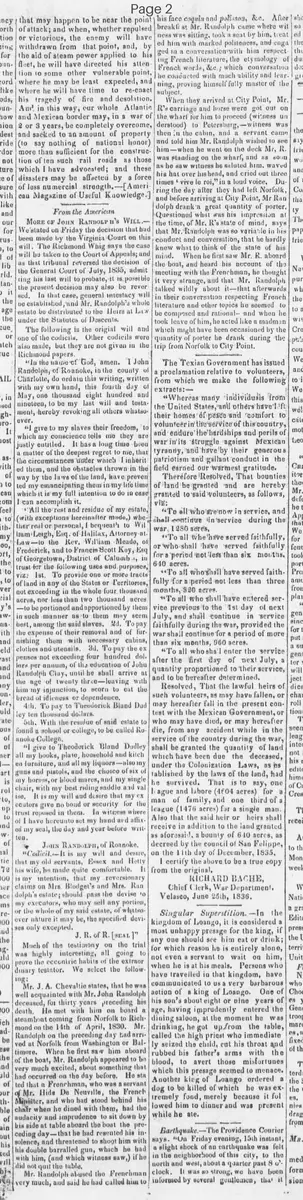
More of John Randolph's Will.—
We stated on Friday the decision that had been made by the Virginia Court on this will. The Richmond Whig says the case will be taken to the Court of Appeals; and as that tribunal reversed the decision of the General Court of July, 1835, admitting his last will to probate, it is possible the present decision may also be reversed. In that case, general intestacy will be established, and Mr. Randolph's whole estate be distributed to the heirs at law under the Statutes of Descents.
The following is the original will and one of the codicils. Other codicils were also made, but they are not given in the Richmond papers.
"In the name of God, amen. I John Randolph, of Roanoke, in the county of Charlotte, do ordain this writing, written with my own hand, this fourth day of May, one thousand eight hundred and nineteen, to be my last will and testament, hereby revoking all others whatsoever.
"I give to my slaves their freedom, to which my conscience tells me they are justly entitled. It has a long time been a matter of the deepest regret to me, that the circumstances under which I inherited them, and the obstacles thrown in the way by the laws of the land, have prevented my emancipating them in my life time which it is my full intention to do in case I can accomplish it.
"All the rest and residue of my estate (with exceptions hereinafter made,) whether real or personal, I bequeath to William Leigh, Esq. of Halifax, Attorney-at-Law—to the Rev. William Meade, of Frederick, and to Francis Scott Key, Esq. of Georgetown, District of Columbia, in trust for the following uses and purposes, viz: 1st. To provide one or more tracts of land in any of the States or Territories, not exceeding in the whole four thousand acres, nor less than two thousand acres—to be portioned and apportioned by them in such manner as to them may seem best, among the said slaves. 2d. To pay the expense of their removal and of furnishing them with necessary cabins, clothes and utensils. 3d. To pay the expenses not exceeding four hundred dollars per annum, of the education of John Randolph Clay, until he shall arrive at the age of twenty three—leaving with him my injunction, to scorn to eat the bread of idleness or dependence. 4th. To pay to Theodorick Bland Dudley ten thousand dollars. 5th. With the residue of said estate to found a school or college, to be called Roanoke College.
"I give to Theodorick Bland Dudley all my books, plate, household and kitchen furniture, and all my liquors—also my guns and pistols, and the choice of six of my horses, or blood mares, and my single chair, with my best riding saddle and valise. It is my will and desire that my executors give no bond or security for the trust reposed in them. In witness whereof I have hereunto set my hand and affixed my seal, the day and year before written.
JOHN RANDOLPH, of Roanoke.
"Codicil,—It is my will and desire that my old servants, Essex and Hetty his wife, be made quite comfortable. It is my intention, that my reversionary claims on Mrs. Blodget's and Mrs. Randolph's estate, should pass the devise to my executors, who may sell any portion, or the whole of my said estate, of whatsoever nature it may be, the specified devises only excepted.
J. R. of R. [seal]"
Much of the testimony on the trial was highly interesting, all going to prove the eccentric habits of the extraordinary testator. We select the following:
Mr. J. A. Chevalier states, that he was well acquainted with Mr. John Randolph deceased, for thirty years preceding his death. He met with him on board a steamboat coming from Norfolk to Richmond on the 14th of April, 1830. Mr. Randolph on the preceding day had arrived at Norfolk from Washington or Baltimore. When he first saw him aboard of the boat, Mr. Randolph appeared to be very much excited, about something that had occurred on the day before. He stated that a Frenchman, who was a servant of Mr. Hyde De Neuville, the French Minister, and who had stood behind his chair when he dined with them, had the audacity and imprudence to sit down by his side at table aboard the boat the preceding day—that he had resented his insolence, and threatened to shoot him with his double barrelled gun, which he had with him, (and which witness saw,) if he did not quit the table.
Mr. Randolph abused the Frenchman very much, and said he had called him to his face coquin and polisson, &c. After breakfast, Mr. Randolph came where witness was sitting, took a seat by him, treated him with marked politeness, and engaged in a conversation with him respecting French literature, the etymology of French words, &c.; which conversation he conducted with much ability and learning, proving himself fully master of the subject.
When they arrived at City Point, Mr. R's carriage and horse were got out on the wharf for him to proceed (witness understood) to Petersburg,—witness was then in the cabin, and a servant came and told him Mr. Randolph wished to see him—when he went on the deck Mr. R. was standing on the wharf, and as soon as he saw witness he saluted him, waved his hat over his head, and cried out three times 'vive le roi,' in a loud voice. During the day after they had left Norfolk, and before arriving at City Point, Mr. Randolph drank a great quantity of porter.
Questioned what was his impression at the time, of Mr. R's state of mind, says that Mr. Randolph was so variable in his conduct and conversation, that he hardly knew what to think of the state of his mind. When he first saw Mr. R. aboard the boat, and heard his account of the meeting with the Frenchman, he thought it very strange, and that Mr. Randolph talked wildly about it—that afterwards in their conversation respecting French literature and other topics he seemed to be composed and rational— and when he took leave of him, he acted like a madman which might have been occasioned by the quantity of porter he drank during the trip from Norfolk to City Point.
What sub-type of article is it?
What themes does it cover?
What keywords are associated?
What entities or persons were involved?
Where did it happen?
Story Details
Key Persons
Location
Roanoke, Charlotte County, Virginia; Steamboat From Norfolk To Richmond; City Point
Event Date
May 4, 1819; April 14, 1830; July 1835
Story Details
Virginia court decision on John Randolph's will freeing slaves and establishing trusts; potential appeal; will text details emancipation, land provision, education, and Roanoke College; codicil for servants; testimony of eccentric behavior on 1830 steamboat trip involving altercation with Frenchman and variable conduct.