Thank you for visiting SNEWPapers!
Sign up free
Alexandria Gazette
Alexandria, Alexandria County, District Of Columbia
What is this article about?
G. W. Summers' speech at the 1844 Baltimore Whig convention lauds Henry Clay, mocks James K. Polk's nomination, defends the 1842 tariff, warns of Texas annexation risks to the Union over slavery, criticizes Calhoun's diplomacy, and calls for Whig unity against Democrats.
Clipping
OCR Quality
Full Text
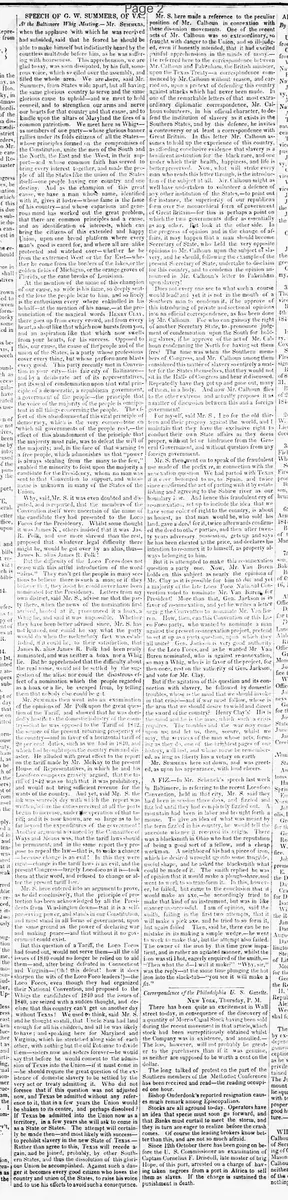
At the Baltimore Whig Meeting.—Mr. SUMMERS, when the applause with which he was received had subsided, said that he feared he should be able to make himself but indistinctly heard by the countless multitude before him, as he was suffering with hoarseness. This apprehension, we are glad to say, was soon dissipated, by his full, sonorous voice, which swelled over the assembly, and filled the whole area. We are here, said Mr. Summers, from States wide apart, but all having the same glorious country to serve and the same glorious cause to uphold—and we meet to hold council, and to strengthen our arms and nerve our hearts for that country and that cause, and to kindle upon the altars of Maryland the fires of a common patriotism.
We meet here as Whigs as members of one party—whose glorious banner rallies under its folds citizens of all the States— whose principles formed on the compromises of the Constitution, unite the men of the South and the North. the East and the West, in their support—and whose common faith has served to bring every interest together, and made the people of all the States like the union of the States itself—one people having one country and one destiny. And as the champion of this great cause, we have a man whose name, identified with it, gives it lustre—whose fame is the fame of his country—and whose capacious and generous mind has worked out the great problem, that there are common principles and a cause, and an identification of interests, which can bring the citizens of this extended and happy Union, upon one broad platform where every man's good is cared for, and where all are alike protected and watched over—whether he be from the extremest West or the far East—whether he come from the borders of the lakes or the golden fields of Michigan, or the orange groves of Florida, or the cane breaks of Louisiana.
At the mention of the name of this champion of our cause, so wide is his fame, so deeply seated the love the people bear to him, and so lively is the enthusiasm every where enkindled in his behalf—at the mention of his name,—at the pronunciation of the magical words Henry Clay, there goes up from every crowd, and from every heart, a shout like that which now bursts from you, and an aspiration like that which now swells from your hearts, for his success. Opposed to this, our cause, the cause of the people and of the union of the States, is a party whose professions cover every thing, but whose performance blasts every good. This party recently met in Convention in your city—this fair city of Baltimore— and by a deliberate act of its representatives, put its seal of condemnation upon that vital principle of a democratic, a republican government, a government of the people—the principle that the voice of the majority of the people is omnipotent in all things concerning the people. The effect of this abandonment, of this vital principle of democracy, which is the very corner-stone on which all governments of the people rest,—the effect of this abandonment of the principle that the majority must rule, was to defeat the will of the majority; and, in the face of that warning to a free people, which admonishes us that "power is always stealing from the many to the few," enabled the minority to foist upon the majority a candidate for the Presidency, whom no man was sent to that Convention to support, and whose name is unknown in many of the States of the Union.
Why, said, Mr. S. it was even doubted and disputed, and is reported, that the members of the Convention itself were uncertain of the name of the candidate they had presented to the Loco Focos for the Presidency. Whilst some thought it was James K , others insisted that it was Jas. R. Polk, and one more shrewd than the rest, proposed that whatever legal difficulty there might be, would be got over by an alias, thus— James K. alias James R. Polk !
But the difficulty of the Loco Focos does not cease with this artful introduction of the word "alias." They can't get the people in many sections to believe there is such a man; or if they believe that, they insist he could never have been nominated for the Presidency. Letters from my own district, said Mr. S., advise me that the party there, when the news of the nomination first arrived, hooted at it, pronounced it a hoax. a Whig lie, and said it was impossible. Whether they have been better advised since, Mr. S. has not learned, nor could he say what the party would do when the melancholy fact was established, if it could be, to their satisfaction, that James K. alias James R. Polk had been really nominated, and was neither a hoax nor a Whig lie. But he apprehended that the difficulty about the real name, would not be settled by the suggestion of the alias: nor could the disastrous effect of a nomination which the people regarded as a hoax or a lie, be escaped from, by telling them that nobody else could be got.
Mr. Summers then went into an examination of the opinions of Mr Polk upon the great question of the Tariff. and showed that he was decidedly hostile to the domestic industry of the country—that he was opposed to the Tariff of 1842. the source of the present returning prosperity of the country—and in favor of a horizontal tariff of 20 per cent. duties, such as we had in 1840, and which had brought upon the country ruin and disaster. He alluded with great effect to the report on the tariff made by Mr. McKay to the present House of Representatives, in which he and his Locofoco compeers gravely argued, that the tariff of 1842 was so high that it was prohibitory, and would not bring sufficient revenue for the wants of the country. And yet, said Mr. S. the ink was scarcely dry with which the report was written, before the duties received at all the ports began to increase, under the operation of that tariff; and it is now known, are so large as to be far beyond the expenditures of the government!
Another argument advanced by the Committee of Ways and Means was, that the tariff laws should be permanent, and in the same report they propose to repeal the law—that is, to make a change - because change is an evil! In this they were right—change in the tariff laws is an evil, and the present Congress—largely Locofoco as it is—took them at their word, and refused to change or alter the present tariff law.
Mr. S. here entered into an argument to prove, as he did conclusively, that the principle of protection has been acknowledged by all the Presidents from Washington down—that it is a self-preserving power, and stands in our Constitution, and must stand in all forms of government, upon the same ground as the power of declaring war and making peace—and that without it no government could exist.
But this question of a Tariff, the Loco Focos had found out. would not serve them—all the old issues of 1840 could no longer be relied on to aid them—and, after being defeated in Connecticut and Virginia—(Oh! this defeat! how it does sharpen the wits of the Loco Foco leaders!)—the Loco Focos, even though they had organized their National Convention, and proposed to the Whigs the candidates of 1840 and the issues of 1840, are seized with a sudden thought, and declare that this country can't get on another day without Texas! We used to think. said Mr. S. and he thought so still, that Uncle Sam had land enough for all his children, and all he was likely to have; and speaking here for Maryland and Virginia, which lie stretched along side of each other, with nothing but the old Potomac to divide them—sisters now and sisters forever—he would say that before he would consent to the admission of Texas into the Union—if it must come in —he should require the great question of the existence of domestic slavery to be settled by the very act or treaty admitting it. Who did not foresee that if this question was not adjusted now, and Texas be admitted without any reference to it, that in a few years the Union would be shaken to its centre, and perhaps dissolved?
If Texas be admitted into the Union now as a territory, in a few years she will ask to come in as a State or States. The attempt will certainly be made then—and most likely with success— to prohibit slavery in the new State of Texas.— Rather than agree to this, Texas will recede again, and be joined, probably, by other Southern States, and thus the dissolution of this glorious Union be accomplished. Against such a danger it becomes every good citizen who loves the country and union of the States, to raise his voice and. to use his efforts to avoid such a consequence.'
Mr. S. here made a reference to the peculiar position of Mr. Calhoun in connection with these dis-union movements. One of the recent acts of Mr. Calhoun was so extraordinary, so fraught with danger to the Union, and so ill-judged, even if honestly intended. that it had excited painful apprehensions in the minds of many.— Hie referred here to the correspondence between Mr. Calhoun and Pakenham, the British minister, upon the Texas Treaty—a correspondence commenced by Mr. Calhoun without reason, and carried on, upon a pretext of defending this country against attacks which had never been made. In one of the remarkable letters of that most extraordinary diplomatic correspondence, Mr. Calhoun volunteers, in his official character, to defend the institution of slavery as it exists in the Southern States, and by this defence, he invites a controversy or at least a correspondence with Great Britain. In this letter Mr. Calhoun assumes to hold up the experience of this country, as affording conclusive evidence that slavery is a beneficent institution for the black race, and one under which their health, happiness, and life is better preserved. Now, what will strike every man who reads this letter through, is the introduction of the subject at all. Mr. Calhoun might as well have undertaken to volunteer a defence of any other institution of the States,—to point out for instance, the superiority of our republican form over the monarchical form of government of Great Britain—for this is perhaps a point on which the two governments differ as essentially as any other. But look at the other side. In the progress of opinion and in the change of affairs, it may happen that a man should become Secretary of State, who held the very opposite opinions to Mr. Calhoun upon the subject of slavery, and he should, following the example of the present Secretary of State, undertake to disclaim for this country, and to condemn the opinion announced in Mr. Calhoun's letter to Pakenham upon slavery!
Does not every one see to what such a course would lead? and yet it is not in the mouth of a Southern man to condemn it, if he approve of this introducing of private and sectional opinions in an official correspondence, as has been done by Mr. Calhoun. For who can gainsay the right of another Secretary State, to pronounce judgment of condemnation upon the South for holding slaves, if he approve of the act of Mr. Calhoun condemning the North for having set them free? The time was when the Southern members of Congress, and Mr. Calhoun among them considered this matter of slavery so entirely a matter for the States themselves, that they would not sit in the Halls of Congress and hear it discussed. Repeatedly have they got up and gone out, many of them, in a body. And now Mr. Calhoun flies to the other extreme and actually proposes it as a matter of discussion between this and a foreign government!
For myself, said Mr. S, I go for the old thirteen and their progeny against the world, and maintain that they have the exclusive right to conduct their own State affairs as they deem proper, without let or hindrance from the General Government, and without question from any foreign government.
Mr. S. then went on to speak of the fraudulent use made of the prefix re, in connection with the annexation question We had parted with Texas if it ever belonged to us, to Spain, and twice since confirmed the act of parting with it by establishing and agreeing to the Sabine river as our boundary line. And hence this fraudulent cry of re-annexation, set up to include the idea that we have some color of right to the country, is about as honest, as that man would be, who sold his land. gave a deed for it, twice afterwards confirmed the deed to other parties, and then after twenty years adversary possession, gets up and says he has been cheated in the price, and declares his intention to re-annex it to himself, as property always belonging to him.
But it is attempted to make this re-annexation question a party one. Now, Mr. Van Buren holds on this subject as nearly the opinions of Mr. Clay as it is possible for him to do: and yet a majority of the late Loco Foco National Convention voted to nominate Mr. Van Buren, for President! More than that, Gen. Jackson is in favor of re-annexation, and yet he writes a letter urging the Convention to nominate Mr. Van Buren. How, then, can this Convention or this Loco Foco party, who wanted to nominate a man against the present re-annexation project, pretend to set it up as a party question, upon which they all unite? Gen. Jackson is very good authority for the Loco Focos, and as he wanted Mr Van Buren nominated, who is against re-annexation, so may a Whig, who is in favor of the project, for then once, rest on the authority of Gen. Jackson, and vote for Mr. Clay.
But if the agitation of this question and its connection with slavery, be followed by domestic troubles, whose is the mind that we should invoke in that crisis;—and if war must follow, whose is the arm that we should desire to wield and direct the sword of the country? Henry Clay's. His is the mind and he is the man, which such a crisis requires. The troubles and the war may come upon us; and let us, then, secure, whilst we may, the services of the man whose acts, forming as they do, one of the brightest pages of our history, will last, and whose praise be remembered, as long as liberty has a votary on earth
Mr, Summers here sat down, and was greeted, as upon his appearance, with loud cheers.
What sub-type of article is it?
What themes does it cover?
What keywords are associated?
What entities or persons were involved?
Where did it happen?
Story Details
Key Persons
Location
Baltimore
Story Details
G. W. Summers delivers a speech at the Baltimore Whig Meeting praising Henry Clay, criticizing the Democratic nomination of James K. Polk as a hoax, opposing Polk's tariff views, advocating protectionism, warning against Texas annexation without settling slavery, condemning Calhoun's correspondence on slavery, and urging support for Clay to preserve the Union.