Thank you for visiting SNEWPapers!
Sign up free
Literary
September 3, 1828
Pawtucket Herald, And Independent Inquirer
Pawtucket, Providence County, Rhode Island
What is this article about?
An essay advising young women on usefully employing their time to avoid idleness and dissipation, emphasizing reading improving books, memorizing poetry, fulfilling duties, exercise, and benevolence, while critiquing novels and promoting moral and religious pursuits.
Clipping
OCR Quality
98%
Excellent
Full Text
MISCELLANY.
ON THE EMPLOYMENT OF TIME.
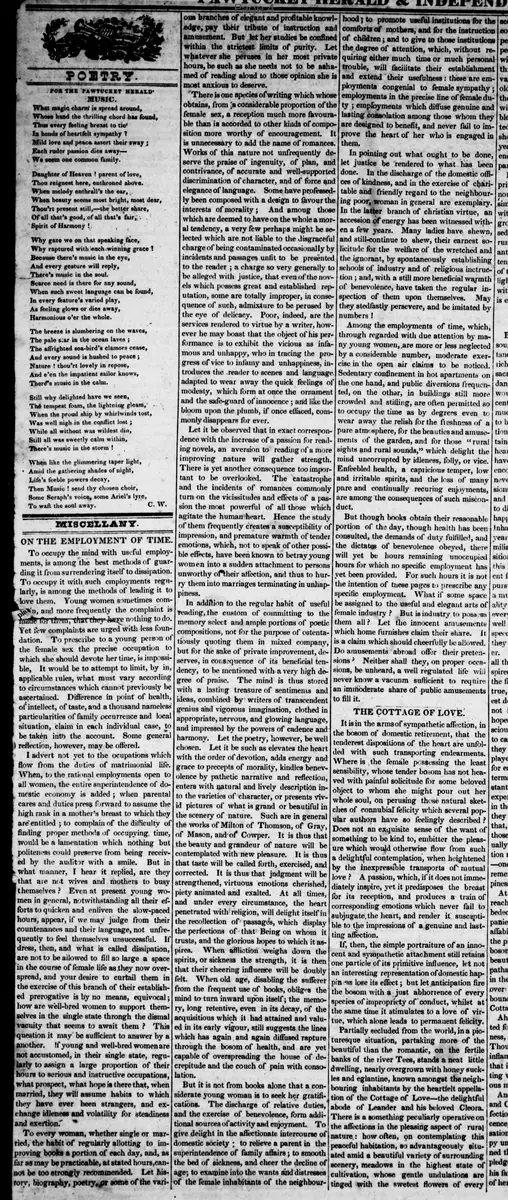
To occupy the mind with useful employments, is among the best methods of guarding it from surrendering itself to dissipation. To occupy it with such employments regularly, is among the methods of leading it to love them. Young women sometimes complain, and more frequently the complaint is made for them, that they have nothing to do. Yet few complaints are urged with less foundation. To prescribe to a young person of the female sex the precise occupation to which she should devote her time, is impossible. It would be to attempt to limit, by inapplicable rules, what must vary according to circumstances which cannot previously be ascertained. Difference in point of health, of intellect, of taste, and a thousand nameless particularities of family occurrence and local situation, claim in each individual case, to be taken into the account. Some general reflection, however, may be offered.
I advert not yet to the occupations which flow from the duties of matrimonial life. When, to the rational employments open to all women, the entire superintendence of domestic economy is added; when parental cares and duties press forward to assume the high rank in a mother's breast to which they are entitled; to complain of the difficulty of finding proper methods of occupying time, would be a lamentation which nothing but politeness could preserve from being received by the auditor with a smile. But in what manner, I hear it replied, are they that are not wives and mothers to busy themselves? Even at present young women in general, notwithstanding all their efforts to quicken and enliven the slow-paced hours, appear, if we may judge from their countenances and their language, not unfrequently to feel themselves unsuccessful. If dress, then, and what is called dissipation, are not to be allowed to fill so large a space in the course of female life as they now overspread, and your desire to curtail them in the exercise of this branch of their established prerogative is by no means equivocal; how are well-bred women to support themselves in the single state through the dismal vacuity that seems to await them? This question it may be sufficient to answer by another. If young and well-bred women are not accustomed, in their single state, regularly to assign a large proportion of their hours to serious and instructive occupations, what prospect, what hope is there that, when married, they will assume habits to which they have ever been strangers, and exchange idleness and volatility for steadiness and exertion.
To every woman, whether single or married, the habit of regularly allotting to improving books a portion of each day, and, as far as may be practicable, at stated hours, cannot be too strongly recommended. Let history, biography, poetry, or some of the various branches of elegant and profitable knowledge, pay their tribute of instruction and amusement. But let her studies be confined within the strictest limits of purity. Let whatever she peruses in her most private hours, be such as she needs not to be ashamed of reading aloud to those opinions she is most anxious to deserve.
There is one species of writing which obtains, from a considerable proportion of the female sex, a reception much more favourable than is accorded to other kinds of composition more worthy of encouragement. It is unnecessary to add the name of romances. Works of this nature not unfrequently deserve the praise of ingenuity, of plan, and contrivance, of accurate and well-supported discrimination of character, and of force and elegance of language. Some have professedly been composed with a design to favour the interests of morality; And among those which are deemed to have on the whole a moral tendency, a very few perhaps might be selected which are not liable to the disgraceful charge of being contaminated occasionally by incidents and passages unfit to be presented to the reader; a charge so very generally to be alleged with justice, that even of the novels which possess great and established reputation, some are totally improper, in consequence of such admixture to be perused by the eye of delicacy. Poor, indeed, are the services rendered to virtue by a writer, however he may boast that the object of his performance is to exhibit the vicious as infamous and unhappy, who in tracing the progress of vice to infamy and unhappiness, introduces the reader to scenes and language adapted to wear away the quick feelings of modesty, which form at once the ornament and the safe-guard of innocence; and like the bloom upon the plum, if once effaced, commonly disappears for ever.
Let it be observed that in exact correspondence with the increase of a passion for reading novels, an aversion to reading of a more improving nature will gather strength. There is yet another consequence too important to be overlooked. The catastrophe and the incidents of romances commonly turn on the vicissitudes and effects of a passion the most powerful of all those which agitate the human heart. Hence the study of them frequently creates a susceptibility of impression, and premature warmth of tender emotions, which, not to speak of other possible effects, have been known to betray young women into a sudden attachment to persons unworthy of their affection, and thus to hurry them into marriages terminating in unhappiness.
In addition to the regular habit of useful reading, the custom of committing to the memory select and ample portions of poetic compositions, not for the purpose of ostentatiously quoting them in mixed company, but for the sake of private improvement, deserves, in consequence of its beneficial tendency, to be mentioned with a very high degree of praise. The mind is thus stored with a lasting treasure of sentiments and ideas, combined by writers of transcendent genius and vigorous imagination, clothed in appropriate, nervous, and glowing language, and impressed by the powers of cadence and harmony. Let the poetry, however, be well chosen. Let it be such as elevates the heart with the ardour of devotion, adds energy and grace to precepts of morality, kindles benevolence by pathetic narrative and reflection, enters with natural and lively description into the varieties of character, or presents vivid pictures of what is grand or beautiful in the scenery of nature. Such are in general the works of Milton, of Thomson, of Gray, of Mason, and of Cowper. It is thus that the beauty and grandeur of nature will be contemplated with new pleasure. It is thus that taste will be called forth, exercised, and corrected. It is thus that judgment will be strengthened, virtuous emotions cherished, piety animated and exalted. At all times, and under every circumstance, the heart penetrated with religion, will delight itself in the recollection of passages, which display the perfections of that Being on whom it trusts, and the glorious hopes to which it aspires.
When affliction weighs down the spirits, or sickness the strength, it is then that their cheering influence will be doubly felt. When old age, disabling the sufferer from the frequent use of books, obliges the mind to turn inward upon itself; the memory, long retentive, even in its decay, of the acquisitions which it had attained and valued in its early vigour, still suggests the lines which has again and again diffused rapture through the bosom of health, and are yet capable of overspreading the house of decrepitude and the couch of pain with consolation.
But it is not from books alone that a considerate young woman is to seek her gratifications. The discharge of relative duties, and the exercise of benevolence, form additional sources of activity and enjoyment. To give delight in the affectionate intercourse of domestic society; to relieve a parent in the superintendence of family affairs; to smooth the bed of sickness, and cheer the decline of age; to examine into the wants and distresses of the female inhabitants of the neighbourhood; to promote useful institutions for the comforts of mothers, and for the instruction of children; and to give to those institutions the degree of attention, which, without requiring either much time or much personal trouble, will facilitate their establishment and extend their usefulness: these are employments congenial to female sympathy; employments in the precise line of female duty; employments which diffuse genuine and lasting consolation among those whom they are designed to benefit, and never fail to improve the heart of her who is engaged in them.
In pointing out what ought to be done, let justice be rendered to what has been done. In the discharge of the domestic offices of kindness, and in the exercise of charitable and friendly regard to the neighbouring poor, woman in general are exemplary. In the latter branch of christian virtue, an accession of energy has been witnessed within a few years. Many ladies have shewn, and still continue to shew, their earnest solicitude for the welfare of the wretched and the ignorant, by spontaneously establishing schools of industry and of religious instruction; and, with a still more beneficial warmth of benevolence, have taken the regular inspection of them upon themselves. May they stedfastly persevere, and be imitated by numbers!
Among the employments of time, which, though regarded with due attention by many young women, are more or less neglected by a considerable number, moderate exercise in the open air claims to be noticed. Sedentary confinement in hot apartments on the one hand, and public diversions frequented, on the other, in buildings still more crowded and stifling, are often permitted so to occupy the time as by degrees even to wear away the relish for the freshness of a pure atmosphere, for the beauties and amusements of the garden, and for those "rural sights and rural sounds," which delight the mind uncorrupted by idleness, folly, or vice. Enfeebled health, a capricious temper, low and irritable spirits, and the loss of many pure and continually recurring enjoyments, are among the consequences of such misconduct.
But though books obtain their reasonable portion of the day, though health has been consulted, the demands of duty fulfilled, and the dictates of benevolence obeyed, there will yet be hours remaining unoccupied hours for which no specific employment has yet been provided. For such hours it is not the intention of these pages to prescribe any specific employment. What if some space be assigned to the useful and elegant arts of female industry? But is industry to possess them all? Let the innocent amusements which home furnishes claim their share. It is a claim which should cheerfully be allowed. Do amusements abroad offer their pretensions? Neither shall they, on proper occasions, be unheard, a well regulated life will never know a vacuum sufficient to require an immoderate share of public amusements to fill it.
ON THE EMPLOYMENT OF TIME.
To occupy the mind with useful employments, is among the best methods of guarding it from surrendering itself to dissipation. To occupy it with such employments regularly, is among the methods of leading it to love them. Young women sometimes complain, and more frequently the complaint is made for them, that they have nothing to do. Yet few complaints are urged with less foundation. To prescribe to a young person of the female sex the precise occupation to which she should devote her time, is impossible. It would be to attempt to limit, by inapplicable rules, what must vary according to circumstances which cannot previously be ascertained. Difference in point of health, of intellect, of taste, and a thousand nameless particularities of family occurrence and local situation, claim in each individual case, to be taken into the account. Some general reflection, however, may be offered.
I advert not yet to the occupations which flow from the duties of matrimonial life. When, to the rational employments open to all women, the entire superintendence of domestic economy is added; when parental cares and duties press forward to assume the high rank in a mother's breast to which they are entitled; to complain of the difficulty of finding proper methods of occupying time, would be a lamentation which nothing but politeness could preserve from being received by the auditor with a smile. But in what manner, I hear it replied, are they that are not wives and mothers to busy themselves? Even at present young women in general, notwithstanding all their efforts to quicken and enliven the slow-paced hours, appear, if we may judge from their countenances and their language, not unfrequently to feel themselves unsuccessful. If dress, then, and what is called dissipation, are not to be allowed to fill so large a space in the course of female life as they now overspread, and your desire to curtail them in the exercise of this branch of their established prerogative is by no means equivocal; how are well-bred women to support themselves in the single state through the dismal vacuity that seems to await them? This question it may be sufficient to answer by another. If young and well-bred women are not accustomed, in their single state, regularly to assign a large proportion of their hours to serious and instructive occupations, what prospect, what hope is there that, when married, they will assume habits to which they have ever been strangers, and exchange idleness and volatility for steadiness and exertion.
To every woman, whether single or married, the habit of regularly allotting to improving books a portion of each day, and, as far as may be practicable, at stated hours, cannot be too strongly recommended. Let history, biography, poetry, or some of the various branches of elegant and profitable knowledge, pay their tribute of instruction and amusement. But let her studies be confined within the strictest limits of purity. Let whatever she peruses in her most private hours, be such as she needs not to be ashamed of reading aloud to those opinions she is most anxious to deserve.
There is one species of writing which obtains, from a considerable proportion of the female sex, a reception much more favourable than is accorded to other kinds of composition more worthy of encouragement. It is unnecessary to add the name of romances. Works of this nature not unfrequently deserve the praise of ingenuity, of plan, and contrivance, of accurate and well-supported discrimination of character, and of force and elegance of language. Some have professedly been composed with a design to favour the interests of morality; And among those which are deemed to have on the whole a moral tendency, a very few perhaps might be selected which are not liable to the disgraceful charge of being contaminated occasionally by incidents and passages unfit to be presented to the reader; a charge so very generally to be alleged with justice, that even of the novels which possess great and established reputation, some are totally improper, in consequence of such admixture to be perused by the eye of delicacy. Poor, indeed, are the services rendered to virtue by a writer, however he may boast that the object of his performance is to exhibit the vicious as infamous and unhappy, who in tracing the progress of vice to infamy and unhappiness, introduces the reader to scenes and language adapted to wear away the quick feelings of modesty, which form at once the ornament and the safe-guard of innocence; and like the bloom upon the plum, if once effaced, commonly disappears for ever.
Let it be observed that in exact correspondence with the increase of a passion for reading novels, an aversion to reading of a more improving nature will gather strength. There is yet another consequence too important to be overlooked. The catastrophe and the incidents of romances commonly turn on the vicissitudes and effects of a passion the most powerful of all those which agitate the human heart. Hence the study of them frequently creates a susceptibility of impression, and premature warmth of tender emotions, which, not to speak of other possible effects, have been known to betray young women into a sudden attachment to persons unworthy of their affection, and thus to hurry them into marriages terminating in unhappiness.
In addition to the regular habit of useful reading, the custom of committing to the memory select and ample portions of poetic compositions, not for the purpose of ostentatiously quoting them in mixed company, but for the sake of private improvement, deserves, in consequence of its beneficial tendency, to be mentioned with a very high degree of praise. The mind is thus stored with a lasting treasure of sentiments and ideas, combined by writers of transcendent genius and vigorous imagination, clothed in appropriate, nervous, and glowing language, and impressed by the powers of cadence and harmony. Let the poetry, however, be well chosen. Let it be such as elevates the heart with the ardour of devotion, adds energy and grace to precepts of morality, kindles benevolence by pathetic narrative and reflection, enters with natural and lively description into the varieties of character, or presents vivid pictures of what is grand or beautiful in the scenery of nature. Such are in general the works of Milton, of Thomson, of Gray, of Mason, and of Cowper. It is thus that the beauty and grandeur of nature will be contemplated with new pleasure. It is thus that taste will be called forth, exercised, and corrected. It is thus that judgment will be strengthened, virtuous emotions cherished, piety animated and exalted. At all times, and under every circumstance, the heart penetrated with religion, will delight itself in the recollection of passages, which display the perfections of that Being on whom it trusts, and the glorious hopes to which it aspires.
When affliction weighs down the spirits, or sickness the strength, it is then that their cheering influence will be doubly felt. When old age, disabling the sufferer from the frequent use of books, obliges the mind to turn inward upon itself; the memory, long retentive, even in its decay, of the acquisitions which it had attained and valued in its early vigour, still suggests the lines which has again and again diffused rapture through the bosom of health, and are yet capable of overspreading the house of decrepitude and the couch of pain with consolation.
But it is not from books alone that a considerate young woman is to seek her gratifications. The discharge of relative duties, and the exercise of benevolence, form additional sources of activity and enjoyment. To give delight in the affectionate intercourse of domestic society; to relieve a parent in the superintendence of family affairs; to smooth the bed of sickness, and cheer the decline of age; to examine into the wants and distresses of the female inhabitants of the neighbourhood; to promote useful institutions for the comforts of mothers, and for the instruction of children; and to give to those institutions the degree of attention, which, without requiring either much time or much personal trouble, will facilitate their establishment and extend their usefulness: these are employments congenial to female sympathy; employments in the precise line of female duty; employments which diffuse genuine and lasting consolation among those whom they are designed to benefit, and never fail to improve the heart of her who is engaged in them.
In pointing out what ought to be done, let justice be rendered to what has been done. In the discharge of the domestic offices of kindness, and in the exercise of charitable and friendly regard to the neighbouring poor, woman in general are exemplary. In the latter branch of christian virtue, an accession of energy has been witnessed within a few years. Many ladies have shewn, and still continue to shew, their earnest solicitude for the welfare of the wretched and the ignorant, by spontaneously establishing schools of industry and of religious instruction; and, with a still more beneficial warmth of benevolence, have taken the regular inspection of them upon themselves. May they stedfastly persevere, and be imitated by numbers!
Among the employments of time, which, though regarded with due attention by many young women, are more or less neglected by a considerable number, moderate exercise in the open air claims to be noticed. Sedentary confinement in hot apartments on the one hand, and public diversions frequented, on the other, in buildings still more crowded and stifling, are often permitted so to occupy the time as by degrees even to wear away the relish for the freshness of a pure atmosphere, for the beauties and amusements of the garden, and for those "rural sights and rural sounds," which delight the mind uncorrupted by idleness, folly, or vice. Enfeebled health, a capricious temper, low and irritable spirits, and the loss of many pure and continually recurring enjoyments, are among the consequences of such misconduct.
But though books obtain their reasonable portion of the day, though health has been consulted, the demands of duty fulfilled, and the dictates of benevolence obeyed, there will yet be hours remaining unoccupied hours for which no specific employment has yet been provided. For such hours it is not the intention of these pages to prescribe any specific employment. What if some space be assigned to the useful and elegant arts of female industry? But is industry to possess them all? Let the innocent amusements which home furnishes claim their share. It is a claim which should cheerfully be allowed. Do amusements abroad offer their pretensions? Neither shall they, on proper occasions, be unheard, a well regulated life will never know a vacuum sufficient to require an immoderate share of public amusements to fill it.
What sub-type of article is it?
Essay
What themes does it cover?
Moral Virtue
Social Manners
Religious
What keywords are associated?
Women Employment
Moral Reading
Female Duties
Benevolence
Novel Critique
Poetry Memory
Exercise Health
Literary Details
Title
On The Employment Of Time.
Subject
Advice On Useful Occupations For Young Women
Key Lines
To Occupy The Mind With Useful Employments, Is Among The Best Methods Of Guarding It From Surrendering Itself To Dissipation.
To Every Woman, Whether Single Or Married, The Habit Of Regularly Allotting To Improving Books A Portion Of Each Day, And, As Far As May Be Practicable, At Stated Hours, Cannot Be Too Strongly Recommended.
Let It Be Observed That In Exact Correspondence With The Increase Of A Passion For Reading Novels, An Aversion To Reading Of A More Improving Nature Will Gather Strength.
The Discharge Of Relative Duties, And The Exercise Of Benevolence, Form Additional Sources Of Activity And Enjoyment.
May They Stedfastly Persevere, And Be Imitated By Numbers!