Thank you for visiting SNEWPapers!
Sign up free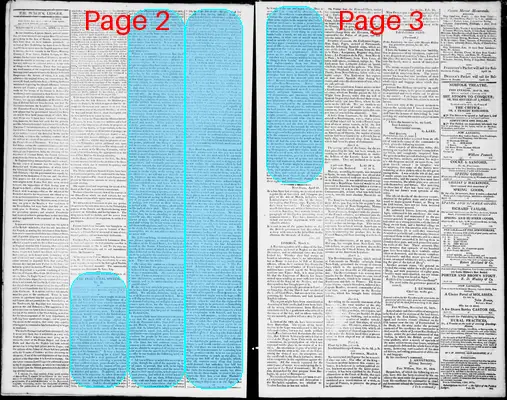
Norfolk Gazette And Publick Ledger
Norfolk, Virginia
What is this article about?
This editorial, part II from the Charleston Courier, critiques President Thomas Jefferson's inaugural speech and administration, accusing him of inconsistency, violating promises of impartiality, and purging Federalist officials to favor Republicans, thus fostering political intolerance.
Merged-components note: The editorial at reading_order 66 on page 2 continues directly into the text at reading_order 67 on page 3; merge across pages as it is the same article on the inaugural speech.
Clippings
1 of 2
OCR Quality
Full Text
THE INAUGURAL SPEECH
No. II.
There is an evil which I have seen under the sun: Folly is set in great Dignity, And the Wise sit in Low Places.
Eccles. X. 5.6.
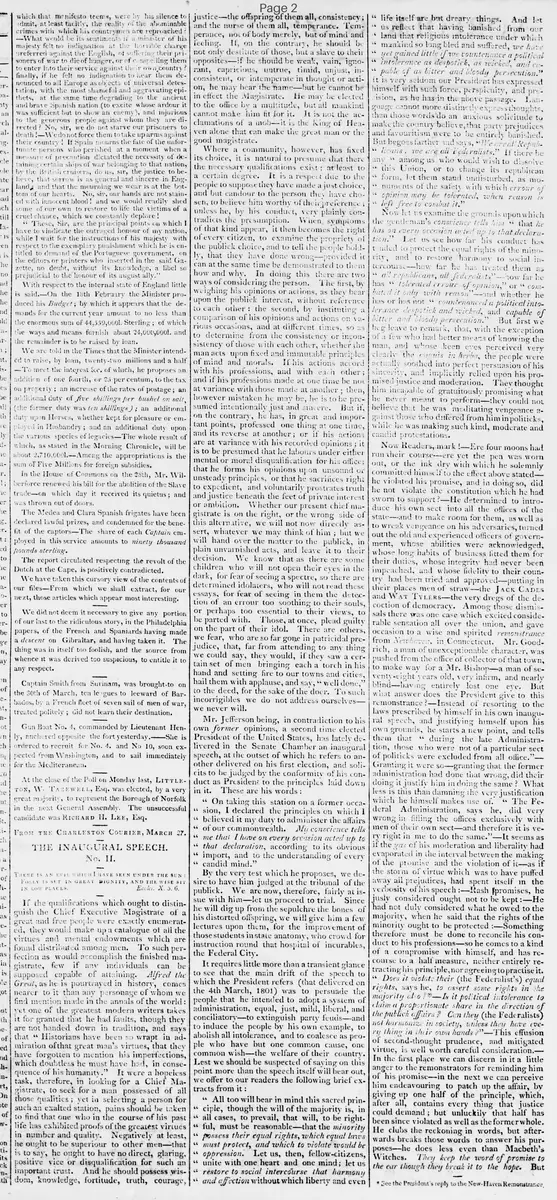
If the qualifications which ought to distinguish the Chief Executive Magistrate of a great and free people were exactly enumerated, they would make up a catalogue of all the virtues and mental endowments which are found distributed among men. To such perfection as would accomplish the finished magistrate, few if any individuals can be supposed capable of attaining. Alfred the Great, as he is portrayed in history, comes nearer to it than any personage of whom we find mention made in the annals of the world: yet one of the greatest modern writers takes it for granted that he had faults, though they are not handed down in tradition, and says that "Historians have been so wrapt in admiration of that great man's virtues, that they have forgotten to mention his imperfections, which doubtless he must have had, in consequence of his humanity." It were a hopeless task, therefore, in looking for a Chief Magistrate, to seek for a man possessed of all those qualities; yet in selecting a person for such an exalted station, pains should be taken to find that one who in the course of his past life has exhibited proofs of the greatest virtues in number and quality. Negatively at least, he ought to be superiour to other men--that is to say, he ought to have no direct, glaring, positive vice or disqualification for such an important trust. And he should possess wisdom, knowledge, fortitude, truth, courage, justice--the offspring of them all, consistency; and the nurse of them all, temperance. Temperance, not of body merely, but of mind and feeling. If, on the contrary, he should be not only destitute of those, but a slave to their opposites--if he should be weak, vain, ignorant, capricious, untrue, timid, unjust, inconsistent, or intemperate in thought or action, he may bear the name--but he cannot be in effect the Magistrate. He may be elected to the office by a multitude, but all mankind cannot make him fit for it. It is not the acclamations of a mob--it is the King of Heaven alone that can make the great man or the good magistrate. Where a community, however, has fixed its choice, it is natural to presume that there the necessary qualifications exist; at least to a certain degree. It is a respect due to the people to suppose they have made a just choice. and but candour to the person they have chosen, to believe him worthy of their preference; unless he, by his conduct, very plainly contradicts the presumption. When symptoms of that kind appear, it then becomes the right of every citizen, to examine the propriety of the publick choice, and to tell the people boldly, that they have done wrong--provided it can at the same time be demonstrated to them how and why. In doing this there are two ways of considering the person. The first, by weighing his opinions or actions, as they bear upon the publick interest, without reference to each other: the second, by instituting a comparison of his opinions and actions on various occasions, and at different times, so as to determine from the consistency or inconsistency of those with each other, whether the man acts upon fixed and immutable principles of mind and morals. If his actions accord with his professions, and with each other; and if his professions made at one time be not at variance with those made at another; then, however mistaken he may be, he is to be presumed intentionally just and sincere. But if, on the contrary, he has, in great and important points, professed one thing at one time, and its reverse at another; or if his actions are at variance with his recorded opinions; it is to be presumed that he labours under either mental or moral disqualification for his office; that he forms his opinions upon unsound or unsteady principles, or that he sacrifices right to expedient, and voluntarily prostrates truth and justice beneath the feet of private interest or ambition. Whether our present chief magistrate is on the right, or the wrong side of this alternative, we will not now directly assert, whatever we may think of him; but we will hand over the matter to the publick, in plain unvarnished acts, and leave it to their decision. We know that as there are some children who will not open their eyes in the dark, for fear of seeing a spectre, so there are determined idolaters, who will not read these essays, for fear of seeing in them the detection of an errour too soothing to their souls, or perhaps too essential to their views, to be parted with. Those, at once, plead guilty on the part of their idol. There are others, we fear, who are so far gone in patricidal prejudice, that, far from attending to any thing we could say, they would, if they saw a certain set of men bringing each a torch in his hand and setting fire to our towns and cities, hail them with applause, and say, "well done," to the deed, for the sake of the doctor. To such incorrigibles we do not address ourselves-- we never will. Mr. Jefferson being, in contradiction to his own former opinions, a second time elected President of the United States, has lately delivered in the Senate Chamber an inaugural speech, at the outset of which he refers to another delivered on his first election, and solicits to be judged by the conformity of his conduct as President to the principles laid down in it. These are his words: "On taking this station on a former occasion, I declared the principles on which I believed it my duty to administer the affairs of our commonwealth. My conscience tells me that I have on every occasion acted up to that declaration, according to its obvious import, and to the understanding of every candid mind." By the very test which he proposes, we desire to have him judged at the tribunal of the publick. We are now, therefore, fairly at issue with him--let us proceed to trial. Since he will dig up from the sepulchre the bones of his distorted offspring, we will give him a few lectures upon them, for the improvement of those students in state anatomy, who crowd for instruction round that hospital of incurables, the Federal City. It requires little more than a transient glance to see that the main drift of the speech to which the President refers (that delivered on the 4th March, 1801) was to persuade the people that he intended to adopt a system of administration, equal, just, mild, liberal, and conciliatory--to extinguish party feuds--and to induce the people by his own example, to abolish all intolerance, and to coalesce as people who have but one common cause, one common wish--the welfare of their country. Lest we should be suspected of saying on this point more than the speech itself will bear out, we offer to our readers the following brief extracts from it: "All too will bear in mind this sacred principle, though the will of the majority is, in all cases, to prevail, that will, to be rightful, must be reasonable--that the minority possess their equal rights, which equal laws must protect, and which to violate would be oppression. Let us, then, fellow-citizens, unite with one heart and one mind; let us restore to social intercourse that harmony and affection without which liberty and even life itself are but dreary things. And let us reflect that having banished from our land that religious intolerance under which mankind so long bled and suffered, we have yet gained little if we countenance a political intolerance as despotick, as wicked, and capable of as bitter and bloody persecution." It is very seldom our President has expressed himself with such force, perspicuity, and precision, as he has in the above passage. Language cannot more distinctly express thoughts, than those words do an anxious solicitude to make the country believe, that party prejudices and favouritism were to be entirely banished. But he goes farther and says, "We are all Republicans; we are all Federalists." If there be any among us who would wish to dissolve this Union, or to change its republican form, let them stand undisturbed, as monuments of the safety with which errour of opinion may be tolerated, when reason is left free to combat it. Now let us examine the grounds upon which the gentleman's conscience tells him "that he has on every occasion acted up to that declaration." Let us see how far his conduct has tended to protect the equal rights of the minority, and to restore harmony to social intercourse--how far he has treated them as "all republicans, all federalists"--how far he has "tolerated errour of opinion," or "combated it only with reason"--and whether he has or has not "countenanced a political intolerance despotick and wicked, and capable of bitter and bloody persecution." But first we beg leave to remark, that, with the exception of a few who had better means of knowing the man, and whose keen eyes perceived very clearly the granum in herba, the people were actually soothed into perfect persuasion of his sincerity, and implicitly relied upon his promised justice and moderation. They thought him incapable of gratuitously promising what he never meant to perform--they could not believe that he was meditating vengeance against those who differed from him in politicks, while he was making such kind, moderate and candid protestations. Now Readers, mark!--Ere four moons had run their course---ere yet the pen was worn out, or the ink dry with which he solemnly committed himself to the effect above stated-- he violated his promise, and in doing so, did he not violate the constitution which he had sworn to support?--He determined to introduce his own sect into all the offices of the state---and to make room for them, as well as to wreak vengeance on his adversaries, turned out the old and experienced officers of government, whose abilities were acknowledged, whose long habits of business fitted them for their duties, whose integrity had never been impeached, and whose fidelity to their country had been tried and approved--putting in their places men of straw--the Jack Cades and Wat Tylers--the very dregs of the decoction of democracy. Among those dismissals there was one case which excited considerable sensation all over the union, and gave occasion to a wise and spirited remonstrance from New-Haven, in Connecticut. Mr. Goodrich, a man of unexceptionable character, was pushed from the office of collector of that town, to make way for a Mr. Bishop--a man of seventy-eight years old, very infirm, and nearly blind--having entirely lost one eye. But what answer does the President give to this remonstrance?--Instead of resorting to the laws prescribed by himself in his own inaugural speech, and justifying himself upon his own grounds, he starts a new point, and tells them that "during the late Administration, those who were not of a particular sect of politicks were excluded from all office."-- Granting it were so--granting that the former administration had done that wrong, did their doing it justify him in doing the same? What less is this than damning the very justification which he himself makes use of. "The Federal Administration, says he, did very wrong in filling the offices exclusively with men of their own sect--and therefore it is very right in me to do the same."--It seems as if the gas of his moderation and liberality had evaporated in the interval between the making of the promise and the violation of it--as if the storm of virtue which was to have puffed away all prejudices, had spent itself in the verbosity of his speech:--Rash promises, he justly considered ought not to be kept:--He had not duly considered what he owed to the majority, when he said that the rights of the minority ought to be protected:--Something therefore must be done to reconcile his conduct to his professions--so he comes to a kind of a compromise with himself, and has recourse to a half measure, neither entirely retracting his principle, nor agreeing to practise it. "Does it violate their (the Federalist's) equal rights, says he, to assert some rights in the majority also?--Is it political intolerance to claim a proportionate share in the direction of the publick affairs? Can they (the Federalists) not harmonize in society, unless they have every thing in their own hands?"--This effusion of second-thought prudence, and mitigated virtue, is well worth careful consideration.-- In the first place we can discern in it a little anger to the remonstrators for reminding him of his promise--in the next we can perceive him endeavouring to patch up the affair, by giving up one half of the principle, which, after all, contains every thing that justice could demand; but unluckily that half has been since violated as well as the former whole. He clubs the reckoning in words, but afterwards breaks those words to answer his purposes--he does less even than Macbeth's Witches. They keep the word of promise to the ear though they break it to the hope. But *See the President's reply to the New-Haven Remonstrance,
He breaks it to the ear and hopes also. Does it -- we ask him, or any of his advocates -- as he did the New-Haven remonstrators -- Does it violate the equal rights of the majority to allow some rights to the minority also? -- Is it political intolerance to claim a proportionate share in the direction of the publick affairs? -- Can you (democrats) not harmonize in society unless you have every thing in your own hands? -- In a word, we ask any one of common sense, in what sort of mould must the mind or morals of a party or a person be cast, who in a paper contention respecting the disposal of offices, lays down for and fastens upon an opponent the rules, that one party had as good a right to a proportionate share of power as the other, tauntingly asks them "can they not harmonize without having every thing in their hands," and then outrages their rights -- pushes them out from all participation -- even the smallest share -- strips them of every thing -- leaves them nothing?
Has not the executive, in contradiction to the principles laid down by himself, turned almost every man of the minority party out of office? Restore harmony to social intercourse indeed! -- He -- No -- never. Never were words put together, never plans machinated, never conduct calculated so well to produce hatred, malignant humours, vile passions, evil dispositions, and rancorous hostility among the worthy, well-meaning, but credulous inhabitants of these states, as those which have been employed by the present administration. The federal party is, unfortunately for both parties, the minority -- yet, they are numerous -- very, very numerous -- and in weight, property, and talents, much superior to their adversaries -- and what can be more aggravating to them than to see themselves anathematized, and the door of state insultingly slapped in their faces -- and by whom? -- By -- hold, discretion hold our pen -- by him who ought -- who has promised -- who is sworn to be the common executive protector of all? What more humiliating to the people at large, if they all had the sense to know it, than to be themselves made the truck, the article of barter, of a head of buying and selling demagogues, and their rights made the trade of a set of men, who do not even afford them the consolation, poor as it would be, of being cajoled by men of genius and talent. For we will maintain it, that the most wretched village in Europe might be ashamed to acknowledge as the act of its town or parish clerk, such productions as those by which the great, free, and exalted people of America, have already been cheated out of their common sense, and will soon be cheated out of their rights and freedom.
What sub-type of article is it?
What keywords are associated?
What entities or persons were involved?
Editorial Details
Primary Topic
Critique Of Jefferson's Inaugural Speech And Partisan Appointments
Stance / Tone
Strongly Critical And Accusatory Towards Jefferson's Administration
Key Figures
Key Arguments