Thank you for visiting SNEWPapers!
Sign up free
Editorial
September 30, 1941
The Daily Monitor
Mount Clemens, Macomb County, Michigan
What is this article about?
The editorial discusses the Second Inter-Allied Conference in London endorsing the Atlantic Charter's Eight Points, including by Russia, offering hope for post-war peace, reconstruction via Eden's food pool plan, and emphasizing true freedom of trade to prevent future conflicts.
Clipping
OCR Quality
98%
Excellent
Full Text
ORGANIZING PEACE
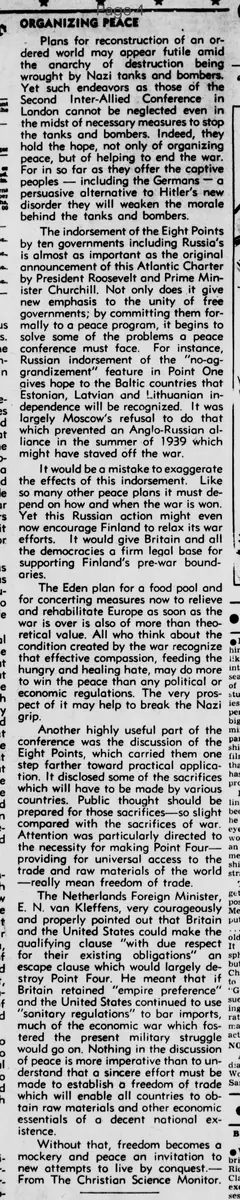
Plans for reconstruction of an ordered world may appear futile amid the anarchy of destruction being wrought by Nazi tanks and bombers. Yet such endeavors as those of the Second Inter-Allied Conference in London cannot be neglected even in the midst of necessary measures to stop the tanks and bombers. Indeed, they hold the hope, not only of organizing peace, but of helping to end the war. For in so far as they offer the captive peoples -- including the Germans -- a persuasive alternative to Hitler's new disorder they will weaken the morale behind the tanks and bombers.
The indorsement of the Eight Points by ten governments including Russia's is almost as important as the original announcement of this Atlantic Charter by President Roosevelt and Prime Minister Churchill. Not only does it give new emphasis to the unity of free governments; by committing them formally to a peace program, it begins to solve some of the problems a peace conference must face. For instance Russian indorsement of the "no aggrandizement" feature in Point One gives hope to the Baltic countries that Estonian, Latvian and Lithuanian independence will be recognized. It was largely Moscow's refusal to do that which prevented an Anglo-Russian alliance in the summer of 1939 which might have staved off the war.
It would be a mistake to exaggerate the effects of this indorsement. Like so many other peace plans it must depend on how and when the war is won. Yet this Russian action might even now encourage Finland to relax its war efforts. It would give Britain and all the democracies a firm legal base for supporting Finland's pre-war boundaries.
The Eden plan for a food pool and for concerting measures now to relieve and rehabilitate Europe as soon as the war is over is also of more than theoretical value. All who think about the condition created by the war recognize that effective compassion, feeding the hungry and healing hate, may do more to win the peace than any political or economic regulations. The very prospect of it may help to break the Nazi grip.
Another highly useful part of the conference was the discussion of the Eight Points, which carried them one step farther toward practical application. It disclosed some of the sacrifices which will have to be made by various countries. Public thought should be prepared for those sacrifices -- so slight compared with the sacrifices of war.
Attention was particularly directed to the necessity for making Point Four -- providing for universal access to the trade and raw materials of the world -- really mean freedom of trade.
The Netherlands Foreign Minister, E. N. van Kleffens, very courageously and properly pointed out that Britain and the United States could make the qualifying clause "with due respect for their existing obligations" an escape clause which would largely destroy Point Four. He meant that if Britain retained "empire preference" and the United States continued to use "sanitary regulations" to bar imports, much of the economic war which fostered the present military struggle would go on. Nothing in the discussion of peace is more imperative than to understand that a sincere effort must be made to establish a freedom of trade which will enable all countries to obtain raw materials and other economic essentials of a decent national existence.
Without that, freedom becomes a mockery and peace an invitation to new attempts to live by conquest.
From The Christian Science Monitor.
Plans for reconstruction of an ordered world may appear futile amid the anarchy of destruction being wrought by Nazi tanks and bombers. Yet such endeavors as those of the Second Inter-Allied Conference in London cannot be neglected even in the midst of necessary measures to stop the tanks and bombers. Indeed, they hold the hope, not only of organizing peace, but of helping to end the war. For in so far as they offer the captive peoples -- including the Germans -- a persuasive alternative to Hitler's new disorder they will weaken the morale behind the tanks and bombers.
The indorsement of the Eight Points by ten governments including Russia's is almost as important as the original announcement of this Atlantic Charter by President Roosevelt and Prime Minister Churchill. Not only does it give new emphasis to the unity of free governments; by committing them formally to a peace program, it begins to solve some of the problems a peace conference must face. For instance Russian indorsement of the "no aggrandizement" feature in Point One gives hope to the Baltic countries that Estonian, Latvian and Lithuanian independence will be recognized. It was largely Moscow's refusal to do that which prevented an Anglo-Russian alliance in the summer of 1939 which might have staved off the war.
It would be a mistake to exaggerate the effects of this indorsement. Like so many other peace plans it must depend on how and when the war is won. Yet this Russian action might even now encourage Finland to relax its war efforts. It would give Britain and all the democracies a firm legal base for supporting Finland's pre-war boundaries.
The Eden plan for a food pool and for concerting measures now to relieve and rehabilitate Europe as soon as the war is over is also of more than theoretical value. All who think about the condition created by the war recognize that effective compassion, feeding the hungry and healing hate, may do more to win the peace than any political or economic regulations. The very prospect of it may help to break the Nazi grip.
Another highly useful part of the conference was the discussion of the Eight Points, which carried them one step farther toward practical application. It disclosed some of the sacrifices which will have to be made by various countries. Public thought should be prepared for those sacrifices -- so slight compared with the sacrifices of war.
Attention was particularly directed to the necessity for making Point Four -- providing for universal access to the trade and raw materials of the world -- really mean freedom of trade.
The Netherlands Foreign Minister, E. N. van Kleffens, very courageously and properly pointed out that Britain and the United States could make the qualifying clause "with due respect for their existing obligations" an escape clause which would largely destroy Point Four. He meant that if Britain retained "empire preference" and the United States continued to use "sanitary regulations" to bar imports, much of the economic war which fostered the present military struggle would go on. Nothing in the discussion of peace is more imperative than to understand that a sincere effort must be made to establish a freedom of trade which will enable all countries to obtain raw materials and other economic essentials of a decent national existence.
Without that, freedom becomes a mockery and peace an invitation to new attempts to live by conquest.
From The Christian Science Monitor.
What sub-type of article is it?
War Or Peace
Foreign Affairs
Economic Policy
What keywords are associated?
Atlantic Charter
Inter Allied Conference
Russian Endorsement
Post War Reconstruction
Freedom Of Trade
Eden Plan
Baltic Independence
Nazi Morale
What entities or persons were involved?
Second Inter Allied Conference
President Roosevelt
Prime Minister Churchill
Russia
Baltic Countries
Finland
Eden
E. N. Van Kleffens
Britain
United States
Nazi
Hitler
Editorial Details
Primary Topic
Endorsement Of Atlantic Charter And Plans For Post War Reconstruction
Stance / Tone
Supportive And Hopeful Of Allied Peace Efforts
Key Figures
Second Inter Allied Conference
President Roosevelt
Prime Minister Churchill
Russia
Baltic Countries
Finland
Eden
E. N. Van Kleffens
Britain
United States
Nazi
Hitler
Key Arguments
Peace Plans Like The Atlantic Charter Weaken Enemy Morale By Offering Alternatives To Hitler's Disorder.
Endorsement By Ten Governments, Including Russia, Emphasizes Unity And Addresses Post War Issues Like Baltic Independence.
Russian Endorsement May Encourage Finland To End War Efforts And Support Pre War Boundaries.
Eden's Food Pool Plan Provides Practical Relief And Rehabilitation For Europe, Aiding Peace.
Discussion Of Eight Points Highlights Necessary Sacrifices And True Freedom Of Trade Under Point Four.
Britain And Us Must Avoid Escape Clauses To Ensure Genuine Access To Trade And Raw Materials.
Without Free Trade, Peace Invites Future Conquests.