Thank you for visiting SNEWPapers!
Sign up free
The Bloomfield Times
New Bloomfield, Perry County, Pennsylvania
What is this article about?
Historical account of the Continental Navy's origins during the Revolution: first vessels from Rhode Island and Massachusetts in 1775-76, Congress's commission, early battles, flags like the rattlesnake 'Don't Tread on Me,' and Paul Jones's exploits. Officers were practical, not showy. (248 characters)
Clipping
OCR Quality
Full Text
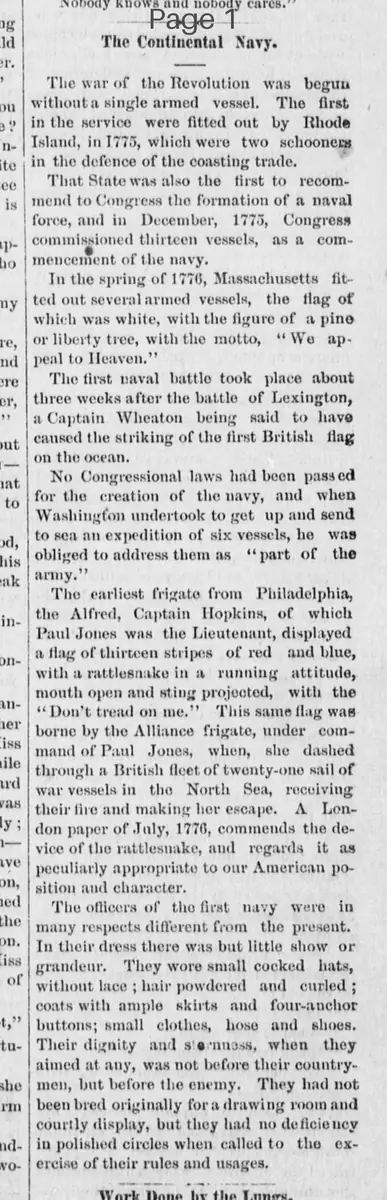
The war of the Revolution was begun without a single armed vessel. The first in the service were fitted out by Rhode Island, in 1775, which were two schooners in the defence of the coasting trade. That State was also the first to recommend to Congress the formation of a naval force, and in December, 1775, Congress commissioned thirteen vessels, as a commencement of the navy.
In the spring of 1776, Massachusetts fitted out several armed vessels, the flag of which was white, with the figure of a pine or liberty tree, with the motto, "We appeal to Heaven."
The first naval battle took place about three weeks after the battle of Lexington, a Captain Wheaton being said to have caused the striking of the first British flag on the ocean.
No Congressional laws had been passed for the creation of the navy, and when Washington undertook to get up and send to sea an expedition of six vessels, he was obliged to address them as "part of the army."
The earliest frigate from Philadelphia, the Alfred, Captain Hopkins, of which Paul Jones was the Lieutenant, displayed a flag of thirteen stripes of red and blue, with a rattlesnake in a running attitude, mouth open and sting projected, with the "Don't tread on me." This same flag was borne by the Alliance frigate, under command of Paul Jones, when she dashed through a British fleet of twenty-one sail of war vessels in the North Sea, receiving their fire and making her escape. A London paper of July, 1776, commends the device of the rattlesnake, and regards it as peculiarly appropriate to our American position and character.
The officers of the first navy were in many respects different from the present. In their dress there was but little show or grandeur. They wore small cocked hats, without lace; hair powdered and curled; coats with ample skirts and four-anchor buttons; small clothes, hose and shoes. Their dignity and sleekness, when they aimed at any, was not before their countrymen, but before the enemy. They had not been bred originally for a drawing room and courtly display, but they had no deficiency in polished circles when called to the exercise of their rules and usages.
What sub-type of article is it?
What themes does it cover?
What keywords are associated?
What entities or persons were involved?
Where did it happen?
Story Details
Key Persons
Location
Rhode Island, Massachusetts, Philadelphia, North Sea, Ocean
Event Date
1775 1776
Story Details
The Continental Navy began without armed vessels; Rhode Island fitted out the first schooners in 1775. Congress commissioned thirteen vessels in December 1775. Massachusetts armed vessels in spring 1776 with a pine tree flag. First naval battle followed Lexington, with Captain Wheaton striking a British flag. Washington sent six vessels as army part. Frigate Alfred under Hopkins with Paul Jones as lieutenant flew rattlesnake flag. Alliance under Paul Jones escaped British fleet in North Sea. Early officers dressed simply.