Thank you for visiting SNEWPapers!
Sign up free
Norfolk Gazette And Publick Ledger
Norfolk, Virginia
What is this article about?
In the District Court of Pennsylvania on January 12, 1810, Jabez Colt was tried and found guilty of violating the 1807-1808 embargo acts by engaging in a prohibited foreign voyage as supercargo of the brig Concord. The jury assessed a $4,000 penalty.
Clipping
OCR Quality
Full Text
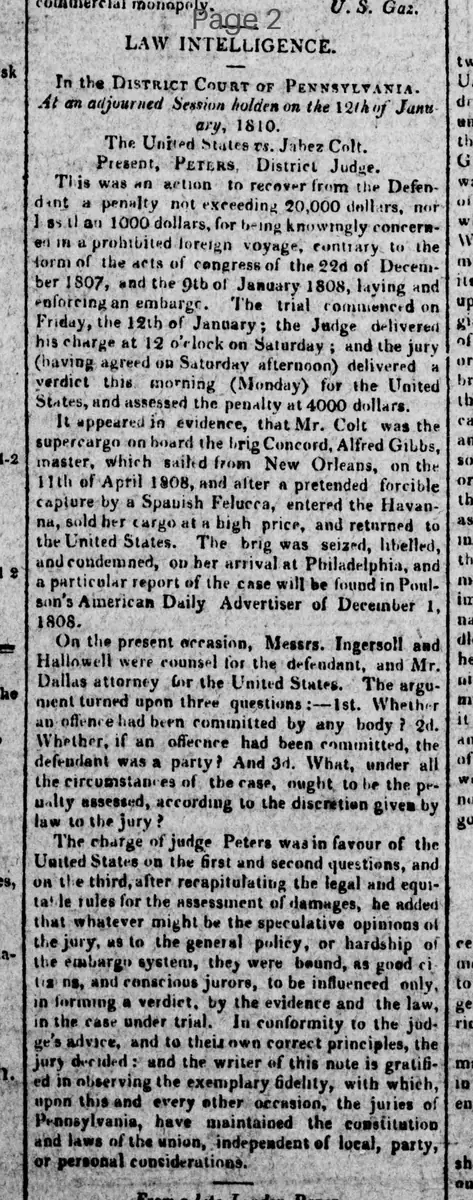
In the District Court of Pennsylvania.
At an adjourned Session holden on the 12th of January, 1810.
The United States vs. Jabez Colt.
Present, Peters, District Judge.
This was an action to recover from the Defendant a penalty not exceeding 20,000 dollars, nor less than 1000 dollars, for being knowingly concerned in a prohibited foreign voyage, contrary to the form of the acts of congress of the 22d of December 1807, and the 9th of January 1808, laying and enforcing an embargo. The trial commenced on Friday, the 12th of January; the Judge delivered his charge at 12 o'clock on Saturday; and the jury (having agreed on Saturday afternoon) delivered a verdict this morning (Monday) for the United States, and assessed the penalty at 4000 dollars.
It appeared in evidence, that Mr. Colt was the supercargo on board the brig Concord, Alfred Gibbs, master, which sailed from New Orleans, on the 11th of April 1808, and after a pretended forcible capture by a Spanish Felucca, entered the Havana, sold her cargo at a high price, and returned to the United States. The brig was seized, libelled, and condemned, on her arrival at Philadelphia, and a particular report of the case will be found in Poulson's American Daily Advertiser of December 1, 1808.
On the present occasion, Messrs. Ingersoll and Hallowell were counsel for the defendant, and Mr. Dallas attorney for the United States. The argument turned upon three questions:—1st. Whether an offence had been committed by any body? 2d. Whether, if an offence had been committed, the defendant was a party? And 3d. What, under all the circumstances of the case, ought to be the penalty assessed, according to the discretion given by law to the jury?
The charge of judge Peters was in favour of the United States on the first and second questions, and on the third, after recapitulating the legal and equitable rules of the assessment of damages, he added that whatever might be the speculative opinions of the jury, as to the general policy, or hardship of the embargo system, they were bound, as good citizens, and conscientious jurors, to be influenced only, in forming a verdict, by the evidence and the law, in the case under trial. In conformity to the judge's advice, and to their own correct principles, the jury decided: and the writer of this note is gratified in observing the exemplary fidelity, with which, upon this and every other occasion, the juries of Pennsylvania, have maintained the constitution and laws of the union, independent of local, party, or personal considerations.
What sub-type of article is it?
What keywords are associated?
What entities or persons were involved?
Where did it happen?
Domestic News Details
Primary Location
Pennsylvania
Event Date
12th Of January, 1810
Key Persons
Outcome
verdict for the united states, penalty assessed at 4000 dollars
Event Details
Action to recover penalty for knowingly concerned in prohibited foreign voyage contrary to embargo acts. Trial commenced January 12, 1810; verdict on following Monday. Evidence: Colt supercargo on brig Concord from New Orleans April 11, 1808, pretended capture, entered Havana, sold cargo, returned; brig condemned in Philadelphia. Arguments on offense, participation, penalty. Judge charged in favor of US on first two points, advised on third.