Thank you for visiting SNEWPapers!
Sign up free
Letter to Editor
March 9, 1782
The New Hampshire Gazette And General Advertiser
Portsmouth, Exeter, Rockingham County, New Hampshire
What is this article about?
A correspondent relays a discovery by Baron Munchhausen to Professor Linnaeus explaining smut in wheat as caused by minute insect eggs, observed via microscope, and recommends preventing it by using clean seed or treating with sea salt and lime lye to destroy the eggs.
Clipping
OCR Quality
95%
Excellent
Full Text
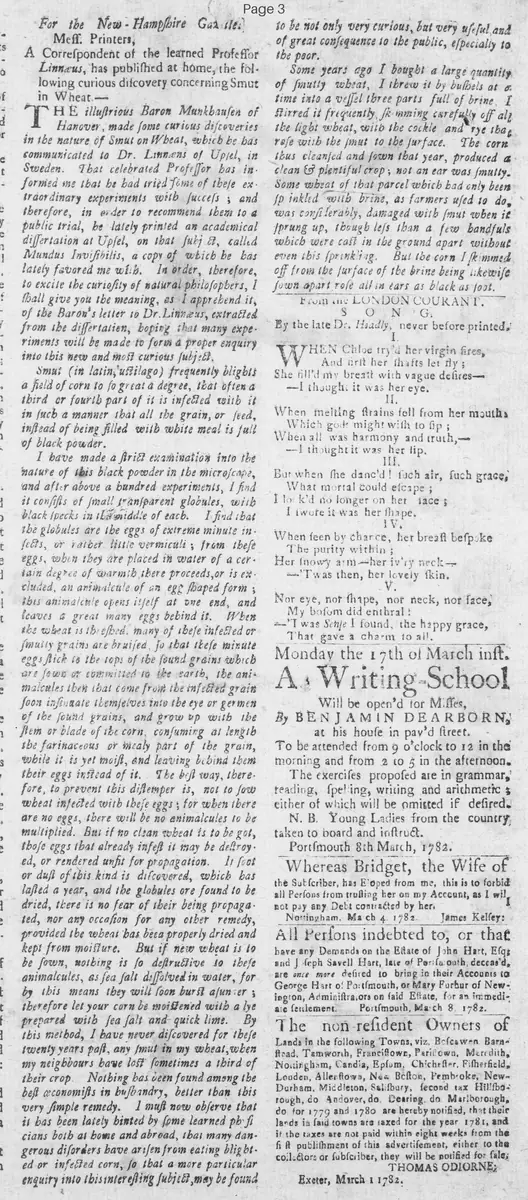
For the New-Hampshire Gazette:
Mess. Printers,
A Correspondent of the learned Professor Linnaeus, has published at home, the following curious discovery concerning Smut in Wheat.
THE illustrious Baron Munchhausen of Hanover, made some curious discoveries in the nature of Smut on Wheat, which he has communicated to Dr. Linnaeus of Upsal, in Sweden. That celebrated Professor has informed me that he had tried some of these extraordinary experiments with success; and therefore, in order to recommend them to public trial, he lately printed an academical dissertation at Upsal, on that subject, called Mundus Invisibilis, a copy of which he has lately favored me with. In order, therefore, to excite the curiosity of natural philosophers, I shall give you the meaning, as I apprehend it, of the Baron's letter to Dr. Linnaeus, extracted from the dissertation, hoping that many experiments will be made to form a proper enquiry into this very and most curious subject.
Smut (in latin, ustilago) frequently blights a field of corn to so great a degree, that often a third or fourth part of it is infected with it in such a manner that all the grain, or seed, instead of being filled with white meal is full of black powder.
I have made a strict examination into the nature of this black powder in the microscope, and after above a hundred experiments, I find it consists of small transparent globules, with black specks in the middle of each. I find that the globules are the eggs of extreme minute insects, or rather little vermiculi: from these eggs, when they are placed in water of a certain degree of warmth there proceeds, or is excluded, an animalcule of an egg shaped form:
this animalcule opens itself at one end, and leaves a great many eggs behind it. When the wheat is threshed, many of these infected or smutty grains are bruised, so that these minute eggs stick to the tops of the sound grains which are sowed or committed to the earth, the animalcules then that come from the infected grain soon insinuate themselves into the eye or germen of the sound grains, and grow up with the stem or blade of the corn, consuming at length the farinaceous or mealy part of the grain, while it is yet moist, and leaving behind them their eggs instead of it. The best way, therefore, to prevent this distemper is, not to sow wheat infected with these eggs: for when there are no eggs, there will be no animalcules to be multiplied. But if no clean wheat is to be got, those eggs that already infect it may be destroyed, or rendered unfit for propagation. If soot or dust of this kind is discovered, which has lasted a year, and the globules are found to be dried, there is no fear of their being propagated, nor any occasion for any other remedy, provided the wheat has been properly dried and kept from moisture. But if new wheat is to be sown, nothing is so destructive to these animalcules, as sea salt dissolved in water, for by this means they will soon burst asunder; therefore let your corn be moistened with a lye prepared with sea salt and quick lime. By this method, I have never discovered for these twenty years past, any smut in my wheat, when my neighbours have lost sometimes a third of their crop. Nothing has been found among the best economists in husbandry, better than this very simple remedy. I must now observe that it has been lately hinted by some learned physicians both at home and abroad, that many dangerous disorders have arisen from eating blighted or infected corn, so that a more particular enquiry into this interesting subject, may be found
Mess. Printers,
A Correspondent of the learned Professor Linnaeus, has published at home, the following curious discovery concerning Smut in Wheat.
THE illustrious Baron Munchhausen of Hanover, made some curious discoveries in the nature of Smut on Wheat, which he has communicated to Dr. Linnaeus of Upsal, in Sweden. That celebrated Professor has informed me that he had tried some of these extraordinary experiments with success; and therefore, in order to recommend them to public trial, he lately printed an academical dissertation at Upsal, on that subject, called Mundus Invisibilis, a copy of which he has lately favored me with. In order, therefore, to excite the curiosity of natural philosophers, I shall give you the meaning, as I apprehend it, of the Baron's letter to Dr. Linnaeus, extracted from the dissertation, hoping that many experiments will be made to form a proper enquiry into this very and most curious subject.
Smut (in latin, ustilago) frequently blights a field of corn to so great a degree, that often a third or fourth part of it is infected with it in such a manner that all the grain, or seed, instead of being filled with white meal is full of black powder.
I have made a strict examination into the nature of this black powder in the microscope, and after above a hundred experiments, I find it consists of small transparent globules, with black specks in the middle of each. I find that the globules are the eggs of extreme minute insects, or rather little vermiculi: from these eggs, when they are placed in water of a certain degree of warmth there proceeds, or is excluded, an animalcule of an egg shaped form:
this animalcule opens itself at one end, and leaves a great many eggs behind it. When the wheat is threshed, many of these infected or smutty grains are bruised, so that these minute eggs stick to the tops of the sound grains which are sowed or committed to the earth, the animalcules then that come from the infected grain soon insinuate themselves into the eye or germen of the sound grains, and grow up with the stem or blade of the corn, consuming at length the farinaceous or mealy part of the grain, while it is yet moist, and leaving behind them their eggs instead of it. The best way, therefore, to prevent this distemper is, not to sow wheat infected with these eggs: for when there are no eggs, there will be no animalcules to be multiplied. But if no clean wheat is to be got, those eggs that already infect it may be destroyed, or rendered unfit for propagation. If soot or dust of this kind is discovered, which has lasted a year, and the globules are found to be dried, there is no fear of their being propagated, nor any occasion for any other remedy, provided the wheat has been properly dried and kept from moisture. But if new wheat is to be sown, nothing is so destructive to these animalcules, as sea salt dissolved in water, for by this means they will soon burst asunder; therefore let your corn be moistened with a lye prepared with sea salt and quick lime. By this method, I have never discovered for these twenty years past, any smut in my wheat, when my neighbours have lost sometimes a third of their crop. Nothing has been found among the best economists in husbandry, better than this very simple remedy. I must now observe that it has been lately hinted by some learned physicians both at home and abroad, that many dangerous disorders have arisen from eating blighted or infected corn, so that a more particular enquiry into this interesting subject, may be found
What sub-type of article is it?
Informative
What themes does it cover?
Science Nature
Agriculture
What keywords are associated?
Smut In Wheat
Insect Eggs
Linnaeus
Baron Munchhausen
Sea Salt Remedy
Agricultural Discovery
Microscope Experiments
What entities or persons were involved?
Mess. Printers
Letter to Editor Details
Recipient
Mess. Printers
Main Argument
smut in wheat is caused by eggs of minute insects that develop into animalcules destroying the grain; prevent by using clean seed or treating infected wheat with a lye of sea salt and quick lime to kill the eggs.
Notable Details
Microscope Examination Revealing Globules As Insect Eggs
Reference To Baron Munchhausen's Letter To Dr. Linnaeus
Linnaeus's Dissertation 'Mundus Invisibilis'
Warning Of Health Risks From Eating Infected Corn