Thank you for visiting SNEWPapers!
Sign up free
Story
February 22, 1788
The New York Journal, And Daily Patriotic Register
New York, New York County, New York
What is this article about?
In the Massachusetts Ratifying Convention on January 22, Mr. Symmes delivers a speech critiquing Section 8 of Article I of the proposed U.S. Constitution, arguing against granting Congress unlimited taxing powers, warning of factionalism, abuse, and potential tyranny on future generations.
Clipping
OCR Quality
95%
Excellent
Full Text
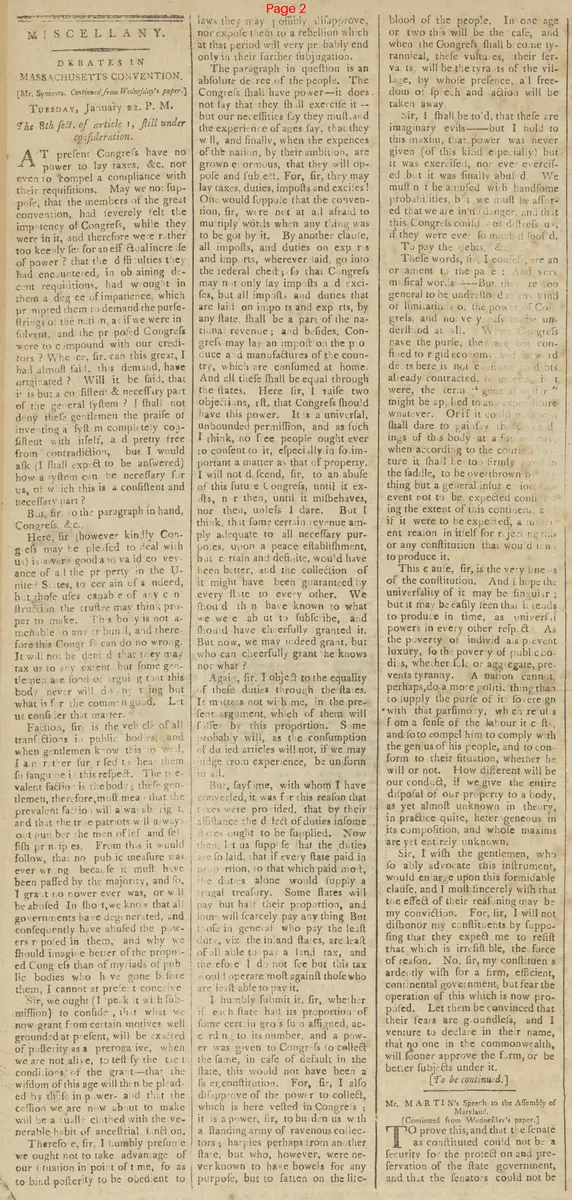
MISCELLANY
DEBATES
MASSACHUSETTS CONVENTION
[Mr. Symmes. Continued from Wednesday's paper.]
TUESDAY, January 22. P. M.
The 8th sect. of article I, under consideration.
The present Congress have no power to lay taxes, &c. nor even to compel a compliance with their requisitions. May we not suppose, that the members of the great convention, had severely felt the impotency of Congress, while they were in it, and therefore were rather too keenly for an effectual increase of power? that the difficulties they had encountered, in obtaining decent requisitions, had wrought in them a degree of impatience, which prompted them to demand the pursestrings of the nation, as if we were insolvent, and the proposed Congress were to compound with our creditors? Whence, sir, can this great, I had almost said, this demand, have originated? Will it be said, that it is but a consistent & necessary part of the general system? I shall not deny these gentlemen the praise of inventing a system completely consistent with itself, and pretty free from contradiction, but I would ask (I shall expect to be answered) how a system can be necessary for us, of which this is a consistent and necessary part?
But, sir, to the paragraph in hand, Congress, &c.
Here, sir (however kindly Congress may be pleased to deal with us) is a very good and valid conveyance of all the property in the United States, to certain uses indeed, but those uses capable of any construction the trustees may think proper to make. This body is not amenable to any tribunal, and therefore this Congress can do no wrong.
It will not be denied that they may tax us to any extent, but some gentlemen are fond of arguing that this body never will do anything but what is for the common good. Let us consider that matter.
Faction, sir, is the vehicle of all transactions in public bodies, and when gentlemen know this, I am rather surprised to hear them so sanguine in this respect. The prevalent faction is the body; these gentlemen, therefore, must mean that the prevalent faction will always be right, and that the true patriots will always outnumber the men of selfish principles. From this it would follow, that no public measure was ever wrong because it must have been passed by the majority, and so, I grant no power ever was, or will be abused. In short, we know that all governments have degenerated, and consequently have abused the powers reposed in them, and why we should imagine better of the proposed Congress than of myriads of public bodies who have gone before them, I cannot at present conceive.
Sir, we ought (I speak it with submission) to consider, that what we now grant from certain motives well grounded at present, will be exacted of posterity as a prerogative, when we are not alive, to testify the fact conditions of the grant that the wisdom of this age will then be paled by those in power- and that the cession we are now about to make will be as fully clothed with the venerable habit of ancestral sanction.
Therefore, sir, I humbly presume we ought not to take advantage of our situation in point of time, so as to bind posterity to be obedient to laws they may justly disapprove, nor expose them to a rebellion which at that period will very probably end only in their further subjugation.
The paragraph in question is an absolute decree of the people. The Congress shall have power- it does not say that they shall exercise it -- but our necessities say they must, and the experience of ages say, that they will, and finally, when the expenses of the nation, by their ambition, are grown enormous, that they will oppress and subjugate. For, sir, they may lay taxes, duties, imposts and excises!
One would suppose that the convention, sir, were not at all afraid to multiply words when anything was to be got by it. By another clause, all imposts, and duties on exports and imports, wherever laid, go into the federal chest: so that Congress may not only lay imposts and excises, but all impost and duties that are laid on imports and exports, by any state, shall be a part of the national revenue; and besides, Congress may lay an impost on the produce and manufactures of the country, which are consumed at home.
And all these shall be equal through the states. Here sir, I raise two objections. 1st. that Congress should have this power. It is a universal, unbounded permission, and as such I think, no free people ought ever to consent to it, especially in so important a matter as that of property.
I will not descend, sir, to an abuse of this future Congress, until it exists, nor then, until it misbehaves, nor then, unless I dare. But I think, that some certain revenue amply adequate to all necessary purposes, upon a peace establishment, but certain and definite, would have been better, and the collection of it might have been guaranteed by every state to every other. We should then have known to what we were about to subscribe, and should have cheerfully granted it.
But now, we may indeed grant, but who can cheerfully grant he knows not what?
Again, sir, I object to the equality of these duties through the states. It matters not with me, in the present argument, which of them will suffer by this proportion. Some probably will, as the consumption of dutied articles will not, if we may judge from experience, be uniform in all.
But, say me, with whom I have conversed, it was for this reason that direct taxes were provided, that by their assistance the defect of duties in some states ought to be supplied. Now then, let us suppose that the duties are so laid, that if every state paid in proportion, to that which paid most, the duties alone would supply a frugal treasury. Some states will pay but half their proportion, and some will scarcely pay anything. But those in general who pay the least duty, viz the inland states, are least of all able to pay a land tax, and therefore I do not see but this tax would operate most against those who are least able to pay it.
I humbly submit it, sir, whether if each state had its proportion of some certain gross sum assigned, according to its number, and a power was given to Congress to call for the same, in case of default in the state, this would not have been a safer constitution. For, sir, I also disapprove of the power to collect, which is here vested in Congress; it is a power, sir, to burden us with a standing army of ravenous collectors; harpies perhaps from another state, but who, however, were never known to have bowels for any purpose, but to fatten on the life-blood of the people. In one age or two this will be the case, and when the Congress shall become tyrannical, these vultures, their servants, will be the tyrants of the village, by whose presence, all freedom of speech and action will be taken away.
Sir, I shall be told, that these are imaginary evils—but I hold to this maxim, that power was never given (of this kind especially) but it was exercised, nor ever exercised but it was finally abused. We must not be amused with handsome probabilities, but we must be assured that we are in no danger, and that this Congress could not distress us, if they were ever so much disposed.
To pay the debts, &c.
These words, sir, I confess, are an ornament to the page: And very magical words -But they are too general to be understood as any kind of limitations of the power of Congress, and no very easy to be understood at all. When Congress have the purse, these not confined to rigid economy and low wages, debts here is not confined to debts already contracted, or indeed if it were, the term general will for 'debts' might be applied to an expenditure whatever. Or if it could now shall dare to gainsay the doings of this body at a future day, when according to the course of nature it shall be too firmly fixed in the saddle, to be overthrown by anything but a general insurrection event not to be expected considering the extent of this continent. as if it were to be expected, a sufficient reason in itself for rejecting this or any constitution that would tend to produce it.
This clause, sir, is the very sinews of the constitution. And I hope the universality of it may be singular; but it may be easily seen that it tends to produce in time, as universal powers in every other respect. As the poverty of individuals prevents luxury, so the poverty of public bodies, whether single or aggregate, prevents tyranny. A nation cannot, perhaps, do a more politic thing than to supply the purse of its sovereign with that parsimony, which results from a sense of the labour it costs.. and to compel him to comply with the genius of his people, and to conform to their situation, whether he will or not. How different will be our conduct, if we give the entire disposal of our property to a body, as yet almost unknown in theory. in practice quite, heterogeneous in its composition, and whose maxims are yet entirely unknown.
Sir, I wish the gentlemen, who so ably advocate this instrument, would enlarge upon this formidable clause, and I most sincerely wish that the effect of their reasoning may be my conviction. For, sir, I will not dishonor my constituents by supposing that they expect me to resist that which is irresistible, the force of reason. No, sir, my constituents ardently wish for a firm, efficient, continental government, but fear the operation of this which is now proposed. Let them be convinced that their fears are groundless, and I venture to declare in their name, that no one in the commonwealth. will sooner approve the form, or be better subjects under it.
[To be continued.]
DEBATES
MASSACHUSETTS CONVENTION
[Mr. Symmes. Continued from Wednesday's paper.]
TUESDAY, January 22. P. M.
The 8th sect. of article I, under consideration.
The present Congress have no power to lay taxes, &c. nor even to compel a compliance with their requisitions. May we not suppose, that the members of the great convention, had severely felt the impotency of Congress, while they were in it, and therefore were rather too keenly for an effectual increase of power? that the difficulties they had encountered, in obtaining decent requisitions, had wrought in them a degree of impatience, which prompted them to demand the pursestrings of the nation, as if we were insolvent, and the proposed Congress were to compound with our creditors? Whence, sir, can this great, I had almost said, this demand, have originated? Will it be said, that it is but a consistent & necessary part of the general system? I shall not deny these gentlemen the praise of inventing a system completely consistent with itself, and pretty free from contradiction, but I would ask (I shall expect to be answered) how a system can be necessary for us, of which this is a consistent and necessary part?
But, sir, to the paragraph in hand, Congress, &c.
Here, sir (however kindly Congress may be pleased to deal with us) is a very good and valid conveyance of all the property in the United States, to certain uses indeed, but those uses capable of any construction the trustees may think proper to make. This body is not amenable to any tribunal, and therefore this Congress can do no wrong.
It will not be denied that they may tax us to any extent, but some gentlemen are fond of arguing that this body never will do anything but what is for the common good. Let us consider that matter.
Faction, sir, is the vehicle of all transactions in public bodies, and when gentlemen know this, I am rather surprised to hear them so sanguine in this respect. The prevalent faction is the body; these gentlemen, therefore, must mean that the prevalent faction will always be right, and that the true patriots will always outnumber the men of selfish principles. From this it would follow, that no public measure was ever wrong because it must have been passed by the majority, and so, I grant no power ever was, or will be abused. In short, we know that all governments have degenerated, and consequently have abused the powers reposed in them, and why we should imagine better of the proposed Congress than of myriads of public bodies who have gone before them, I cannot at present conceive.
Sir, we ought (I speak it with submission) to consider, that what we now grant from certain motives well grounded at present, will be exacted of posterity as a prerogative, when we are not alive, to testify the fact conditions of the grant that the wisdom of this age will then be paled by those in power- and that the cession we are now about to make will be as fully clothed with the venerable habit of ancestral sanction.
Therefore, sir, I humbly presume we ought not to take advantage of our situation in point of time, so as to bind posterity to be obedient to laws they may justly disapprove, nor expose them to a rebellion which at that period will very probably end only in their further subjugation.
The paragraph in question is an absolute decree of the people. The Congress shall have power- it does not say that they shall exercise it -- but our necessities say they must, and the experience of ages say, that they will, and finally, when the expenses of the nation, by their ambition, are grown enormous, that they will oppress and subjugate. For, sir, they may lay taxes, duties, imposts and excises!
One would suppose that the convention, sir, were not at all afraid to multiply words when anything was to be got by it. By another clause, all imposts, and duties on exports and imports, wherever laid, go into the federal chest: so that Congress may not only lay imposts and excises, but all impost and duties that are laid on imports and exports, by any state, shall be a part of the national revenue; and besides, Congress may lay an impost on the produce and manufactures of the country, which are consumed at home.
And all these shall be equal through the states. Here sir, I raise two objections. 1st. that Congress should have this power. It is a universal, unbounded permission, and as such I think, no free people ought ever to consent to it, especially in so important a matter as that of property.
I will not descend, sir, to an abuse of this future Congress, until it exists, nor then, until it misbehaves, nor then, unless I dare. But I think, that some certain revenue amply adequate to all necessary purposes, upon a peace establishment, but certain and definite, would have been better, and the collection of it might have been guaranteed by every state to every other. We should then have known to what we were about to subscribe, and should have cheerfully granted it.
But now, we may indeed grant, but who can cheerfully grant he knows not what?
Again, sir, I object to the equality of these duties through the states. It matters not with me, in the present argument, which of them will suffer by this proportion. Some probably will, as the consumption of dutied articles will not, if we may judge from experience, be uniform in all.
But, say me, with whom I have conversed, it was for this reason that direct taxes were provided, that by their assistance the defect of duties in some states ought to be supplied. Now then, let us suppose that the duties are so laid, that if every state paid in proportion, to that which paid most, the duties alone would supply a frugal treasury. Some states will pay but half their proportion, and some will scarcely pay anything. But those in general who pay the least duty, viz the inland states, are least of all able to pay a land tax, and therefore I do not see but this tax would operate most against those who are least able to pay it.
I humbly submit it, sir, whether if each state had its proportion of some certain gross sum assigned, according to its number, and a power was given to Congress to call for the same, in case of default in the state, this would not have been a safer constitution. For, sir, I also disapprove of the power to collect, which is here vested in Congress; it is a power, sir, to burden us with a standing army of ravenous collectors; harpies perhaps from another state, but who, however, were never known to have bowels for any purpose, but to fatten on the life-blood of the people. In one age or two this will be the case, and when the Congress shall become tyrannical, these vultures, their servants, will be the tyrants of the village, by whose presence, all freedom of speech and action will be taken away.
Sir, I shall be told, that these are imaginary evils—but I hold to this maxim, that power was never given (of this kind especially) but it was exercised, nor ever exercised but it was finally abused. We must not be amused with handsome probabilities, but we must be assured that we are in no danger, and that this Congress could not distress us, if they were ever so much disposed.
To pay the debts, &c.
These words, sir, I confess, are an ornament to the page: And very magical words -But they are too general to be understood as any kind of limitations of the power of Congress, and no very easy to be understood at all. When Congress have the purse, these not confined to rigid economy and low wages, debts here is not confined to debts already contracted, or indeed if it were, the term general will for 'debts' might be applied to an expenditure whatever. Or if it could now shall dare to gainsay the doings of this body at a future day, when according to the course of nature it shall be too firmly fixed in the saddle, to be overthrown by anything but a general insurrection event not to be expected considering the extent of this continent. as if it were to be expected, a sufficient reason in itself for rejecting this or any constitution that would tend to produce it.
This clause, sir, is the very sinews of the constitution. And I hope the universality of it may be singular; but it may be easily seen that it tends to produce in time, as universal powers in every other respect. As the poverty of individuals prevents luxury, so the poverty of public bodies, whether single or aggregate, prevents tyranny. A nation cannot, perhaps, do a more politic thing than to supply the purse of its sovereign with that parsimony, which results from a sense of the labour it costs.. and to compel him to comply with the genius of his people, and to conform to their situation, whether he will or not. How different will be our conduct, if we give the entire disposal of our property to a body, as yet almost unknown in theory. in practice quite, heterogeneous in its composition, and whose maxims are yet entirely unknown.
Sir, I wish the gentlemen, who so ably advocate this instrument, would enlarge upon this formidable clause, and I most sincerely wish that the effect of their reasoning may be my conviction. For, sir, I will not dishonor my constituents by supposing that they expect me to resist that which is irresistible, the force of reason. No, sir, my constituents ardently wish for a firm, efficient, continental government, but fear the operation of this which is now proposed. Let them be convinced that their fears are groundless, and I venture to declare in their name, that no one in the commonwealth. will sooner approve the form, or be better subjects under it.
[To be continued.]
What sub-type of article is it?
Historical Event
What themes does it cover?
Justice
Misfortune
Moral Virtue
What keywords are associated?
Constitution Debate
Taxing Power
Congress Authority
Factionalism
Tyranny Fears
Massachusetts Convention
What entities or persons were involved?
Mr. Symmes
Where did it happen?
Massachusetts Convention
Story Details
Key Persons
Mr. Symmes
Location
Massachusetts Convention
Event Date
Tuesday, January 22
Story Details
Mr. Symmes argues against the proposed Constitution's grant of unlimited taxing power to Congress, citing risks of factionalism, abuse of power, inequality in taxation across states, and potential tyranny, advocating instead for a certain and definite revenue system.