Thank you for visiting SNEWPapers!
Sign up free
Literary
May 30, 1789
Gazette Of The United States
New York, New York County, New York
What is this article about?
Continuation of a letter critiquing arguments for popular government without checks, using Roman history. Discusses triumvirates of Pompey-Caesar-Crassus and Augustus-Lepidus-Antony as examples of how unchecked power leads to tyranny. Argues for balanced government with Senate as check; refutes idea that making office burdensome ensures honest leaders, citing historical figures like Cincinnatus and Pericles.
Clipping
OCR Quality
95%
Excellent
Full Text
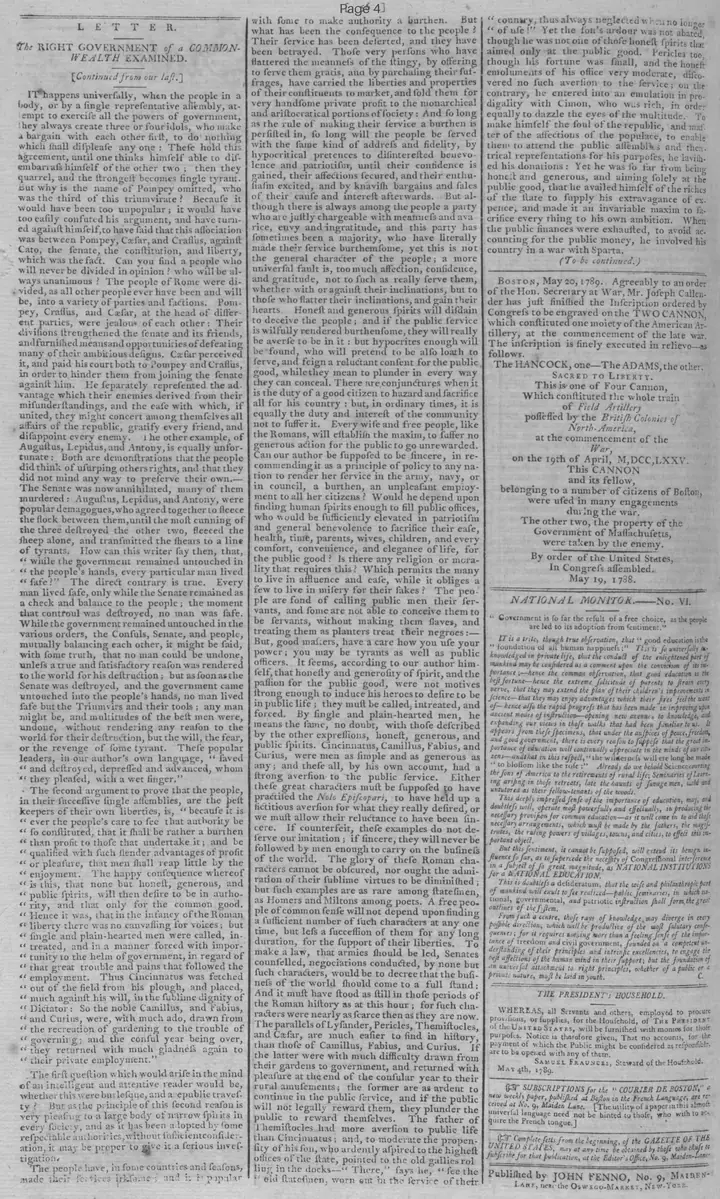
LETTER.
The RIGHT GOVERNMENT of a COMMONWEALTH EXAMINED.
[Continued from our last.]
IT happens universally, when the people in a body, or by a single representative assembly, attempt to exercise all the powers of government, they always create three or four idols, who make a bargain with each other first, to do nothing which shall displease any one: These hold this agreement, until one thinks himself able to disembarrass himself of the other two; then they quarrel, and the strongest becomes single tyrant.
But why is the name of Pompey omitted, who was the third of this triumvirate? Because it would have been too unpopular; it would have too easily confuted his argument, and have turned against himself, to have said that this association was between Pompey, Caesar, and Crassus, against Cato, the senate, the constitution, and liberty, which was the fact. Can you find a people who will never be divided in opinion? who will be always unanimous? The people of Rome were divided, as all other people ever have been and will be, into a variety of parties and factions. Pompey, Crassus, and Caesar, at the head of different parties, were jealous of each other: Their divisions strengthened the senate and its friends, and furnished means and opportunities of defeating many of their ambitious designs. Caesar perceived it, and paid his court both to Pompey and Crassus, in order to hinder them from joining the senate against him. He separately represented the advantage which their enemies derived from their misunderstandings, and the ease with which, if united, they might concert among themselves all affairs of the republic, gratify every friend, and disappoint every enemy. The other example, of Augustus, Lepidus, and Antony, is equally unfortunate: Both are demonstrations that the people did think of usurping others rights, and that they did not mind any way to preserve their own.—
The Senate was now annihilated, many of them murdered: Augustus, Lepidus, and Antony, were popular demagogues, who agreed together to fleece the flock between them, until the most cunning of the three destroyed the other two, fleeced the sheep alone, and transmitted the shears to a line of tyrants. How can this writer say then, that, "while the government remained untouched in the people's hands, every particular man lived safe?" The direct contrary is true. Every man lived safe, only while the Senate remained as a check and balance to the people; the moment that control was destroyed, no man was safe.
While the government remained untouched in the various orders, the Consuls, Senate, and people, mutually balancing each other, it might be said, with some truth, that no man could be undone, unless a true and satisfactory reason was rendered to the world for his destruction; but as soon as the Senate was destroyed, and the government came untouched into the people's hands, no man lived safe but the Triumvirs and their tools; any man might be, and multitudes of the best men were, undone, without rendering any reason to the world for their destruction, but the will, the fear, or the revenge of some tyrant. These popular leaders, in our author's own language, "saved and destroyed, depressed and advanced, whom they pleased, with a wet finger."
The second argument to prove that the people, in their successive single assemblies, are the best keepers of their own liberties, is, "because it is ever the people's care to see that authority be so constituted, that it shall be rather a burthen than profit to those that undertake it; and be qualified with such slender advantages of profit or pleasure, that men shall reap little by the enjoyment. The happy consequence whereof is this, that none but honest, generous, and public spirits, will then desire to be in authority, and that only for the common good.
Hence it was, that in the infancy of the Roman liberty there was no canvassing for voices; but single and plain-hearted men were called, entreated, and in a manner forced with importunity to the helm of government, in regard of that great trouble and pains that followed the employment. Thus Cincinnatus was fetched out of the field from his plough, and placed, much against his will, in the sublime dignity of Dictator: So the noble Camillus, and Fabius, and Curius, were, with much ado, drawn from the recreation of gardening to the trouble of governing; and the consul year being over, they returned with much gladness again to their private employment."
The first question which would arise in the mind of an intelligent and attentive reader would be, whether this were burlesque, and a republic travesty? But as the principle of this second reason is very pleasing to a large body of narrow spirits in every society, and as it has been adopted by some respectable authorities, without sufficient consideration, it may be proper to give it a serious investigation.
The people have, in some countries and seasons, made their services irksome; and it is popular with some to make authority a burthen. But what has been the consequence to the people? Their service has been deserted, and they have been betrayed. Those very persons who have flattered the meanness of the stingy, by offering to serve them gratis, and by purchasing their suffrages, have carried the liberties and properties of their constituents to market, and sold them for very handsome private profit to the monarchical and aristocratical portions of society: And so long as the rule of making their service a burthen is persisted in, so long will the people be served with the same kind of address and fidelity, by hypocritical pretences to disinterested benevolence and patriotism, until their confidence is gained, their affections secured, and their enthusiasm excited, and by knavish bargains and sales of their cause and interest afterwards. But although there is always among the people a party who are justly chargeable with meanness and avarice, envy and ingratitude, and this party has sometimes been a majority, who have literally made their service burthensome, yet this is not the general character of the people; a more universal fault is, too much affection, confidence, and gratitude, not to such as really serve them, whether with or against their inclinations, but to those who flatter their inclinations, and gain their hearts. Honest and generous spirits will disdain to deceive the people; and if the public service is wilfully rendered burthensome, they will really be averse to be in it: but hypocrites enough will be found, who will pretend to be also loath to serve, and feign a reluctant consent for the public good, while they mean to plunder in every way they can conceal. There are conjunctures when it is the duty of a good citizen to hazard and sacrifice all for his country: but, in ordinary times, it is equally the duty and interest of the community not to suffer it. Every wise and free people, like the Romans, will establish the maxim, to suffer no generous action for the public to go unrewarded.
Can our author be supposed to be sincere, in recommending it as a principle of policy to any nation to render her service in the army, navy, or in council, a burthen, an unpleasant employment to all her citizens? Would he depend upon finding human spirits enough to fill public offices, who would be sufficiently elevated in patriotism and general benevolence to sacrifice their ease, health, time, parents, wives, children, and every comfort, convenience, and elegance of life, for the public good? Is there any religion or morality that requires this? Which permits the many to live in affluence and ease, while it obliges a few to live in misery for their sakes? The people are fond of calling public men their servants, and some are not able to conceive them to be servants, without making them slaves, and treating them as planters treat their negroes:— But, good masters, have a care how you use your power; you may be tyrants as well as public officers. It seems, according to our author himself, that honesty and generosity of spirit, and the passion for the public good, were not motives strong enough to induce his heroes to desire to be in public life; they must be called, entreated, and forced. By single and plain-hearted men, he means the same, no doubt, with those described by the other expressions, honest, generous, and public spirits. Cincinnatus, Camillus, Fabius, and Curius, were men as simple and as generous as any; and these all, by his own account, had a strong aversion to the public service. Either these great characters must be supposed to have practised the Nolo Episcopari, to have held up a fictitious aversion for what they really desired, or we must allow their reluctance to have been sincere. If counterfeit, these examples do not deserve our imitation; if sincere, they will never be followed by men enough to carry on the business of the world. The glory of these Roman characters cannot be obscured, nor ought the admiration of their sublime virtues to be diminished; but such examples are as rare among statesmen, as Homers and Miltons among poets. A free people of common sense will not depend upon finding a sufficient number of such characters at any one time, but less a succession of them for any long duration, for the support of their liberties. To make a law, that armies should be led, Senates counselled, negotiations conducted, by none but such characters, would be to decree that the business of the world should come to a full stand: And it must have stood as still in those periods of the Roman history as at this hour; for such characters were nearly as scarce then as they are now.
The parallels of Lycurgus, Pericles, Themistocles, and Caesar, are much easier to find in history, than those of Camillus, Fabius, and Curius. If the latter were with much difficulty drawn from their gardens to government, and returned with pleasure at the end of the consular year to their rural amusements; the former are as ardent to continue in the public service, and if the public will not legally reward them, they plunder the public to reward themselves. The father of Themistocles had more aversion to public life than Cincinnatus; and, to moderate the propensity of his son, who ardently aspired to the highest offices of the state, pointed to the old galleys rolling in the docks—"There," says he, "see the old statesmen, worn out in the service of their
"country, thus always neglected when no longer
"of use!" Yet the son's ardour was not abated, though he was not one of those honest spirits that aimed only at the public good. Pericles too, though his fortune was small, and the honest emoluments of his office very moderate, discovered no such aversion to the service; on the contrary, he entered into an emulation in prodigality with Cimon, who was rich, in order equally to dazzle the eyes of the multitude. To make himself the soul of the republic, and master of the affections of the populace, to enable them to attend the public assemblies and theatrical representations for his purposes, he lavished his donations: Yet he was so far from being honest and generous, and aiming solely at the public good, that he availed himself of the riches of the state to supply his extravagance of expense, and made it an invariable maxim to sacrifice every thing to his own ambition. When the public finances were exhausted, to avoid accounting for the public money, he involved his country in a war with Sparta.
(To be continued.)
The RIGHT GOVERNMENT of a COMMONWEALTH EXAMINED.
[Continued from our last.]
IT happens universally, when the people in a body, or by a single representative assembly, attempt to exercise all the powers of government, they always create three or four idols, who make a bargain with each other first, to do nothing which shall displease any one: These hold this agreement, until one thinks himself able to disembarrass himself of the other two; then they quarrel, and the strongest becomes single tyrant.
But why is the name of Pompey omitted, who was the third of this triumvirate? Because it would have been too unpopular; it would have too easily confuted his argument, and have turned against himself, to have said that this association was between Pompey, Caesar, and Crassus, against Cato, the senate, the constitution, and liberty, which was the fact. Can you find a people who will never be divided in opinion? who will be always unanimous? The people of Rome were divided, as all other people ever have been and will be, into a variety of parties and factions. Pompey, Crassus, and Caesar, at the head of different parties, were jealous of each other: Their divisions strengthened the senate and its friends, and furnished means and opportunities of defeating many of their ambitious designs. Caesar perceived it, and paid his court both to Pompey and Crassus, in order to hinder them from joining the senate against him. He separately represented the advantage which their enemies derived from their misunderstandings, and the ease with which, if united, they might concert among themselves all affairs of the republic, gratify every friend, and disappoint every enemy. The other example, of Augustus, Lepidus, and Antony, is equally unfortunate: Both are demonstrations that the people did think of usurping others rights, and that they did not mind any way to preserve their own.—
The Senate was now annihilated, many of them murdered: Augustus, Lepidus, and Antony, were popular demagogues, who agreed together to fleece the flock between them, until the most cunning of the three destroyed the other two, fleeced the sheep alone, and transmitted the shears to a line of tyrants. How can this writer say then, that, "while the government remained untouched in the people's hands, every particular man lived safe?" The direct contrary is true. Every man lived safe, only while the Senate remained as a check and balance to the people; the moment that control was destroyed, no man was safe.
While the government remained untouched in the various orders, the Consuls, Senate, and people, mutually balancing each other, it might be said, with some truth, that no man could be undone, unless a true and satisfactory reason was rendered to the world for his destruction; but as soon as the Senate was destroyed, and the government came untouched into the people's hands, no man lived safe but the Triumvirs and their tools; any man might be, and multitudes of the best men were, undone, without rendering any reason to the world for their destruction, but the will, the fear, or the revenge of some tyrant. These popular leaders, in our author's own language, "saved and destroyed, depressed and advanced, whom they pleased, with a wet finger."
The second argument to prove that the people, in their successive single assemblies, are the best keepers of their own liberties, is, "because it is ever the people's care to see that authority be so constituted, that it shall be rather a burthen than profit to those that undertake it; and be qualified with such slender advantages of profit or pleasure, that men shall reap little by the enjoyment. The happy consequence whereof is this, that none but honest, generous, and public spirits, will then desire to be in authority, and that only for the common good.
Hence it was, that in the infancy of the Roman liberty there was no canvassing for voices; but single and plain-hearted men were called, entreated, and in a manner forced with importunity to the helm of government, in regard of that great trouble and pains that followed the employment. Thus Cincinnatus was fetched out of the field from his plough, and placed, much against his will, in the sublime dignity of Dictator: So the noble Camillus, and Fabius, and Curius, were, with much ado, drawn from the recreation of gardening to the trouble of governing; and the consul year being over, they returned with much gladness again to their private employment."
The first question which would arise in the mind of an intelligent and attentive reader would be, whether this were burlesque, and a republic travesty? But as the principle of this second reason is very pleasing to a large body of narrow spirits in every society, and as it has been adopted by some respectable authorities, without sufficient consideration, it may be proper to give it a serious investigation.
The people have, in some countries and seasons, made their services irksome; and it is popular with some to make authority a burthen. But what has been the consequence to the people? Their service has been deserted, and they have been betrayed. Those very persons who have flattered the meanness of the stingy, by offering to serve them gratis, and by purchasing their suffrages, have carried the liberties and properties of their constituents to market, and sold them for very handsome private profit to the monarchical and aristocratical portions of society: And so long as the rule of making their service a burthen is persisted in, so long will the people be served with the same kind of address and fidelity, by hypocritical pretences to disinterested benevolence and patriotism, until their confidence is gained, their affections secured, and their enthusiasm excited, and by knavish bargains and sales of their cause and interest afterwards. But although there is always among the people a party who are justly chargeable with meanness and avarice, envy and ingratitude, and this party has sometimes been a majority, who have literally made their service burthensome, yet this is not the general character of the people; a more universal fault is, too much affection, confidence, and gratitude, not to such as really serve them, whether with or against their inclinations, but to those who flatter their inclinations, and gain their hearts. Honest and generous spirits will disdain to deceive the people; and if the public service is wilfully rendered burthensome, they will really be averse to be in it: but hypocrites enough will be found, who will pretend to be also loath to serve, and feign a reluctant consent for the public good, while they mean to plunder in every way they can conceal. There are conjunctures when it is the duty of a good citizen to hazard and sacrifice all for his country: but, in ordinary times, it is equally the duty and interest of the community not to suffer it. Every wise and free people, like the Romans, will establish the maxim, to suffer no generous action for the public to go unrewarded.
Can our author be supposed to be sincere, in recommending it as a principle of policy to any nation to render her service in the army, navy, or in council, a burthen, an unpleasant employment to all her citizens? Would he depend upon finding human spirits enough to fill public offices, who would be sufficiently elevated in patriotism and general benevolence to sacrifice their ease, health, time, parents, wives, children, and every comfort, convenience, and elegance of life, for the public good? Is there any religion or morality that requires this? Which permits the many to live in affluence and ease, while it obliges a few to live in misery for their sakes? The people are fond of calling public men their servants, and some are not able to conceive them to be servants, without making them slaves, and treating them as planters treat their negroes:— But, good masters, have a care how you use your power; you may be tyrants as well as public officers. It seems, according to our author himself, that honesty and generosity of spirit, and the passion for the public good, were not motives strong enough to induce his heroes to desire to be in public life; they must be called, entreated, and forced. By single and plain-hearted men, he means the same, no doubt, with those described by the other expressions, honest, generous, and public spirits. Cincinnatus, Camillus, Fabius, and Curius, were men as simple and as generous as any; and these all, by his own account, had a strong aversion to the public service. Either these great characters must be supposed to have practised the Nolo Episcopari, to have held up a fictitious aversion for what they really desired, or we must allow their reluctance to have been sincere. If counterfeit, these examples do not deserve our imitation; if sincere, they will never be followed by men enough to carry on the business of the world. The glory of these Roman characters cannot be obscured, nor ought the admiration of their sublime virtues to be diminished; but such examples are as rare among statesmen, as Homers and Miltons among poets. A free people of common sense will not depend upon finding a sufficient number of such characters at any one time, but less a succession of them for any long duration, for the support of their liberties. To make a law, that armies should be led, Senates counselled, negotiations conducted, by none but such characters, would be to decree that the business of the world should come to a full stand: And it must have stood as still in those periods of the Roman history as at this hour; for such characters were nearly as scarce then as they are now.
The parallels of Lycurgus, Pericles, Themistocles, and Caesar, are much easier to find in history, than those of Camillus, Fabius, and Curius. If the latter were with much difficulty drawn from their gardens to government, and returned with pleasure at the end of the consular year to their rural amusements; the former are as ardent to continue in the public service, and if the public will not legally reward them, they plunder the public to reward themselves. The father of Themistocles had more aversion to public life than Cincinnatus; and, to moderate the propensity of his son, who ardently aspired to the highest offices of the state, pointed to the old galleys rolling in the docks—"There," says he, "see the old statesmen, worn out in the service of their
"country, thus always neglected when no longer
"of use!" Yet the son's ardour was not abated, though he was not one of those honest spirits that aimed only at the public good. Pericles too, though his fortune was small, and the honest emoluments of his office very moderate, discovered no such aversion to the service; on the contrary, he entered into an emulation in prodigality with Cimon, who was rich, in order equally to dazzle the eyes of the multitude. To make himself the soul of the republic, and master of the affections of the populace, to enable them to attend the public assemblies and theatrical representations for his purposes, he lavished his donations: Yet he was so far from being honest and generous, and aiming solely at the public good, that he availed himself of the riches of the state to supply his extravagance of expense, and made it an invariable maxim to sacrifice every thing to his own ambition. When the public finances were exhausted, to avoid accounting for the public money, he involved his country in a war with Sparta.
(To be continued.)
What sub-type of article is it?
Essay
What themes does it cover?
Political
Liberty Freedom
What keywords are associated?
Roman Republic
Triumvirate
Senate Balance
Public Service
Political Liberty
Honest Leaders
Tyranny
Cincinnatus
Pericles
Literary Details
Title
The Right Government Of A Commonwealth Examined.
Key Lines
It Happens Universally, When The People In A Body, Or By A Single Representative Assembly, Attempt To Exercise All The Powers Of Government, They Always Create Three Or Four Idols, Who Make A Bargain With Each Other First, To Do Nothing Which Shall Displease Any One: These Hold This Agreement, Until One Thinks Himself Able To Disembarrass Himself Of The Other Two; Then They Quarrel, And The Strongest Becomes Single Tyrant.
Every Man Lived Safe, Only While The Senate Remained As A Check And Balance To The People; The Moment That Control Was Destroyed, No Man Was Safe.
The People Have, In Some Countries And Seasons, Made Their Services Irksome; And It Is Popular With Some To Make Authority A Burthen. But What Has Been The Consequence To The People? Their Service Has Been Deserted, And They Have Been Betrayed.
A Free People Of Common Sense Will Not Depend Upon Finding A Sufficient Number Of Such Characters At Any One Time, But Less A Succession Of Them For Any Long Duration, For The Support Of Their Liberties.
When The Public Finances Were Exhausted, To Avoid Accounting For The Public Money, He Involved His Country In A War With Sparta.