Thank you for visiting SNEWPapers!
Sign up free
The New York Herald
New York, New York County, New York
What is this article about?
Political analysis predicting debates on the Wilmot Proviso after the Mexican War treaty, opposition from South and Northern Democrats, abolitionist support, electoral impact, and eventual compromise to avoid Union dissolution.
Clipping
OCR Quality
Full Text
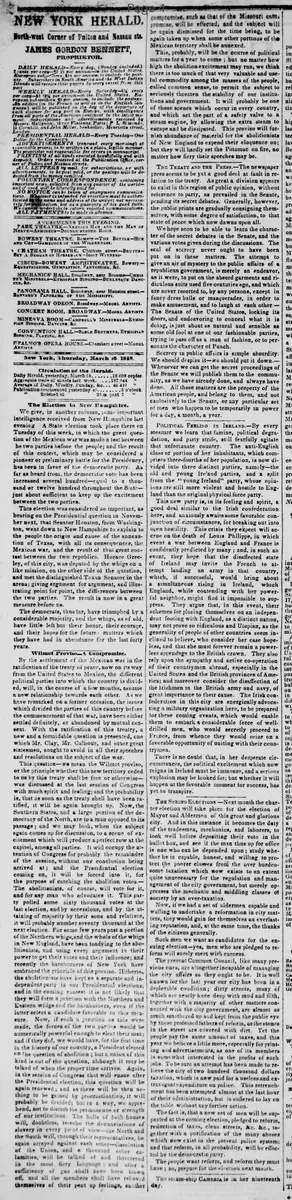
By the settlement of the Mexican war in the ratification of the treaty of peace, now on its way from the United States to Mexico, the different political parties into which this country is divided, will, in the course of a few months, assume a new relationship towards each other. As we have remarked on a former occasion, the issues which divided the parties of this country before the commencement of that war, have been either settled definitely, or abandoned by mutual consent. With the ratification of this treaty, a new and a formidable question is presented, one which Mr. Clay, Mr. Calhoun, and other great statesmen, sought to avoid in all their speeches and resolutions on the subject of the war.
This question-we mean the Wilmot proviso, or the principle whether this new territory ceded to us by this treaty shall be free or otherwise—was discussed at the last session of Congress with much spirit and feeling; and the probability is, that as soon as the treaty shall have been ratified, it will be again brought up. Now, the Southern States, and a large portion of the democracy of the North, are to a man opposed to its passage; and we may look, when the subject again comes up for discussion, to a scene of excitement which will produce a perfect row at the capitol, among all parties. It will occupy the attention of Congress for probably the remainder of the session, without any conclusion being arrived at; and the Presidential election coming on, it will be forced into it, for the purpose of catching the abolition votes.—The abolitionists, of course, will vote for it, and for any man who advocates it. This party polled some sixty thousand votes at the last election, and by accessions, and by the attaining of majority by their sons and relatives, it will probably number seventy thousand at the next election. For some few years past a portion of the Northern whigs, and the whole of the whigs in New England, have been toadying to the abolitionists, and using every argument in their power to get their votes and their influence; and recently the barnburners of New York have embraced the principle of this proviso. Hitherto, the abolitionists have kept as a separate and independent party in our Presidential elections; and in the coming contest it is not likely that they will form a junction with the Northern and Eastern whigs and the barnburners, even if the latter select a candidate favorable to this measure. Now, if such a junction as this were made, the forces of the two parties would be numerically powerful enough to elect their man; and if they did, we would have, for the first time in the history of our country, a President elected on the question of abolition; but a union of this kind is out of the question, although it may be talked of when the proper time arrives. Again, in the session of Congress that will ensue after the Presidential election, this question will be again renewed; and as there will be then nothing to be gained by procrastination, it will probably be decided: but in a way, we apprehend, not to disturb the permanence or strength of our institutions. The halls of both houses will, doubtless, re-echo the denunciations of slavery in every point of view-the North and the South will, through their representatives, be again arrayed against each other-dissolution of the Union, and a thousand other calamities, will be talked of and threatened in the most fiery language; and after a sufficiency of gas shall have been blown off, and all the members shall have relieved themselves of their pent up feelings, another compromise, such as that of the Missouri compromise, will be effected, and the subject will be again dismissed for the time being, to be again taken up when some other portions of the Mexican territory shall be annexed.
This, probably, will be the course of political matters for a year to come; but no matter how high the abolition excitement may run, we think there is too much of that very valuable and useful commodity among the masses of the people, called common sense, to permit the subject to seriously threaten the stability of our institutions and government. It will probably be one of those scenes which occur in every country, and which act the part of a safety valve to a steam engine, by allowing the extra steam to escape and be dissipated. This proviso will furnish abundance of material for the abolitionists of New England to expend their eloquence on; but they will hardly set the Potomac on fire, no matter how fiery their speeches may be.
What sub-type of article is it?
What themes does it cover?
What keywords are associated?
What entities or persons were involved?
Where did it happen?
Story Details
Key Persons
Location
United States, Mexico, Capitol
Event Date
After Ratification Of The Treaty Of Peace From The Mexican War
Story Details
The article discusses the impending political debates over the Wilmot Proviso following the Mexican War treaty ratification, predicting opposition from Southern States and Northern Democrats, support from abolitionists, potential excitement in Congress, influence on the Presidential election, and eventual compromise similar to the Missouri Compromise to preserve institutions.