Thank you for visiting SNEWPapers!
Sign up free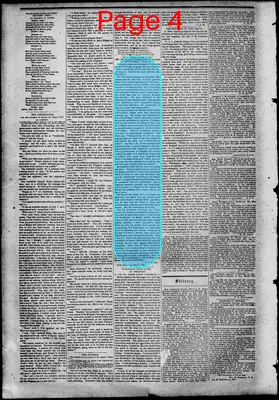
Editorial
June 9, 1864
Southern Christian Advocate
Charleston, Charleston County, South Carolina
What is this article about?
An editorial by R. C. Oliver in the Southern Christian Advocate urges professing Christians to acquire and impart knowledge of God and the Gospel to their families and slaves, despite state laws prohibiting teaching slaves to read. It defends biblical sanction for slavery but criticizes treating slaves as mere profit machines and neglecting spiritual duties.
Clipping
OCR Quality
95%
Excellent
Full Text
For the Southern Christian Advocate.
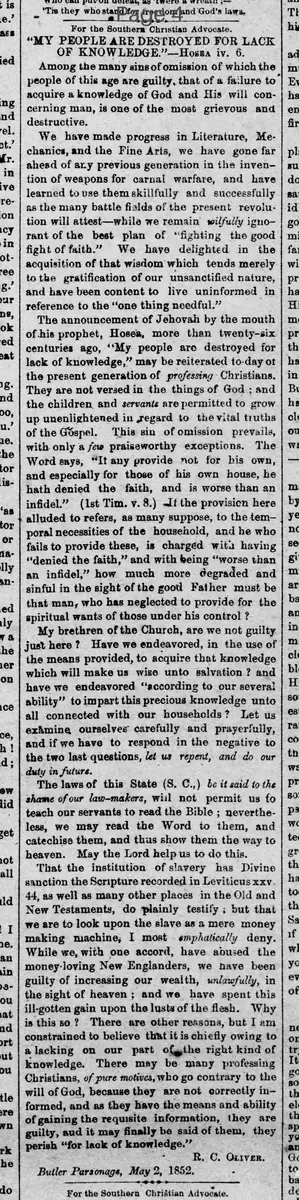
"MY PEOPLE ARE DESTROYED FOR LACK OF KNOWLEDGE." Hosea iv. 6.
Among the many sins of omission of which the people of this age are guilty, that of a failure to acquire a knowledge of God and His will concerning man, is one of the most grievous and destructive.
We have made progress in Literature, Mechanics, and the Fine Arts, we have gone far ahead of any previous generation in the invention of weapons for carnal warfare, and have learned to use them skillfully and successfully as the many battle fields of the present revolution will attest--while we remain wilfully ignorant of the best plan of "fighting the good fight of faith." We have delighted in the acquisition of that wisdom which tends merely to the gratification of our unsanctified nature, and have been content to live uninformed in reference to the "one thing needful."
The announcement of Jehovah by the mouth of his prophet, Hosea, more than twenty-six centuries ago, "My people are destroyed for lack of knowledge," may be reiterated to-day of the present generation of professing Christians. They are not versed in the things of God; and the children and servants are permitted to grow up unenlightened in regard to the vital truths of the Gospel. This sin of omission prevails, with only a few praiseworthy exceptions. The Word says, "If any provide not for his own, and especially for those of his own house, he hath denied the faith, and is worse than an infidel." (1st Tim. v. 8.) If the provision here alluded to refers, as many suppose, to the temporal necessities of the household, and he who fails to provide these, is charged with having "denied the faith," and with being "worse than an infidel," how much more degraded and sinful in the sight of the good Father must be that man, who has neglected to provide for the spiritual wants of those under his control?
My brethren of the Church, are we not guilty just here? Have we endeavored, in the use of the means provided, to acquire that knowledge which will make us wise unto salvation? and have we endeavored "according to our several ability" to impart this precious knowledge unto all connected with our households? Let us examine ourselves carefully and prayerfully, and if we have to respond in the negative to the two last questions, let us repent, and do our duty in future.
The laws of this State (S. C.,) be it said to the shame of our law-makers, will not permit us to teach our servants to read the Bible; nevertheless, we may read the Word to them, and catechise them, and thus show them the way to heaven. May the Lord help us to do this.
That the institution of slavery has Divine sanction the Scripture recorded in Leviticus xxv. 44, as well as many other places in the Old and New Testaments, do plainly testify: but that we are to look upon the slave as a mere money making machine, I most emphatically deny. While we, with one accord, have abused the money-loving New Englanders, we have been guilty of increasing our wealth, unlawfully, in the sight of heaven; and we have spent this ill-gotten gain upon the lusts of the flesh. Why is this so? There are other reasons, but I am constrained to believe that it is chiefly owing to a lacking on our part of the right kind of knowledge. There may be many professing Christians, of pure motives, who go contrary to the will of God, because they are not correctly informed, and as they have the means and ability of gaining the requisite information, they are guilty, and it may finally be said of them, they perish "for lack of knowledge."
R. C. OLIVER.
Butler Parsonage, May 2, 1852.
"MY PEOPLE ARE DESTROYED FOR LACK OF KNOWLEDGE." Hosea iv. 6.
Among the many sins of omission of which the people of this age are guilty, that of a failure to acquire a knowledge of God and His will concerning man, is one of the most grievous and destructive.
We have made progress in Literature, Mechanics, and the Fine Arts, we have gone far ahead of any previous generation in the invention of weapons for carnal warfare, and have learned to use them skillfully and successfully as the many battle fields of the present revolution will attest--while we remain wilfully ignorant of the best plan of "fighting the good fight of faith." We have delighted in the acquisition of that wisdom which tends merely to the gratification of our unsanctified nature, and have been content to live uninformed in reference to the "one thing needful."
The announcement of Jehovah by the mouth of his prophet, Hosea, more than twenty-six centuries ago, "My people are destroyed for lack of knowledge," may be reiterated to-day of the present generation of professing Christians. They are not versed in the things of God; and the children and servants are permitted to grow up unenlightened in regard to the vital truths of the Gospel. This sin of omission prevails, with only a few praiseworthy exceptions. The Word says, "If any provide not for his own, and especially for those of his own house, he hath denied the faith, and is worse than an infidel." (1st Tim. v. 8.) If the provision here alluded to refers, as many suppose, to the temporal necessities of the household, and he who fails to provide these, is charged with having "denied the faith," and with being "worse than an infidel," how much more degraded and sinful in the sight of the good Father must be that man, who has neglected to provide for the spiritual wants of those under his control?
My brethren of the Church, are we not guilty just here? Have we endeavored, in the use of the means provided, to acquire that knowledge which will make us wise unto salvation? and have we endeavored "according to our several ability" to impart this precious knowledge unto all connected with our households? Let us examine ourselves carefully and prayerfully, and if we have to respond in the negative to the two last questions, let us repent, and do our duty in future.
The laws of this State (S. C.,) be it said to the shame of our law-makers, will not permit us to teach our servants to read the Bible; nevertheless, we may read the Word to them, and catechise them, and thus show them the way to heaven. May the Lord help us to do this.
That the institution of slavery has Divine sanction the Scripture recorded in Leviticus xxv. 44, as well as many other places in the Old and New Testaments, do plainly testify: but that we are to look upon the slave as a mere money making machine, I most emphatically deny. While we, with one accord, have abused the money-loving New Englanders, we have been guilty of increasing our wealth, unlawfully, in the sight of heaven; and we have spent this ill-gotten gain upon the lusts of the flesh. Why is this so? There are other reasons, but I am constrained to believe that it is chiefly owing to a lacking on our part of the right kind of knowledge. There may be many professing Christians, of pure motives, who go contrary to the will of God, because they are not correctly informed, and as they have the means and ability of gaining the requisite information, they are guilty, and it may finally be said of them, they perish "for lack of knowledge."
R. C. OLIVER.
Butler Parsonage, May 2, 1852.
What sub-type of article is it?
Moral Or Religious
Education
Slavery Abolition
What keywords are associated?
Religious Knowledge
Spiritual Neglect
Family Duty
Slave Instruction
Biblical Slavery
Gospel Teaching
What entities or persons were involved?
R. C. Oliver
Professing Christians
Slaves
New Englanders
South Carolina Law Makers
Editorial Details
Primary Topic
Importance Of Religious Knowledge For Salvation And Duty To Families And Slaves
Stance / Tone
Exhortative Call To Repentance And Spiritual Education, Defense Of Biblical Slavery With Criticism Of Exploitation
Key Figures
R. C. Oliver
Professing Christians
Slaves
New Englanders
South Carolina Law Makers
Key Arguments
Failure To Acquire Knowledge Of God Is A Grievous Sin Of Omission Destroying People.
Professing Christians Are Ignorant Of God's Ways, Neglecting To Teach Children And Servants The Gospel.
Neglecting Spiritual Provision For Household Is Worse Than Denying The Faith.
State Laws Prevent Teaching Slaves To Read, But Reading And Catechizing The Bible Is Possible And Necessary.
Slavery Has Divine Sanction In Scripture, But Slaves Should Not Be Treated As Mere Money Making Machines.
Wealth Gained Through Poor Treatment Of Slaves Is Unlawful And Leads To Fleshly Lusts Due To Lack Of Knowledge.