Thank you for visiting SNEWPapers!
Sign up free
Editorial
August 11, 1796
Gazette Of The United States, & Philadelphia Daily Advertiser
Philadelphia, Philadelphia County, Pennsylvania
What is this article about?
Editorial argues for government-established public schools to educate the majority poor children left ignorant otherwise, emphasizing education's role in freedom and society. Quotes a Wilmington writer and addresses Quaker exemptions, signed 'E.'
Clipping
OCR Quality
95%
Excellent
Full Text
Philadelphia,
THURSDAY EVENING, AUGUST 11
PUBLIC SCHOOLS No. VI
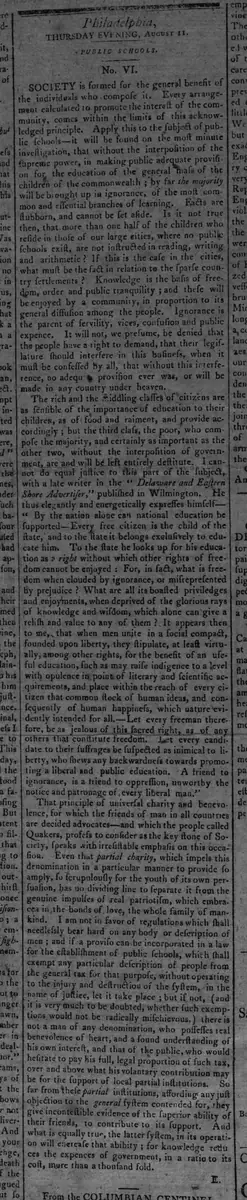
Society is formed for the general benefit of the individuals who compose it. Every arrangement calculated to promote the interest of the community, comes within the limits of this acknowledged principle. Apply this to the subject of public schools--it will be found on the most minute investigation, that without the interposition of the supreme power, in making public adequate provision for the education of the general mass of the children of the commonwealth; by far the majority will be brought up in ignorance, of the most common and essential branches of learning. Facts are stubborn, and cannot be set aside. Is it not true then, that more than one half of the children who reside in those of our large cities, where no public schools exist, are not instructed in reading, writing and arithmetic? If this is the case in the cities, what must be the fact in relation to the pare country settlements? Knowledge is the basis of freedom, order and public tranquility; and these will be enjoyed by a community, in proportion to its general diffusion among the people. Ignorance is the parent of servility, vices, confusion and public expense. It will not, we presume, be denied that the people have a right to demand, that their legislature should interfere in this business, when it must be confessed by all, that without this interference, no adequate provision ever was, or will be made in any country under heaven.
The rich and the middling class of citizens are as sensible of the importance of education to their children, as of food and raiment, and provide accordingly; but the third class, the poor, who compose the majority, and certainly as important as the other two, without the interposition of government, are and will be left entirely destitute. I cannot do equal justice to this part of the subject, with a late writer in the "Delaware and Eastern Shore Advertiser," published in Wilmington. He thus elegantly and energetically expresses himself-
"By the nation alone can national education be supported-Every free citizen is the child of the state, and to the state it belongs exclusively to educate him. To the state he looks up for his education as a right without which other rights of freedom cannot be enjoyed: For, in fact, what is freedom when clouded by ignorance, or misrepresented by prejudice? What are all its boasted privileges and enjoyments, when deprived of the glorious rays of knowledge and wisdom, which alone can give a relish and value to any of them? It appears then to me, that when men unite in a social compact, founded upon liberty, they stipulate, at least virtually, among other rights, for the benefit of an useful education, such as may raise indigence to a level with opulence in point of literary and scientific acquirements, and place within the reach of every citizen that common stock of human ideas, and consequently of human happiness, which nature evidently intended for all. Let every freeman therefore, be as jealous of this sacred right, as of any others that constitute freedom. Let every candidate to their suffrages be suspected as inimical to liberty, who shews any backwardness towards promoting a liberal and public education. A friend to ignorance, is a friend to oppression, unworthy the notice and patronage of, every liberal man."
That principle of universal charity and benevolence, for which the friends of man in all countries are decided advocates-and which the people called Quakers, profess to consider as the key stone of Society, speaks with irresistible emphasis on this occasion. Even that partial charity, which impels this denomination in a particular manner to provide so amply, so scrupulously for the youth of its own persuasion, has no dividing line to separate it from the genuine impulses of real patriotism, which embraces in the bonds of love, the whole family of mankind. I am not in favor of regulations which shall needlessly bear hard on any body or description of men; and if a proviso can be incorporated in a law for the establishment of public schools, which shall exempt any particular description of people from the general tax for that purpose, without operating to the injury and destruction of the system, in the name of justice, let it take place; but if not, (and it is very much to be doubted, whether such exemptions would not be radically mischievous,) there is not a man of any denomination, who possesses real benevolence of heart, and a sound understanding of his own interest, and that of the public, who would hesitate to pay his full, legal proportion of such tax, over and above what his voluntary contribution may be for the support of local partial institutions. So far from these partial institutions, affording any just objection to the general system contended for, they give incontestable evidence of the superior ability of their friends, to contribute to its support. And what is equally true, the latter system, in its operation will increase that ability; for knowledge reduces the expenses of government, in a ratio to its cost, more than a thousand fold.
E.
THURSDAY EVENING, AUGUST 11
PUBLIC SCHOOLS No. VI
Society is formed for the general benefit of the individuals who compose it. Every arrangement calculated to promote the interest of the community, comes within the limits of this acknowledged principle. Apply this to the subject of public schools--it will be found on the most minute investigation, that without the interposition of the supreme power, in making public adequate provision for the education of the general mass of the children of the commonwealth; by far the majority will be brought up in ignorance, of the most common and essential branches of learning. Facts are stubborn, and cannot be set aside. Is it not true then, that more than one half of the children who reside in those of our large cities, where no public schools exist, are not instructed in reading, writing and arithmetic? If this is the case in the cities, what must be the fact in relation to the pare country settlements? Knowledge is the basis of freedom, order and public tranquility; and these will be enjoyed by a community, in proportion to its general diffusion among the people. Ignorance is the parent of servility, vices, confusion and public expense. It will not, we presume, be denied that the people have a right to demand, that their legislature should interfere in this business, when it must be confessed by all, that without this interference, no adequate provision ever was, or will be made in any country under heaven.
The rich and the middling class of citizens are as sensible of the importance of education to their children, as of food and raiment, and provide accordingly; but the third class, the poor, who compose the majority, and certainly as important as the other two, without the interposition of government, are and will be left entirely destitute. I cannot do equal justice to this part of the subject, with a late writer in the "Delaware and Eastern Shore Advertiser," published in Wilmington. He thus elegantly and energetically expresses himself-
"By the nation alone can national education be supported-Every free citizen is the child of the state, and to the state it belongs exclusively to educate him. To the state he looks up for his education as a right without which other rights of freedom cannot be enjoyed: For, in fact, what is freedom when clouded by ignorance, or misrepresented by prejudice? What are all its boasted privileges and enjoyments, when deprived of the glorious rays of knowledge and wisdom, which alone can give a relish and value to any of them? It appears then to me, that when men unite in a social compact, founded upon liberty, they stipulate, at least virtually, among other rights, for the benefit of an useful education, such as may raise indigence to a level with opulence in point of literary and scientific acquirements, and place within the reach of every citizen that common stock of human ideas, and consequently of human happiness, which nature evidently intended for all. Let every freeman therefore, be as jealous of this sacred right, as of any others that constitute freedom. Let every candidate to their suffrages be suspected as inimical to liberty, who shews any backwardness towards promoting a liberal and public education. A friend to ignorance, is a friend to oppression, unworthy the notice and patronage of, every liberal man."
That principle of universal charity and benevolence, for which the friends of man in all countries are decided advocates-and which the people called Quakers, profess to consider as the key stone of Society, speaks with irresistible emphasis on this occasion. Even that partial charity, which impels this denomination in a particular manner to provide so amply, so scrupulously for the youth of its own persuasion, has no dividing line to separate it from the genuine impulses of real patriotism, which embraces in the bonds of love, the whole family of mankind. I am not in favor of regulations which shall needlessly bear hard on any body or description of men; and if a proviso can be incorporated in a law for the establishment of public schools, which shall exempt any particular description of people from the general tax for that purpose, without operating to the injury and destruction of the system, in the name of justice, let it take place; but if not, (and it is very much to be doubted, whether such exemptions would not be radically mischievous,) there is not a man of any denomination, who possesses real benevolence of heart, and a sound understanding of his own interest, and that of the public, who would hesitate to pay his full, legal proportion of such tax, over and above what his voluntary contribution may be for the support of local partial institutions. So far from these partial institutions, affording any just objection to the general system contended for, they give incontestable evidence of the superior ability of their friends, to contribute to its support. And what is equally true, the latter system, in its operation will increase that ability; for knowledge reduces the expenses of government, in a ratio to its cost, more than a thousand fold.
E.
What sub-type of article is it?
Education
Social Reform
What keywords are associated?
Public Schools
Education Reform
Government Intervention
Poor Education
Social Equality
Quaker Charity
Legislative Duty
What entities or persons were involved?
Legislature
Quakers
Poor Citizens
Editorial Details
Primary Topic
Advocacy For Government Funded Public Schools
Stance / Tone
Strong Support For Public Education To Benefit The Poor And Society
Key Figures
Legislature
Quakers
Poor Citizens
Key Arguments
Society Benefits From Public Education For All Children
Without Government Intervention, Most Children, Especially The Poor, Remain Ignorant
Knowledge Ensures Freedom And Order; Ignorance Leads To Servility And Vice
The State Has A Duty To Educate Every Citizen As A Right Of Freedom
Public Schools Level The Playing Field Between Rich And Poor In Education
Quakers' Partial Charity Supports The Need For General Public System
Taxes For Public Schools Should Be Paid By All, With Possible Exemptions If Not Harmful
Public Education Reduces Government Expenses More Than Its Cost