Thank you for visiting SNEWPapers!
Sign up free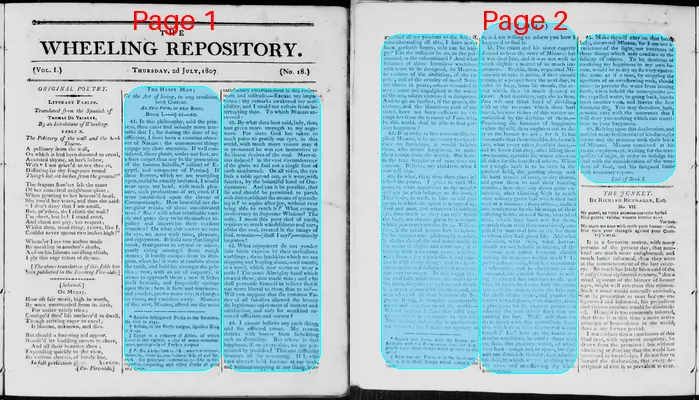
The Wheeling Repository
Wheeling, Ohio County, West Virginia
What is this article about?
In Book I of the epic poem 'The Happy Man,' a princess and afflicted count converse with Misano about finding contentment through observing nature's beauty and divine design. Misano argues that true happiness lies in the mind, resilient to bodily afflictions, promising to share his philosophy the next day.
Merged-components note: Continuation of the epic poem 'The Happy Man' across pages 1 and 2.
Clippings
1 of 2
OCR Quality
Full Text
Or the Art of living, in any condition,
with Content.
An Epic Poem, in XIV Books.
Book I. -- (41--49.
41. In this philosophy, said the princess,
thou canst find nobody more traceable than I; for during the time of my
affliction, I have been a constant observer of Nature: the commonest things
engage my close attention. If well considered, these plants, under our feet, are
a finer carpet than any in the possession of the famous Saladin,* sultan of Egypt,‡ and conqueror of Persia.§ If these flowers, which we are trampling upon, could be exactly imitated, I would wear upon my head, with much pleasure, such productions of art, even if I were established upon the throne of Constantinople. How beautiful are the irregular trunks of those uncultivated trees! See! with what inimitable variety and grace they twist themselves together and intertwine their verdant branches! On what side soever we turn the eye, we meet with taste, pleasure, and enjoyment. Behold now that limpid brook, transparent as crystal or silver, gently rising amongst those rough stones; it hardly escapes from its dungeon, when lo! it runs at random about the earth, and bubbles amongst the pebbles; now, with an air of coquetry, it seems to approach them; now it hides itself beneath, and frequently springs upon them; here it frets and murmurs; and yonder, grown more coy, it changes its route, and vanishes away. Matters of this sort, Misano, afford me the most satisfactory entertainment in this retirement and solitude.--Excuse my impatience: thy remarks awakened my sensibility, and I could not refrain from interrupting thee.
To which Misano answered:
42. By what thou hast said, lady, thou hast given more strength to my argument. For since God has taken so much pains to gratify our eyes, in this world, with much more reason may it be presumed he was not inattentive to the chaste desires of the soul. Marvellous indeed! in the vast circumference of the globe we find not a single foot of earth unadorned: On all sides, the eye finds a table spread out, as it were, with dainties; by the bountiful hand of Omnipotence: And can it be possible, that the soul should be permitted to parch with thirst, without the means of quenching it? to aspire after joy, without ever being able to reach it? What strange incoherency in Supreme Wisdom! The body, I mean this poor clod of earth, requires so much watchfulness and care, whilst the soul, created in the image of God, remains-(shall I say?)-entirely forgotten!
43. What enjoyment do not yonder little birds express by their melodious warblings; those lambkins which we see skipping and leaping about,=all nature, in a word, which now seems to wear a smile? The same Almighty hand which created these, also made man; and who shall persuade himself to believe that it was more liberal to them, than to us?— Will you suppose that the common Father of all families allowed the brutes the legitimate enjoyment of content and satisfaction, and only for mankind reserved affliction and sorrow?
44. I cannot believe any such thing said the afflicted count. My reason shrinks with horror from beholding such an absurdity. But where is that happiness, if, on every side, we are persecuted by troubles? This one difficulty destroys all thy reasoning. If I, who have always held fortune at my beck, and without stopping at any thing, have
Footnotes:
* Saladin subjugated Persia to the Saracens. He died in 1191.
Sultan, in the Persian tongue, signifies King of kings.
Egypt is a country of Africa, of which Cairo is the capital, a city of many manufactures, particularly of Turkey carpets.
Persia, a kingdom in Asia, which produces annually, about 20,000 bales of silk, of 216 lbs. each.
Its principal commerce consists in fine tapestry, carpeting, and other cloths of gold and silver.
N.
G.
gratified all my passions to the full; if, notwithstanding all this, I have never been perfectly happy, who can be happy?
Can the indigent be so, or the persecuted, or the calumniated? And what becomes of those harmless wretches, who seem to be designed, by Heaven, as victims of the ambition, of the caprice, and of the cruelty of men? Some are slaves in peace, others wounded in war; some are engulfed in the waves of the sea, others immured in dungeons. And to go no further, if the graces, the virtues, and the illustrious rank of my sister, have not been sufficient to exempt her from the tyranny of Fate, who, in this world, shall be able to find perfect happiness?
45. If in order to live contentedly, replied Misano, it be necessary to experience no hardships, it would behove those who desire happiness, to make their escape from the world. But herein the true happiness of man does not consist. Believe, my children, what I now tell you.
46. In what, then, dost thou place it? asked the count. I place it, said Misano, in what appertains to the mind, and not in what belongs to the body. This body, in truth, is like an old garment, in which the spirit is wrapped up. Toil and pain, and whatever is without use, forasmuch as they can only touch the body, are thrusts given by a weapon which penetrates not the dress. Wherefore, if the mind knows how to behave in the manner true philosophy teaches, it abides cheerfully and contentedly in the midst of slights and torments; it abounds with a constant peace, which arises from a joy which fills it and satisfies it with every thing; and it experiences an internal delight, which no events can ever interrupt.
In this happy state the soul foils misfortune, triumphs over the fates, despises envy, fears not death: it is never alarmed by enemies, and, independent of all that is below the Supreme Being, it remains substantially great, and superior to all the world. Behold in what I place that solid happiness which is attainable in this life.
This sterling philosophy is undiscovered by men; but I make no mystery of it, and am willing to inform you how I [footnote: Seneca and Zeno, with the Stoics, and Aristotle with the Peripatetics, founded happiness upon those things which pertain to the mind: The Epicureans and Plato, with the Academics, placed it in those things which concern the body.] happened to find it.
47. The count and his sister eagerly desired to hear the story of Misano; but it was then late, and it was not well to touch slightly a matter of so much importance. Sophia, then, requested Misano not to take it amiss, if they should return, at a proper hour the next day, in order to hear, from his mouth, the secret which they so much desired to know. And doubtless, says she to him, thou wilt not think hard of dividing with us the treasure which thou hast found, because riches of this nature are multiplied by the division of them.
Possessing the fountain of happiness within thyself, thou oughtest not to deny us the favour we ask; for it is but reasonable that thou shouldst do, in such case, what every other fountain does—and we know that they, after filling their own basins, sprinkle the water about on all sides for the benefit of others. When not a single herb is to be seen in the parched field, the panting sheep seek the hard trunks of trees, or dry thorns, and gnaw them to cool their burning mouths; here they slip down quite exhausted, after climbing high to reach some solitary green leaf which they had seen at a distance; there others, melted into tenderness by the bleatings of their suffering lambs around them, instead of milk, which they have not for them, nourish them with their own blood, compelled by maternal love to die for them to whom they had given life. Ah! what confusion, what evils, what horrors should we not behold in nature, if the covetous and selfish fountain should shut up its treasures within itself! To prevent these evils, God has commanded otherwise, and in obedience to the command, the careful fountain is willing to extend her succours to all, and runs, in haste, to do so; here she stumbles over the stones, there she falls into the clefts of the rocks, and yonder she throws herself down, with alacrity, from a precipice, for the express purpose of solacing the poor thirsty flock that are panting for her. Well! wilt thou not do as much with this marvellous fountain which thou hast discovered within thyself? Lo! here are thy lambs in a similar condition, in want; share with us, then, this precious water, of which thou hast enough and to spare, for thou wilt not diminish, thereby, that admirable delight which we see gushing from thy eyes, and overflowing thy whole countenance.
134
48. Make thyself easy on that head, lady, answered Misano, for I am not avaricious of the light, nor covetous of those things which may conduce to the felicity of others. To be desirous of confining my happiness to my own bosom, would be to dry up its very source: the same as if a man, by stopping the aperture of an overflowing rock, should strive to prevent the water from issuing forth, when behold the consequence; the repelled water, in going back, bursts open another vent, and leaves the first fountain dry. You may therefore, both, remain easy with the assurance that I will deny you nothing which can contribute to your happiness.
49. Relying upon this declaration, and amidst many testimonies of kindness, the count and the princess took their leave of Misano. Misano remained at his rustic employment, waiting for the tranquillity of night, in order to indulge his soul with the consideration of the wonders of God, and his fatigued limbs with necessary repose.
End of Book I.
What sub-type of article is it?
What themes does it cover?
What keywords are associated?
Literary Details
Title
The Happy Man; Or The Art Of Living, In Any Condition, With Content. An Epic Poem, In Xiv Books. Book I.
Subject
The Art Of Living Contentedly In Any Condition Through Philosophy
Form / Style
Philosophical Dialogue In Epic Poem Form
Key Lines