Thank you for visiting SNEWPapers!
Sign up free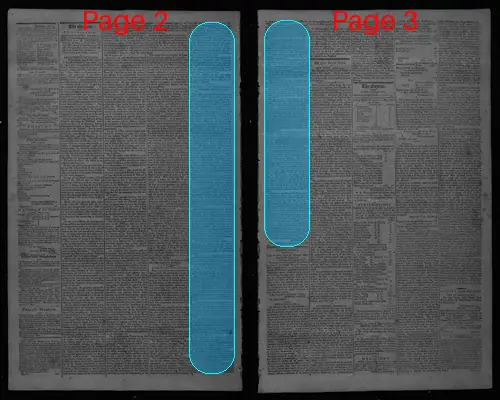
Gazette Of The United States, & Philadelphia Daily Advertiser
Philadelphia, Philadelphia County, Pennsylvania
What is this article about?
In a letter to the Virginia Argus editor, Americanus republishes key points from his 'Development of the causes of the disturbances between the American and French Republics' series, posing interrogative questions critiquing Thomas Jefferson's alleged pro-French sentiments, inconsistencies in his political actions, and involvement in intrigues like the Blount conspiracy to undermine American governance.
Merged-components note: The text in the second component is a direct continuation of the letter to the editor in the first component.
Clippings

1 of 2
OCR Quality
Full Text
Richmond, October 4, 1797.
SIR,
The useful and interesting matter with which your paper is always filled, makes it improper, perhaps, to expect or ask of you, the re-publication of any essays which may have appeared in other papers of your own state, much less those of your own city: Yet, the anxiety which I have heard a number of your subscribers, who do not take the Virginia Gazette and General Advertiser express, to see the papers published in that Gazette under the signature which I now write, induces me to acquit myself of the charge of partiality for the subscribers or friends to any particular newspaper, by publishing in yours, some of the leading features of the NINE numbers of the Development of the causes of the disturbances between the American and French Republics.
This I am impelled the more strongly to, by another consideration in addition to the one already stated. Besides the equal attention I wish to shew to your subscribers at large, with those of every other paper in America, there is one person in particular, whose name has been frequently mentioned in those papers, and who, I am credibly informed, declared (tho' with a blush, I am told, of modest innocence, I presume, on his cheek) to a citizen of his own county, after the publication of the 7th No. that "he had never seen one of those publications;" who, if there was no other entitled to be gratified, certainly of himself is. That the person alluded to, may no longer be without a sight of what I have already said and thought of him (as he is the last of all men I would conceal those sentiments and opinions from) I shall therefore now draw up a summary of the principal things I have there said of him, with the addition of a few more which yet remain to be touched upon, and which in my opinion, it behoves that person to explain: And this I shall do, for the most part, by the way of interrogation, as that appears to be the favorite way of arriving at truth, with some of that person's advocates and friends.
By the ingenious invention of the Aurora which may justly be styled the enemies of Jacobinism put to the rack, we are taught to propound a few useful queries on the other side; a few candid answers to which will very much aid the querist and Editor of that useful paper in arriving at truth on the subject of his enquiries. By as ready and as satisfactory answers being made, as were afforded on that occasion, it may be seen, who, and what party, are best prepared to pass the fiery ordeal of such a torturous examination as has been there set on foot.
In the first place then, Mr. Pleasants, to pursue and be consistent with my original plan, who, give me leave to ask, was our ambassador in France, when their revolution broke out, and our general government was sacred?
2d Q. Did not that ambassador write to America, while our government was under consideration for adoption or rejection, recommending certain things to be done which were not done, or paid any very great attention to?
3d Q. Had that neglect and the presumption of the people of America to form a government for themselves, in his absence, and in contempt of his advice, any, and what effect, on his secret opinions and dispositions towards that government?
4th Q. How did it happen that an attachment to the cause of France (of which that character was well known to be a warm admirer) became connected with, and understood to be inseparable from, an enmity to our government; and that the person who had been the chief cause of the adoption of the government, and was well known to be under the influence of the ambassador, became immediately on his return to America, so strangely changed, as to become among the foremost in those ultra principles of a friendship to the cause of France and enmity to the American government?
5th Q. Who was it that recommended the writings of Mr. Paine here as the "standard of Common Sense:" and whether was the same person then acquainted with Mr. Paine's whole system, or if he was not, when he became acquainted with it, whether did he wish the influence of that recommendation to extend to the whole of his wise writings?
6th Q Who were the two influential characters who introduced Mr Freneau into the department of state and set him up as a printer; who introduced his subscription papers into Albemarle, Orange, &c. recommended him as the republican printer, and acted as agents even between him and his subscribers in that quarter; and why all this industry, trouble and pains, and what the object if the complexion of that paper?
7th Q. Why were the resolutions of Albemarle on the subject of the proclamation of neutrality (formed and warmly advocated by young gentlemen immediately from under the private roof and influence of the secretary of state) so materially different from the communications from the public office of state upon the same subject?
8th Q. Why were the sentiments of those of the same connexions and immediately under the same influence, always and uniformly warm, bitter and loud against principles, men and measures, which the person holding that influence over them pretended to view in a very different light?
9th Q. Why was the same inconsistency of sentiment which thus prevailed between this man of influence and his admirers, even maintained in the same character at once, by holding up to different people of different sentiments, almost in the same breath, the same characters in different lights?
Both Q. Whether or not, was the letter said to have been written to Mazzei, the production of the person to whom it was imputed; and if it was not, why was the influence of its reputed author's name not taken from it as soon as it was known to be published in France with a view of injuring this country?
11th Q. Was the Department of State, during the Secretary-ship of Mr. Jefferson, made the channel through which letters were sent to France, which the writers of such letters apprehended to be improper to be trusted through the department, after that devoted friend to France had left it, and were therefore committed to the immediate care of the minister of that country, as the more secure channel, as it has been acknowledged by a man opposed to be in such secrets?
12th Q. Who was the person Du Pont de Nemours in the council so declared would be devoted to France if he was appointed President of America; and how did the servant of the French people come by that information which was withheld from the American people?
13th Q. Why was Mr. Adet so extremely anxious for, and active in the election of Mr. Jefferson; and was not he the person to be devoted to France if elected president?
14th Q. Why did Mr. Adet communicate with Mr. Blount on that subject, and why was that amiable senator of America so strenuous (in the election of President for Mr. Jefferson?)
15th Q. Why did Mr. Jefferson quit his important post in the Senate, when Mr. Blount who had been among the most warm, decided and important advocates for his election in America, was to be disgraced?
16th Q. And finally and lastly—was not Mr. Adet (with whom Mr. Blount was intimate, and coincided and operated so perfectly in the election of a president devoted to France) certainly and absolutely at the bottom of the Canada plot; to give a colourable pretext to which, and raise a plausible pretence for retaining our posts in the southern western parts of America, to bring about a partition of the United States, in which those schemes of French influence and American devotion would be more easily reciprocated, than by the troublesome means of the little unnecessary formality of consulting the will of the American people, the pretence of an invasion from Canada on Upper Louisiana was raised and Mr. Blount's pretended plot with the British fabricated?
This last conclusion (which I trust will close the scene of French influence and American devotion to that country among us) I think I am now warranted to draw, from a little hint of the complexion of the plan which accidentally and unguardedly fell from Mr. Blount himself, before it was known how far and which way the operation of the discovery of the contents of his letter to Cary was to go.
This very amiable senator on his way to congress in 1796, in company with his patriotic brother, one a devoted friend and advocate for French principles, the other, supposed by him, from certain striking circumstances, to be a warm and decided advocate for the election of Mr. Jefferson "He hoped," he said, "the latter gentleman had been doing every thing in his power to ensure the election of his friend Mr. Jefferson as president; that he had secured for him all the votes in his state; and that if he was not elected, he would make America shake to her foundation." Mr. Jefferson we well know, was not elected president. How Mr. Blount was to make America shake to her foundation, and for what, let this declaration, now added to that of Du Pont de Nemours; the exertions of Mr. Adet and Blount to the same object in the election of a president; the agency of Mr. Blount's friend (A. Adet) in the Canada scheme; and Mr. Vice President's unwillingness to be present and aiding in the disgrace of his good friend, citizen Blount—all proclaim!
Whether this confession of Mr. Blount, made at that particular stage of the business ought to attract the notice of the committee charged with an enquiry into every circumstance attending the business, is not for me to say. One thing however, becomes necessary now for me to declare; and that is, the author of these publications holding it equally improper and mean to do either a public or private injury under a cover of any kind whatever, now offers, that if those whom he conceives have injured their country in that way, and are here pointed at, will condescend to come forward and answer such questions as are here put, and within their power to answer, he will, on his part, assume a more visible appearance, and pledges himself to substantiate every thing he has asserted: And, that any one who possesses the principles of democracy and equality, should hold himself aloof from the enquiries of the people under an idea of superior dignity and worth, or from any official consideration, is only a confirmation of their deceptive pretences in every way.
AMERICANUS.
See Americanus No. 8, for an explanation of this fact.
What sub-type of article is it?
What themes does it cover?
What keywords are associated?
What entities or persons were involved?
Letter to Editor Details
Author
Americanus
Recipient
To The Editor Of The Virginia Argus
Main Argument
the writer summarizes his series critiquing pro-french influences in american politics, particularly targeting thomas jefferson's alleged inconsistencies and ties to french agents, posing 16 questions to expose these connections and challenge the accused to respond publicly.
Notable Details