Thank you for visiting SNEWPapers!
Sign up free
Story
November 13, 1958
Arizona Sun
Phoenix, Maricopa County, Arizona
What is this article about?
NAACP executive secretary Roy Wilkins hails the 1958 election results as a triumph for civil rights and liberalism, noting key congressional gains, the election of supportive figures like Nelson Rockefeller, and improved chances for anti-filibuster rules and protecting the Supreme Court.
Clipping
OCR Quality
98%
Excellent
Full Text
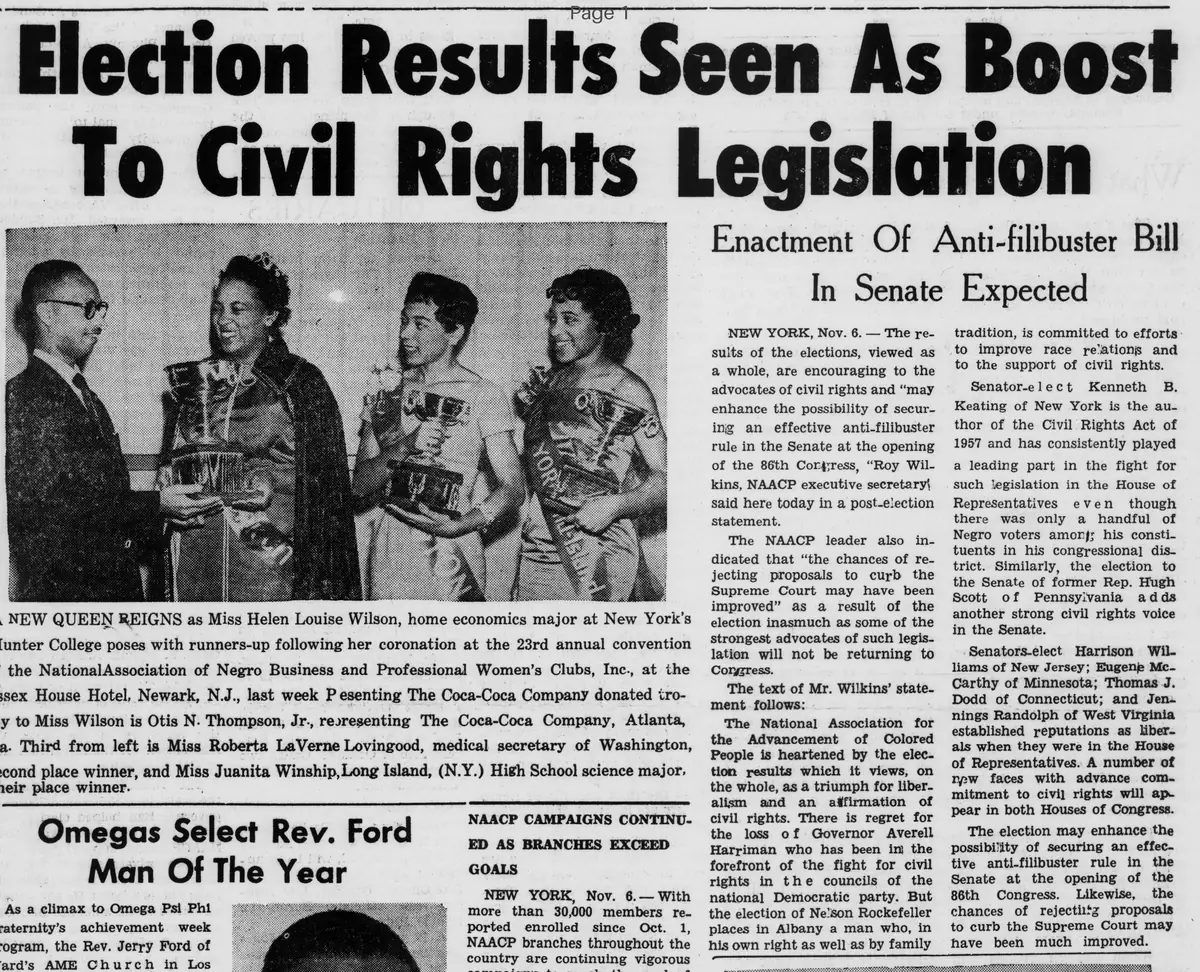
Election Results Seen As Boost To Civil Rights Legislation
NEW YORK, Nov. 6. - The results of the elections, viewed as a whole, are encouraging to the advocates of civil rights and "may enhance the possibility of securing an effective anti-filibuster rule in the Senate at the opening of the 86th Congress," Roy Wilkins, NAACP executive secretary said here today in a post-election statement.
The NAACP leader also indicated that "the chances of rejecting proposals to curb the Supreme Court may have been improved" as a result of the election inasmuch as some of the strongest advocates of such legislation will not be returning to Congress.
The text of Mr. Wilkins' statement follows:
The National Association for the Advancement of Colored People is heartened by the election results which it views, on the whole, as a triumph for liberalism and an affirmation of civil rights. There is regret for the loss of Governor Averell Harriman who has been in the forefront of the fight for civil rights in the councils of the national Democratic party. But the election of Nelson Rockefeller places in Albany a man who, in his own right as well as by family tradition, is committed to efforts to improve race relations and to the support of civil rights.
Senator-elect Kenneth B. Keating of New York is the author of the Civil Rights Act of 1957 and has consistently played a leading part in the fight for such legislation in the House of Representatives even though there was only a handful of Negro voters among his constituents in his congressional district. Similarly, the election to the Senate of former Rep. Hugh Scott of Pennsylvania adds another strong civil rights voice in the Senate.
Senators-elect Harrison Williams of New Jersey; Eugene McCarthy of Minnesota; Thomas J. Dodd of Connecticut; and Jennings Randolph of West Virginia established reputations as liberals when they were in the House of Representatives. A number of new faces with advance commitment to civil rights will appear in both Houses of Congress.
The election may enhance the possibility of securing an effective anti-filibuster rule in the Senate at the opening of the 86th Congress.
Likewise, the chances of rejecting proposals to curb the Supreme Court may have been much improved.
NEW YORK, Nov. 6. - The results of the elections, viewed as a whole, are encouraging to the advocates of civil rights and "may enhance the possibility of securing an effective anti-filibuster rule in the Senate at the opening of the 86th Congress," Roy Wilkins, NAACP executive secretary said here today in a post-election statement.
The NAACP leader also indicated that "the chances of rejecting proposals to curb the Supreme Court may have been improved" as a result of the election inasmuch as some of the strongest advocates of such legislation will not be returning to Congress.
The text of Mr. Wilkins' statement follows:
The National Association for the Advancement of Colored People is heartened by the election results which it views, on the whole, as a triumph for liberalism and an affirmation of civil rights. There is regret for the loss of Governor Averell Harriman who has been in the forefront of the fight for civil rights in the councils of the national Democratic party. But the election of Nelson Rockefeller places in Albany a man who, in his own right as well as by family tradition, is committed to efforts to improve race relations and to the support of civil rights.
Senator-elect Kenneth B. Keating of New York is the author of the Civil Rights Act of 1957 and has consistently played a leading part in the fight for such legislation in the House of Representatives even though there was only a handful of Negro voters among his constituents in his congressional district. Similarly, the election to the Senate of former Rep. Hugh Scott of Pennsylvania adds another strong civil rights voice in the Senate.
Senators-elect Harrison Williams of New Jersey; Eugene McCarthy of Minnesota; Thomas J. Dodd of Connecticut; and Jennings Randolph of West Virginia established reputations as liberals when they were in the House of Representatives. A number of new faces with advance commitment to civil rights will appear in both Houses of Congress.
The election may enhance the possibility of securing an effective anti-filibuster rule in the Senate at the opening of the 86th Congress.
Likewise, the chances of rejecting proposals to curb the Supreme Court may have been much improved.
What sub-type of article is it?
Historical Event
What themes does it cover?
Triumph
Justice
What keywords are associated?
Election Results
Civil Rights
Naacp
Congress
Senate
Filibuster
Supreme Court
What entities or persons were involved?
Roy Wilkins
Averell Harriman
Nelson Rockefeller
Kenneth B. Keating
Hugh Scott
Harrison Williams
Eugene Mccarthy
Thomas J. Dodd
Jennings Randolph
Where did it happen?
New York
Story Details
Key Persons
Roy Wilkins
Averell Harriman
Nelson Rockefeller
Kenneth B. Keating
Hugh Scott
Harrison Williams
Eugene Mccarthy
Thomas J. Dodd
Jennings Randolph
Location
New York
Event Date
Nov. 6
Story Details
Roy Wilkins of the NAACP praises the election results as a boost for civil rights, highlighting the election of supportive senators and governors, regret over Harriman's loss, and improved prospects for anti-filibuster rules and Supreme Court protection.