Thank you for visiting SNEWPapers!
Sign up free
Daily National Intelligencer
Washington, District Of Columbia
What is this article about?
Private letter from Paris, March 23, 1815, expresses anti-Napoleon sentiments among Parisians and National Guard after his return from Elba, Bourbon expulsion, and observed fear in Bonaparte; describes melancholy illumination, shut shops, and hopes for national uprising against the 'tyrant' and traitors like Ney.
Clipping
OCR Quality
Full Text
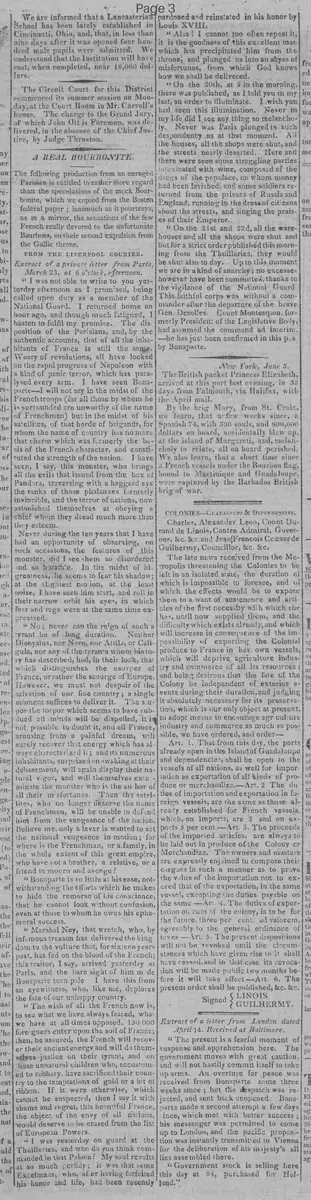
The following production from an enraged Parisian is entitled to rather more regard than the speculations of the mock Bourbonite, which we copied from the Boston federal paper; inasmuch as it pourtrays, as in a mirror, the sensations of the few French really devoted to the unfortunate Bourbons, on their second expulsion from the Gallic throne.
FROM THE LIVERPOOL COURIER.
Extract of a private letter from Paris, March 23, at 6 o'clock, afternoon.
"I was not able to write to you yesterday afternoon as I promised, being called upon duty as a member of the National Guard. I returned home an hour ago, and though much fatigued, I hasten to fulfil my promise. The disposition of the Parisians, and, by the authentic accounts, that of all the inhabitants of France is still the same. Weary of revolutions, all have looked on the rapid progress of Napoleon with a kind of panic terror, which has paralysed every arm. I have seen Bonaparte—I will not say in the midst of the French troops (for all those by whom he is surrounded are unworthy of the name of Frenchmen) but in the midst of his satellites, of that horde of brigands, for whom the name of country has no more that charm which was formerly the basis of the French character, and constituted the strength of the nation. I have seen, I say, this monster, who brings all the evils that issued from the box of Pandora, traversing with a haggard eye the ranks of those phalanxes formerly invincible, and the terror of nations, now astonished themselves at obeying a chief whom they dread much more than they esteem.
Never during the ten years that I have had an opportunity of observing, on such occasions, the features of this monster, did I see them so disordered and so horrible. In the midst of his greatness, he seems to fear his shadow; at the slightest motion, at the least noise, I have seen him start, and roll in their narrow orbit his eyes, in which fear and rage were at the same time expressed.
"No; never can the reign of such a tyrant be of long duration. Neither Dionysius, nor Nero, nor Attila, or Caligula, nor any of the tyrants whom history has described, had, in their look, that which distinguishes the usurper of France, or rather the scourge of Europe. However, we must not despair of the salvation of our fine country; a single moment suffices to deliver it. The stupor, the torpor which seems to have subdued all minds will be dispelled, it is not possible to doubt it, and all France, arousing from a painful dream, will surely recover that energy which has always characterized it; and its numerous inhabitants, surprised on awaking at their debasement, will again display their natural vigor, and will themselves exterminate the monster who is the author of all their misfortunes. Then the satellites, who no longer deserve the name of Frenchmen, will be unable to defend him from the vengeance of the nation. Believe me, only a lever is wanted to set the national vengeance in motion; for where is the Frenchman, or a family, in the whole extent of this great empire, who have not a brother, a relative, or a friend to mourn and avenge?
"Bonaparte is so little at his ease, notwithstanding the efforts which he makes to hide the remorse of his conscience that he cannot look without confusion, even at those to whom he owes his ephemeral success.
"Marshal Ney, that wretch, who, by infamous treason has delivered the kingdom to the vulture that, for sixteen years past, has fed on the blood of the French; this traitor, I say, arrived yesterday at Paris, and the bare sight of him made Bonaparte turn pale. I have this from an eyewitness, who, like me, deplores the fate of our unhappy country.
"The wish of all the French now is, to see what we have always feared, what we have at all times opposed, 150,000 foreigners enter upon the soil of France; then, be assured, the French will recover their ancient energy and will do themselves justice on their tyrant, and on those unnatural children who, accustomed to robbery, have sacrificed their country to the temptations of gold or a bit of ribbon. If it were otherwise, which cannot be suspected, then I say it with shame and regret, this beautiful France, the object of the envy of all nations, would deserve to be erased from the list of European Powers.
"I was yesterday on guard at the Thuilleries, and who do you think commanded in that Palace? My soul revolts at so much perfidy; it was that same Excelmans, who, after having forfeited his honor and life, had been recently pardoned and reinstated in his honor by Louis XVIII.
"Alas! I cannot too often repeat it, it is the goodness of this excellent man which has precipitated him from the throne, and plunged us into an abyss of misfortunes, from which God knows how we shall be delivered.
"On the 20th, at 9 in the morning, there was published, as I told you in my last, an order to illuminate. I wish you had seen this illumination. Never in my life did I see anything so melancholy. Never was Paris plunged in such despondency as at that moment. All the houses, all the shops were shut, and the streets nearly deserted. Here and there were seen some straggling parties intoxicated with wine, composed of the dregs of the populace, on whom money had been lavished, and some soldiers returned from the prisons of Russia and England, running in the dress of citizens about the streets, and singing the praises of their Emperor.
"On the 21st and 22d, all the warehouses and all the shops were shut and but for a strict order published this morning from the Thuilleries, they would be shut also to day. Up to this moment we are in a kind of anarchy; no excesses however have been committed, thanks to the vigilance of the National Guard. This faithful corps was without a commander after the departure of the brave Gen. Desolles. Count Montesquiou, formerly President of the Legislative Body, had assumed the command ad interim.—he has just been confirmed in this post by Bonaparte.
What sub-type of article is it?
What keywords are associated?
What entities or persons were involved?
Where did it happen?
Foreign News Details
Primary Location
Paris
Event Date
March 23
Key Persons
Outcome
no excesses committed; shops and warehouses shut; illumination on march 20 melancholy with deserted streets; national guard vigilant under interim command of count montesquiou, now confirmed by bonaparte.
Event Details
Letter describes Parisians' panic and weariness at Napoleon's rapid return, portraying him as a fearful tyrant surrounded by brigands and traitors; eyewitness accounts of Bonaparte's disordered features and paleness at Ney's arrival; hopes for French awakening to exterminate the 'monster' and satellites; criticism of pardoned Excelmans commanding at Tuileries; reports of despondent city atmosphere post-Bourbon expulsion.