Thank you for visiting SNEWPapers!
Sign up free
Alexandria Daily Gazette, Commercial & Political
Alexandria, Virginia
What is this article about?
On April 11, the U.S. House of Representatives considered a resolution by Mr. Randolph for a Treasury statement on receipts and debts from 1789 to 1809. Committees discussed bills on Maryland circuit courts and commercial intercourse with Britain and France, including amendments proposed by Mr. Gholson, opposed by Messrs. Taylor and Garland. The House adjourned after reporting progress.
Clipping
OCR Quality
Full Text
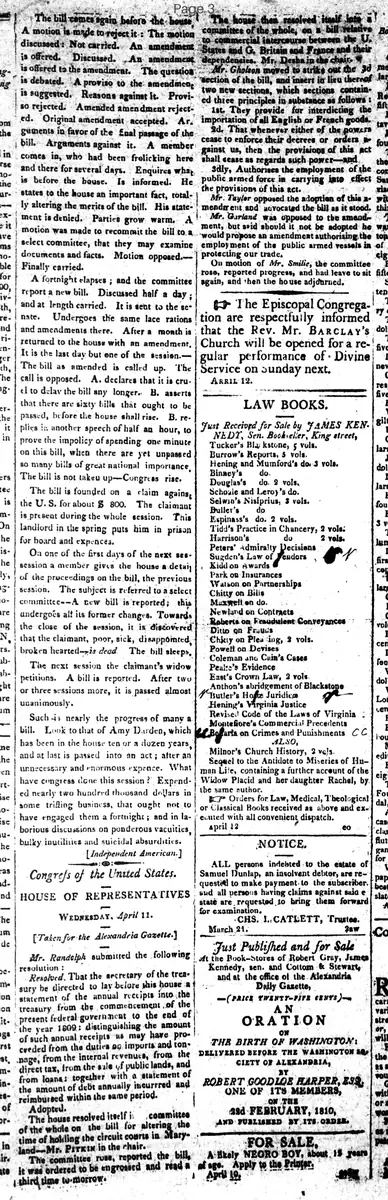
Congress of the United States.
HOUSE OF REPRESENTATIVES
WEDNESDAY, April 11.
[Taken for the Alexandria Gazette.]
Mr. Randolph submitted the following resolution:
Resolved, That the secretary of the treasury be directed to lay before this house a statement of the annual receipts into the treasury from the commencement of the present federal government to the end of the year 1809: distinguishing the amount of such annual receipts as may have proceeded from the duties on imports and tonnage, from the internal revenues, from the direct tax, from the sale of public lands, and from loans: together with a statement of the amount of debt annually incurred and reimbursed within the same period.
The house resolved itself into a committee of the whole on the bill for altering the time of holding the circuit courts in Maryland—Mr. Pitkin in the chair.
The committee rose, reported the bill, it was ordered to be engrossed and read a third time to-morrow.
The house then resolved itself into a committee of the whole on a bill relative to commercial intercourse between the U. States and G. Britain and France and their dependencies. Mr. Desha in the chair.
Mr. Gholson moved to strike out the 3d section of the bill, and insert in lieu thereof two new sections, which sections contained three principles in substance as follows:
1st. They provide for interdicting the importation of all English or French goods.
2d, That whenever either of the powers cease to enforce their decrees or orders against us, then the provisions of this act shall cease as regards such power—and
3dly, Authorizes the employment of the public armed force in carrying into effect the provisions of this act.
Mr. Taylor opposed the adoption of this amendment and advocated the bill as it stood.
Mr. Garland was opposed to the amendment, but said should it not be adopted he would propose an amendment authorizing the employment of the public armed vessels in protecting our trade.
On motion of Mr. Smilie, the committee rose, reported progress, and had leave to sit again, and then the house adjourned.
What sub-type of article is it?
What keywords are associated?
What entities or persons were involved?
Where did it happen?
Domestic News Details
Primary Location
United States House Of Representatives
Event Date
Wednesday, April 11.
Key Persons
Outcome
the committee on the circuit courts bill reported it for engrossment and third reading the next day. the committee on the commercial intercourse bill reported progress and was granted leave to sit again. the house adjourned.
Event Details
Mr. Randolph submitted a resolution directing the Secretary of the Treasury to provide statements of annual receipts and debts from the start of the federal government to 1809, distinguishing sources. The House formed a committee of the whole on a bill altering the time of holding circuit courts in Maryland, chaired by Mr. Pitkin, which reported the bill. It then formed another committee on a bill relative to commercial intercourse with Great Britain and France, chaired by Mr. Desha. Mr. Gholson proposed an amendment to strike the 3d section and insert two new sections interdicting imports from England and France, ceasing provisions if decrees stopped, and authorizing armed force. Mr. Taylor opposed the amendment. Mr. Garland opposed it but suggested an alternative for armed vessels if rejected. On Mr. Smilie's motion, the committee rose and reported progress.