Thank you for visiting SNEWPapers!
Sign up free
The Enquirer
Richmond, Henrico County, Virginia
What is this article about?
In early 1809, the U.S. House and Senate debated repealing the Embargo Act, enacting non-intercourse with Britain and France, passing a bill for additional import duties, and handling related memorials and resolutions amid concerns over commerce, war, and national unity.
Merged-components note: Merged continued reports on congressional debates and proceedings from January 20 to February 16 across sequential reading orders.
Clippings
1 of 2
OCR Quality
Full Text
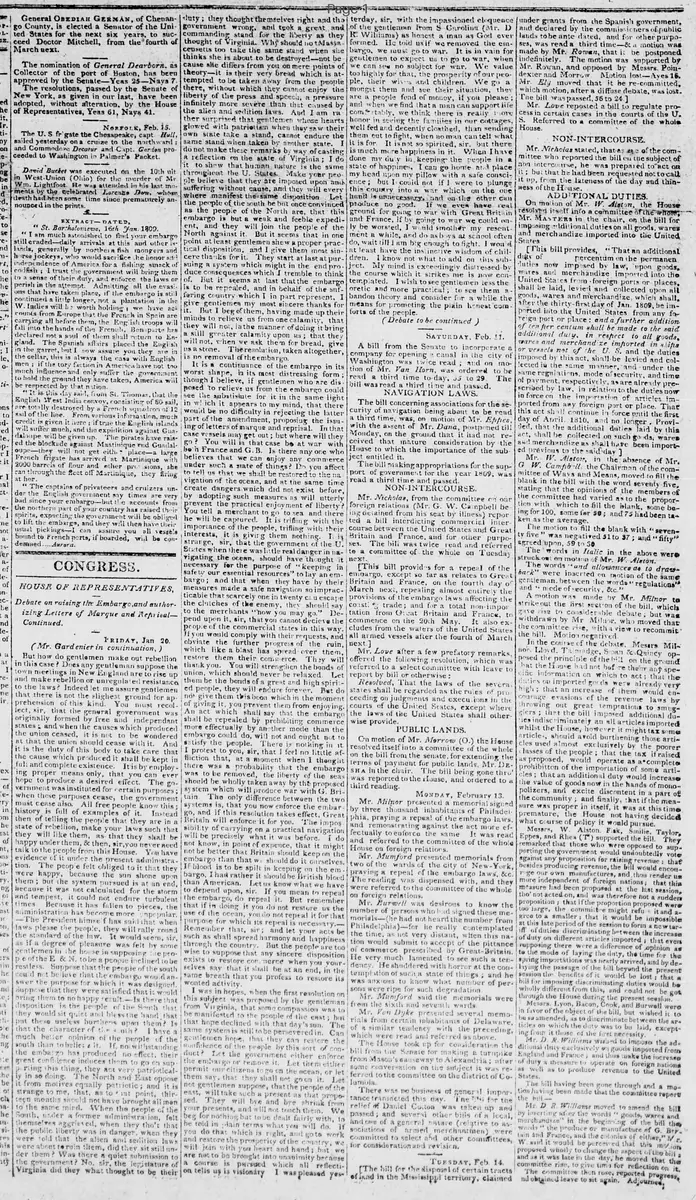
HOUSE OF REPRESENTATIVES.
Debate on raising the Embargo, and authorizing Letters of Marque and Reprisal--Continued.
FRIDAY, Jan. 20.
(Mr. Gardenier, in continuation.)
But how do gentlemen make out rebellion in this case? Does any gentleman suppose the town meetings in New England are to rise up and make rebellion or unregulated resistance to the laws? Indeed let me assure gentlemen that there is not the slightest ground for apprehension of this kind. You must recollect, sir, that the general government was originally formed by free and independent states: and when the causes which produced the union ceased, it is not to be wondered at that the union should cease with it. And it is the duty of this body to take care that the cause which produced it shall be kept in full and complete existence. It is by employing proper means only, that you can ever hope to produce a desired effect. The government was instituted for certain purposes; when those purposes cease, the government must cease also. All free people know this; history is full of examples of it. Instead then of telling the people that they are in a state of rebellion, make your laws such that they will like them, as that they shall be happy under them, & then, sir, you never need talk to the people from this House. You have evidence of it under the present administration. The people felt obliged to it that they were happy, because the sun shone upon them; but the system pursued is at an end, because it was not calculated for the storm and tempest, it could not endure turbulent times. Because it has fallen to pieces, the administration has become more unpopular. The President himself has said that when laws please the people, they will rally round the standard of the law. It would seem, sir, as if a degree of pleasure was felt by some gentlemen in the house in supposing the people of the E & N. to be a people inclined to be restless. Suppose that the people of the south could not believe that the embargo would answer the purpose for which it was designed. Suppose that they were satisfied that it would bring them to no happy result.--Is there that disposition in the people of the South that they would sit quiet and kiss the hand that put these useless burdens upon them? Is that the character of the S & oih? I have a much better opinion of the people of the south than to believe it. If, notwithstanding the embargo has produced no effect, their great confidence induces them to go on supporting this thing, they act very patriotically in so doing. The North and East oppose it from motives equally patriotic; and it is strange to me, that, as to that point, thirteen months should not have brought all men to the same mind. When the people of the South, under a former administration, felt themselves aggrieved, when they thought that the public liberty was in danger, when they were told that the alien and sedition laws were about to ruin them, did they sit still under them? Was there a quiet submission to the government? No, sir, the Legislature of Virginia did what they thought to be their
duty; they thought themselves right and the government wrong, and took a great and commanding stand for the liberty as they thought of Virginia. Why should not Massachusetts too take the same stand when she thinks she is about to be destroyed--not because she differs from you on mere points of theory--it is their very bread which is attempted to be taken away from the people there, without which they cannot enjoy the liberty of the press and speech, a pressure infinitely more severe than that caused by the alien and sedition laws. And I am rather surprised that gentlemen whose hearts glowed with patriotism when they saw their own state take a stand, cannot endure the same stand when taken by another state. I do not make these remarks by way of casting a reflection on the state of Virginia; I do it to shew that human nature is the same throughout the U. States. Make your people believe that they are imposed upon and suffering without cause, and they will everywhere manifest the same disposition. Let the people of the south be but once convinced as the people of the North are, that this embargo is but a weak and feeble expedient, and they will join the people of the North against it. But it seems that in one point at least gentlemen shew a proper practical disposition, and I give them most sincere thanks for it. They start at last at pursuing a system which might in the end produce consequences which I tremble to think of. But it seems at last that the embargo is to be repealed, and in behalf of the suffering country which I in part represent, I give gentlemen my most sincere thanks for it. But I beg of them, having made up their minds to relieve us from one calamity, that they will not, in the manner of doing it bring a still greater calamity upon us; that they will not, when we ask them for bread, give us a stone. The resolution, taken altogether, is no removal of the embargo. It is a continuance of the embargo in its worst shape, in its most distressing form; though I believe, if gentlemen who are disposed to relieve us from the embargo could see the substitute for it in the same light in which it appears to my mind, that there would be no difficulty in rejecting the latter part of the amendment, proposing the issuing of letters of marque and reprisal. In that case vessels may get out; but where will they go? You will in that case be at war with both France and G.B. Is there any one who believes that we can enjoy any commerce under such a state of things? Do you affect to tell us that we shall be restored to the navigation of the ocean, and at the same time create dangers which did not exist before, by adopting such measures as will utterly prevent the practical enjoyment of liberty? You tell a merchant to go to sea and there he will be captured. It is trifling with the importance of the people, trifling with their interests, it is giving them nothing. It is strange, sir, that the government of the U. States when there was little real danger in navigating the ocean, should have thought it necessary for the purpose of "keeping in safety our essential resources" to lay an embargo; and that when they have by their measures made a safe navigation so impracticable that scarcely one in twenty can escape the clutches of the enemy, they should say to the merchants "now you may go."
Depend upon it, sir, that you cannot deceive the people of the commercial states in this way. If you would comply with their requests, and obviate the further progress of the ruin, which like a blight has spread over them, restore them their commerce. They will thank you. You will strengthen the bonds of union, which should never be relaxed. Let them be the bonds of a great and high spirited people, they will endure forever. But do not give them this boon which in the moment of giving it, you prevent them from enjoying. An act which shall say that the embargo shall be repealed by prohibiting commerce more effectually by another mode than the embargo could do, will not and ought not to satisfy the people. There is nothing in it.
I protest to you, sir, that I feel no little affliction that, at a moment when I thought there was a probability that the embargo was to be removed, the liberty of the seas should be wholly taken away by the proposed system which will produce war with G. Britain. The only difference between the two systems is, that you now enforce the embargo, and if this resolution takes effect, Great Britain will enforce it for you. The impossibility of carrying on a practical navigation will be precisely what it was before. I do not know, in point of expense, that it might not be better that Britain should keep on the embargo than that we should do it ourselves. If blood is to be spilt in keeping on the embargo, I had rather it should be British blood than American. Let us know what we have to depend upon, sir. If you mean to repeal the embargo, do repeal it. But remember that if in doing it you do not restore us the use of the ocean, you do not repeal it for that purpose for which its repeal is necessary.--Remember that, sir; and let your acts be such as shall spread harmony and happiness through the country. But the people are too wise to suppose that any sincere disposition exists to restore commerce when you yourselves say that it shall be at an end, in the same breath that you profess to restore its wonted activity.
I was in hopes, when the first resolution on this subject was proposed by the gentleman from Virginia, that some compassion was to be manifested to the people of the east; but that hope declined with that day's sun. The same system is still to be persevered in. Can gentlemen hope, that they can restore the confidence of the people by this sort of conduct? Let the government either enforce the embargo or remove it. Let them either permit our citizens to go on the ocean, or let them say, that they shall not go on it. Let not gentlemen suppose, that the people of the east, will take such a present as that proposed. They will by and by shrink from your presents, and will not touch them. We beg for nothing but to be dealt fairly with, to be told in plain terms what you will do. If you do that which is right, and go to work and restore the prosperity of the country, we will join with you heart and hand; but we are not to be brought into unanimity because a course is pursued which all reflection tells us is visionary. I was pleased yesterday, sir, with the impassioned eloquence of the gentleman from S. Carolina (Mr. D. R. Williams) as honest a man as God ever formed. He told us if we removed the embargo, we must go to war. It is in vain for gentlemen to expect us to go to war, when we can see no subject for war. We value too highly for that, the prosperity of our people, their wives and children. We go amongst them and see their situation, they are a people fond of money, if you please; and when we find that a man can support life comfortably, we think there is really more honor in seeing the families in our cottages, well fed and decently clothed, than sending them out to fight, when no man can tell what it is for. It is not so spirited, sir, but there is much more happiness in it. When I have done my duty in keeping the people in a state of happiness, I can go home and place my head upon my pillow with a safe conscience; but I could not if I were to plunge this country into a war which on the one hand is unnecessary and on the other can produce no good. If we even have real ground for going to war with Great Britain and France, if by going to war we could only be worsted, I would smother my resentment a while, and do as boys at school often do, wait till I am big enough to fight. I would at least have the instinctive wisdom of children. I know not what to add on this subject. My mind is exceedingly distressed by the course which it strikes me is now contemplated. I wish to see gentlemen less theoretic and more practical; to see them abandon theory and consider for a while the means for promoting the plain honest comforts of the people.
(Debate to be continued.)
SATURDAY, Feb. 11.
A bill from the Senate to incorporate a company for opening a canal in the city of Washington was twice read; and on motion of Mr. Van Horn, was ordered to be read a third time to-day. 55 to 29. The bill was read a third time and passed.
NAVIGATION LAWS.
The bill concerning associations for the security of navigation being about to be read a third time, was, on motion of Mr. Eppes, with the assent of Mr. Dana, postponed till Monday, on the ground that it had not received that mature consideration by the House to which the importance of the subject entitled it.
The bill making appropriations for the support of government for the year 1809, was read a third time and passed.
NON-INTERCOURSE.
Mr. Nicholas, from the committee on foreign relations (Mr. G. W. Campbell being detained from his seat by illness) reported a bill interdicting commercial intercourse between the United States and Great Britain and France, and for other purposes. The bill was twice read and referred to a committee of the whole on Tuesday next.
[This bill provides for a repeal of the embargo, except so far as relates to Great Britain and France, on the fourth day of March next, repealing almost entirely the provisions of the embargo laws affecting the coasting trade; and for a total non-importation from Great Britain and France, to commence on the 20th May. It also excludes from the waters of the United States all armed vessels after the fourth of March next.]
Mr. Love after a few prefatory remarks, offered the following resolution, which was referred to a select committee with leave to report by bill or otherwise:
Resolved, That the laws of the several states shall be regarded as the rules of proceeding on judgments and executions in the courts of the United States, except where the laws of the United States shall otherwise provide.
PUBLIC LANDS.
On motion of Mr. Morrow (O.) the House resolved itself into a committee of the whole on the bill from the senate, for extending the terms of payment for public lands, Mr. Desha in the chair. The bill being gone through was reported to the House, and ordered to a third reading.
MONDAY, February 13.
Mr. Milnor presented a memorial signed by three thousand inhabitants of Philadelphia, praying a repeal of the embargo laws, and remonstrating against the act more effectually to enforce the same. It was read and referred to the committee of the whole House on foreign relations.
Mr. Mumford presented memorials from two of the wards of the city of New-York, praying a repeal of the embargo laws, &c. The reading was dispensed with, and they were referred to the committee of the whole on foreign relations.
Mr. Burwell was desirous to know the number of persons who had signed these memorials--(he had not heard the number from Philadelphia)--for he really contemplated the time, as not very distant, when this nation would submit to accept of the pittance of commerce prescribed by Great-Britain. He very much lamented to see such a tendency. He shuddered with horror at the contemplation of such a state of things; and he was anxious to know what number of persons were ripe for such degradation.
Mr. Mumford said the memorials were from the sixth and seventh wards.
Mr. Van Dyke presented several memorials from certain inhabitants of Delaware, of a similar tendency with the preceding, which were read and referred as above.
The House took up for consideration the bill from the Senate for making a turnpike from Mason's Causeway to Alexandria; after some conversation on the subject it was referred to the committee on the district of Columbia.
There was no business of general importance transacted this day. The bill for the relief of Daniel Cotton was taken up and passed; and several other bills of a local, and one of a general nature (relative to associations of armed merchantmen) were committed to select and other committees, for consideration and revision.
Tuesday, Feb. 14.
The bill for the disposal of certain tracts of land in the Mississippi territory, claimed under grants from the Spanish government, and declared by the commissioners of public lands to be ante dated, and for other purposes, was read a third time--and a motion was made by Mr. Rowan, that it be postponed indefinitely. The motion was supported by Mr. Rowan, and opposed by Messrs. Poindexter and Morrow. Motion lost--Ayes 16.
Mr. Ely moved that it be re-committed, which motion, after a diffuse debate, was lost. The bill was passed, 56 to 24.
Mr. Love reported a bill to regulate process in certain cases in the courts of the U. S. Referred to a committee of the whole House.
NON-INTERCOURSE.
Mr. Nicholas stated, that as one of the committee who reported the bill on the subject of non intercourse, he was prepared to act on it; but that he had been requested not to call it up, from the lateness of the day and thinness of the House.
ADDITIONAL DUTIES.
On motion of Mr. W. Alston, the House resolved itself into a committee of the whole, Mr. Masters in the chair, on the bill for imposing additional duties on all goods, wares and merchandize imported into the United States.
[This bill provides,
"That an additional duty of fifty per centum on the permanent duties now imposed by law, upon goods, wares and merchandize imported into the United States from foreign ports or places, shall be laid, levied and collected upon all goods, wares and merchandize, which shall, after the thirty-first day of Jan. 1809, be imported into the United States from any foreign port or place: and a further addition of ten per centum shall be made to the said additional duty, in respect to all goods, wares and merchandize imported in ships or vessels not of the U. S. and the duties imposed by this act, shall be levied and collected in the same manner, and under the same regulations, mode of security, and time of payment, respectively, as are already prescribed by law, in relation to the duties now in force on the importation of articles imported from any foreign port or place. That this act shall continue in force until the first day of April, 1810, and no longer, Provided, that the additional duties laid by this act, shall be collected on such goods, wares and merchandize as shall have been imported previous to the said day.]
Mr. W. Alston, in the absence of Mr. G. W. Campbell, the Chairman of the committee of Ways and Means, moved to fill the blank in the bill with the word seventy five, stating that the opinions of the members of the committee had varied as to the proportion with which to fill the blank, some being for 100, some for 50; and 75 had been taken as the average.
The motion to fill the blank with "seventy five" was negatived 51 to 37; and "fifty" agreed to, 59 to 30.
The words in Italic in the above were struck out on motion of Mr. W. Alston.
The words "and allowances to draw back" were inserted on motion of the same gentleman, between the words "regulations" and "mode of security, &c."
A motion was made by Mr. Milnor to strike out the first section of the bill, which gave rise to considerable debate; but was withdrawn by Mr. Milnor, who moved that the committee rise, with a view to recommit the bill. Motion negatived.
In the course of the debate, Messrs. Milnor, Lloyd, Talmadge, Sloan & Quincy opposed the principle of the bill on the ground that the House had not before them any specific information on which to act; that the duties on imported goods were already very high; that an increase of them would encourage evasions of the revenue laws by throwing out great temptations to smugglers; that the bill imposed additional duties indiscriminately on all articles imported whilst the House, however it might tax some articles, should avoid burthening those articles used almost exclusively by the poorer classes of the people; that the tax if raised as proposed, would operate as a complete prohibition of the importation of some articles; that an additional duty would increase the value of goods now in the hands of monopolizers, and excite discontent in a part of the community; and finally, that if the measure was proper in itself, it was at this time premature, the House not having decided what course of policy it would pursue.
Messrs. W. Alston, Fisk, Smilie, Taylor, Eppes, and Rhea (T.) supported the bill. They remarked that those who were opposed to supporting the government would undoubtedly vote against any proposition for raising revenue; that besides producing revenue, the bill would encourage our own manufactures, and thus render us more independent of foreign nations; that this measure had been proposed at the last session, tho' not acted on, and was therefore not a sudden proposition; that if the proportion proposed were too large, the committee might reduce it and agree to a smaller; that it would be impossible at this late period of the session to form a new tariff of duties discriminating between the increase of duty on different articles imported; that even supposing there were a difference of opinion as to the mode of laying the duty, the time for the spring importations was nearly arrived, and by delaying the passage of the bill beyond the present session the benefits of it would be lost; that a bill for imposing discriminating duties would be wholly different from this, and could not be got through the House during the present session.
Messrs. Lyon, Bacon, Cook, and Burwell were in favor of the object of the bill, but wished it to be so amended, as to discriminate between the articles on which the duty was to be laid, excepting from it those of the first necessity.
Mr. D. R. Williams wished to impose the additional duty exclusively on goods imported from England and France; and thus make the increase of duty a measure to operate on foreign nations as well as to produce revenue to the United States.
The bill having been gone through and a motion having been made that the committee report the bill--
Mr. D. R. Williams moved to amend the bill by inserting after the words "goods, wares and merchandize" in the beginning of the bill the words "the produce or manufacture of G. Britain and France, and the colonies of either," Mr. W. said it would be perceived that this motion proposed wholly to change the aspect of the bill; and as it was late in the day, he moved that the committee rise, to give time for reflection on it.
The committee then rose, reported progress, and obtained leave to sit again. Adjourned.
WEDNESDAY, Feb. 15.
NON-INTERCOURSE.
On motion of Mr. Nicholas, the House resolved itself into a committee of the whole, Mr. Bassett in the Chair, on the bill for interdicting commercial intercourse between the United States and Great Britain and France and for other purposes.
Mr. Minor moved to strike out the first section of the bill, with a view to try the principle of the non-intercourse system.
Mr. Quincy entered at considerable length into an examination of the system of coercion on foreign nations by means of commercial restrictions. The idea of the efficacy of this system he traced to a deeper root than any administration under this government. It was an error of the American people, originating in a period antecedent to the revolution: it grew out of our colonial regulations. It began to be a favorable belief with the people, antecedent to the year 1780, and was then fostered by the patriots of that day, the idea being also encouraged by the patriots of England. Mr. Quincy entered into a comparative statement of the exports from and imports to Great Britain from America at two different periods, viz. the nine years preceding the year 1775, and the nine years succeeding it, with a view to show that the average imports into Great Britain from all the world, during the nine years hence with this country amounted to but about one thirtieth more than the average imports during the same period of soar; and the exports diminished nearly in the same proportion.
From his statements on this head and a comparison of the present relative situation of the two countries, Mr. Quincy drew the inference that this supposed means of coercing the European powers did not exist. He deemed it peculiarly unfortunate that a confidence in this power of coercion had so long existed, as it had prevented the United States from making preparations which they otherwise might have made. He hoped the idea would now cease.
In relation to our present situation, he recommended a plain remedy, comprised in two words: 'Follow nature.' What did the first dictate for remedying any complaint? The removal of all obstructions on her operations. Mr. Quincy therefore recommended the removal of the embargo, the repeal of the non-importation act and the abandonment of the non-intercourse system. He wished peace if possible; if war, union in that war; for this reason he wished a negotiation to be opened unshackled with those impediments to it which now existed. As long as they remained, the people in the portion of the country whence he came, would not deem an unsuccessful attempt at negotiation to be cause for war; if they were removed, and an earnest attempt at negotiation was made unimpeded with these restrictions, and should not meet with success, they would join heartily in a war. They would not, however, go to war to contest the rights of Great Britain to search American seamen for British seamen; for it was a general opinion with them, that if American seamen were encouraged, there would be no occasion for the employment of foreign seamen. The removal of the embargo without adopting any other measure until the event of negotiation had been tried, Mr. Quincy's plan would first prevent any collision with the belligerents which might tend to embarrass negotiation; and secondly, would give an opportunity to the country to ascertain what would be the practical operation of these orders and decrees on our commerce hence; and give an opportunity to the next Congress to shape its measures according to their actual effect. If commerce did not suffer, the knowledge of this fact would supersede the necessity of any other measure, and peace would follow of course; if on the contrary, a general sweep was made of all the property afloat, it would unite all parties in a war. Mr. Quincy concluded a speech of two hours in length, by lamenting the state of the country, and invoking the spirit which 'rides the whirlwind and directs the storm' to guide the nation to a happy result.
Mr. Nicholas replied to the observations of Mr. Quincy on the subject of the legal opposition to the embargo laws in Massachusetts. He said if the laws of the nation were to be resisted in the manner in which he lamented to say that he saw it contemplated in one part of the community, it became the duty of this Legislature to meet it; it was not compatible with their duty to shrink from it. He could not consent that thirteen or fourteen states should submit to one. As men vested with certain powers by the constitution, Congress could not transfer the powers to any state legislature or to any town. In relation to negotiating with measures of coercion in existence, Mr. Nicholas asked when did the violations of our rights commence? So long ago that the precise time could not be fixed. When did our coercive measures commence? In 1805. Mr. N. noticed the negotiators during whose ministry abroad these injuries had commenced and continued. Mr. King, Mr. Monroe and Mr. Pinkney, all honorable men, had successively represented the United States in Great Britain. And could anything be gathered from anything they had ever written or said, to induce a belief that this government had not acted with sincerity? There was the most conclusive evidence to the contrary. Mr. N. said he would ask nothing of Great Britain or France that would tend to sacrifice their honor; and he wished when gentlemen dwelt so much on the regard of foreign nations for their national character, that they would respect a little the character of our own country.
Mr. D. R. Williams said he had been decidedly in favor of issuing letters of marque and reprisal at once; he believed it would have cut off all that gangrenous matter now deteriorating the body politic—for the people of New-England were as patriotic as any, and when the choice was between their own and a foreign country, they would cling to their own. It was the hot-bed politicians who stirred them up; and it was necessary to do something promptly to put an end to their intrigues. Mr. W. disliked the non-intercourse system throughout. If he could not get war or a continuance of the embargo, he wished, inasmuch as Great-Britain and France had each interdicted us from going to the other, to declare that neither their armed or unarmed ships should contaminate our waters. This was a system which required no exertion of patriotism to carry into effect, which could excite no animosities between the north and south. In relation to the non-intercourse, he believed that it could not be enforced, and used a variety of arguments to show that it could not. If it could be enforced, he believed it would be prodigiously partial. If the embargo was to be removed and war not to be substituted,
if the nation was to submit, he wished to do it profitably. If the embargo were raised as to a single cent, it was raised entirely to all effectual purposes. Then let your vessels go (said he) without let or hindrance; let them go and be burnt; your merchants will then feel that the embargo was a shield spread over them, and will come back to your protection like the prodigal son, and unite like brethren in the common cause.
Mr. Williams said his plan was to interdict the entrance of our ports to belligerent vessels armed or unarmed, and lay a tax of 50 per cent. on their manufactures. Great-Britain must then either go to war or treat with us. If she was inclined to go to war in preference to revoking her orders in council, let her do so. But he was inclined to believe that she would treat. If she seized our vessels, however, the effect would be inevitable. Division amongst us would be done away—all would unite heart and hand in war. Mr. W. replied to a number of the observations of Mr. Quincy—particularly in relation to his position that all obstructions ought to be removed with a view to negotiation. He asked what security had the United States if they did all this, if they submitted to such abject humiliation, that G. Britain would treat? Was it to be expected that she would treat more liberally with us when we solicited as slaves, than she would whilst we magnanimously contended for our rights? The gentleman from Massachusetts (said he) when repeating his creed, had forgotten a part, viz: 'Unfurl the banners of the republic against the imperial standard!'
This would complete a project he had lately seen proposed from the east; and as to its application, coinciding with the wishes over the water would be just such a project as Mr. Canning might dictate. Revoke your proclamation, remove the embargo and 'unfurl the republican banners against the imperial standard.'
Mr. Williams concluded a speech of an hour and a half in length with giving notice, that he should move to amend the bill, when the present motion was decided, by striking out all that part of it relating to non-intercourse, and inserting a provision interdicting the entrance of our harbors to any vessel of G. Britain and France, and imposing an additional duty on all goods imported from those countries.
When Mr. Williams concluded, the committee rose and obtained leave to sit again.
THURSDAY, Feb. 16.
ADDITIONAL DUTIES.
The House this day passed the bill laying an additional duty (50 per cent. on present duties) on all goods, wares and merchandize imported into the U. States.
NON-INTERCOURSE.
Some progress was made in the non-intercourse bill.
The motion for striking out the first section of the bill was negatived, 24 only rising in favor of it.
The twentieth day of May was fixed as the day on which the part interdicting the entrance of British and French vessels should take effect.
Mr. D. R. Williams moved to strike out the fourth section of the bill (prohibiting the importation of British and French goods) and insert in lieu of it a section for imposing a discriminating duty of fifty per cent on all former duties, on goods, &c. imported from those countries.
The Committee rose without coming to a decision on this question.
[Further details of this day's proceedings in our next]
SENATE OF THE U. STATES.
Monday, Feb. 13.
Mr. Giles occupied the greater part of the day in support of his resolution relative to the embargo, &c.
FEB. 14.
Mr. Gregg reported a bill authorizing an augmentation of the marine corps. [This bill passed to a third reading on the 16th. It authorizes the president to augment the present corps by one major, two captains, two first lieutenants, 185 corporals, and 594 privates.]
The senate resumed the consideration of Mr. Giles's resolution, which is as follows:
Resolved, That the several laws laying an embargo on all ships and vessels in the ports and harbors of the U States be repealed on the fourth day of March next, except as to Great Britain and France, and their dependencies; and that provision be made by law for prohibiting all commercial intercourse with those nations and their dependencies, & the importation of any article into the U. States, the growth, produce or manufacture of either of the said nations, or of the dominions of either of them.
Mr. Bayard moved to strike out the words in Italic.
On this motion Mr. Bayard spoke at great length, when the question was taken by yeas and nays as follows:
Yeas—Messrs. Bayard, Gilman, Goodrich, Hillhouse, Lloyd, Parker, Pickering, White—8.
Nays—Messrs. Anderson, Condit, Crawford, Franklin, Gaillard, Giles, Gregg, Howard, Mitchell, Leib, Mathewson, Milledge, Moore, Pope, Reed, Smith, of Md. Smith, of N. York. Smith, of Tn. Sumner, Thurston, Tiffin, Turner—23.
Mr. Hillhouse moved to postpone the further consideration of the resolution—Lost.
On agreeing to the original resolution the Senate divided—Yeas 22—Nays 9—All the members voting in the affirmative, who voted in the negative on Mr. Bayard's amendment, and vice versa; except Mr. Turner, who on the resolution voted in the negative.
Ordered, that Messrs. Giles, Smith of Md. and Crawford, be a committee to bring in a bill.
Wednesday, Feb. 15.
On motion of Mr. Smith, of Md. Resolved that a committee be appointed to join such committee as may be appointed on the part of the House of Representatives, to Consider whether any, and if any, what measures ought to be adopted for further accommodation of the president of the United States, for the term commencing the 4th of March next. Committee Messrs. Smith of Md. White and Sumter.
THURSDAY, Feb. 16.
Mr. Giles reported a bill to interdict the commercial intercourse between the U. S. and Great Britain and France, and their dependencies, and for other purposes.
What sub-type of article is it?
What keywords are associated?
What entities or persons were involved?
Where did it happen?
Domestic News Details
Primary Location
Washington
Event Date
January 20 To February 16, 1809
Key Persons
Outcome
passage of bill for additional 50% import duties; progress on non-intercourse bill interdicting trade with britain and france effective may 20, 1809; memorials from philadelphia, new york, delaware presented; various other bills passed or postponed including canal incorporation, navigation laws, appropriations, public lands, marine corps augmentation.
Event Details
House of Representatives debates continuation of embargo repeal and letters of marque by Mr. Gardenier; reports and debates on non-intercourse bill, additional duties bill with amendments debated; memorials against embargo presented; Senate debates Mr. Giles's resolution on embargo repeal except for Britain and France, votes to proceed; reports bill on commercial interdiction.