Thank you for visiting SNEWPapers!
Sign up free
Richmond Enquirer
Richmond, Richmond County, Virginia
What is this article about?
A dinner at Barnard's Hotel in Washington honors Henry Clay, departing as Secretary of State after the 1828 election loss. Toasts praise past and new administrations, state rights, and Clay. Clay speaks on his views of Jackson's election, personal grievances, and hopes for the nation, proposing a toast to the Republic.
Clipping
OCR Quality
Full Text
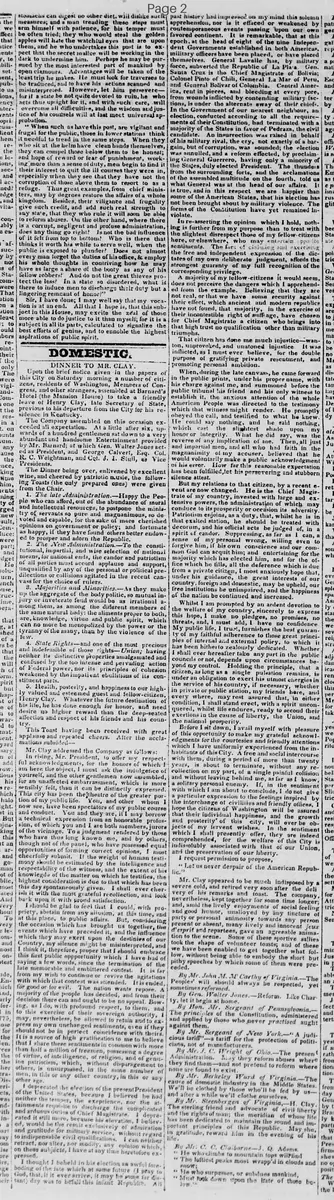
DINNER TO MR. CLAY.
Upon the brief notice given in the papers of this City on Saturday morning a number of citizens, residents of Washington, Members of Congress, and other strangers, assembled at Barnard's Hotel (the Mansion House) to take a friendly leave of Henry Clay, late Secretary of State, previous to his departure from the City for his residence in Kentucky.
The Company assembled on this occasion exceeded all expectation. At a little after six, upwards of a hundred gentlemen sat down to a very abundant and handsome Entertainment provided by Mr. Barnard; at which Gen. Walter Jones acted as President, and George Calvert, Esq. Col. R. C. Weightman, and Col. J. I. Smith, as Vice Presidents.
The Dinner being over, enlivened by excellent wine, and cheered by patriotic music, the following Toasts (the only prepared ones) were given from the Chair.
1. The late Administration.-Happy the People who can afford, out of the abundance of moral and intellectual resources, to postpone the ministry of servants so pure and magnanimous, so devoted and capable, for the sake of more cherished opinions on government or policy; and fortunate as happy, if they have found others better endowed to prosper and adorn the Republic.
2. The New Administration.-To the constitutional, impartial, and wise selection of national means, for national ends, the candor and patriotism of all parties must accord applause and support, unqualified by any of the personal or political predilections or collisions agitated in the recent canvass for the choice of rulers.
3. Majorities and Minorities.-As they make up the aggregate of the body politic, so mutual injury or inveterate feud would be as irrational among them, as among the different members of the same natural body: the aliments proper to both, are, knowledge, virtue and public spirit, which can no more be monopolized by the power or the tyranny of the many, than by the violence of the few.
4. State Rights--and one of the most precious and indefeasible of those rights-Union; having neither its distinctive properties amalgamated and confused by the too intense and pervading action of Federal power, nor its principles of cohesion weakened by the impatient ebullitions of its constituent parts.
5. Health, prosperity, and happiness to our highly valued and esteemed guest and fellow-citizen, Henry Clay. Whatever the future destination of his life, he has done enough for honor, and need desire no higher reward than the deep-seated affection and respect of his friends and his country.
This Toast having been received with great applause and repeated cheers. After the acclamations subsided--
Mr. Clay addressed the Company as follows:
In rising, Mr. President, to offer my respectful acknowledgments, for the honors of which I am the object, I must ask the indulgence of yourself, and the other gentlemen now assembled, for an unaffected embarrassment, which is more sensibly felt, than it can be distinctly expressed. This city has been the theatre of the greater portion of my public life. You, and others whom I now see, have been spectators of my public course and conduct. You and they are, if I may borrow a technical expression from an honorable profession, of which you and I are both members, jurors of the vicinage. To a judgment rendered by those who have thus long known me, and by others, though not of the panel, who have possessed equal opportunities of forming correct opinions, I most cheerfully submit. If the weight of human testimony should be estimated by the intelligence and respectability of the witness, and the extent of his knowledge of the matter on which he testifies, the highest consideration is due to that which has been this day spontaneously given. I shall ever cherish it with the most grateful recollection, and look back upon it with proud satisfaction.
I should be glad to feel that I could, with propriety, abstain from any allusion, at this time, and at this place, to public affairs. But, considering the occasion which has brought us together, the events which have preceded it, and the influence which they may exert upon the destinies of our Country, my silence might be misinterpreted, and I think it, therefore, proper that I should embrace this first public opportunity which I have had of saying a few words, since the termination of the late memorable and embittered contest. It is far from my wish to continue or revive the agitations with which that contest was attended. It is ended. for good or for evil. The nation wants repose. A majority of the people has decided, and from their decision there can and ought to be no appeal. Bowing, as I do, with profound respect, to them, and to this exercise of their sovereign authority, I may, nevertheless, be allowed to retain and to express my own unchanged sentiments, even if they should not be in perfect coincidence with theirs. It is a source of high gratification to me to believe that I share these sentiments in common with more than half a million of freemen, possessing a degree of virtue, of intelligence, of religion, and of genuine patriotism, which, without disparagement to others, is unsurpassed, in the same number of men, in this or any other country, in this or any other age.
I deprecated the election of the present President of the United States, because I believed he had neither the temper, the experience, nor the attainments requisite to discharge the complicated and arduous duties of Chief Magistrate. I deprecated it still more, because his elevation, I believed, would be the result exclusively of admiration and gratitude for military service, without regard to indispensable civil qualifications. I can neither retract, nor alter, nor modify, any opinion which, on these subjects, I have at any time heretofore expressed.
I thought I beheld in his election an awful forewarning of the fate which at some future (I pray to God, that, if it ever arrive, it may be some far distant day) was to befall this infant Republic. All past history had impressed on my mind this solemn apprehension, nor is it effaced or weakened by contemporaneous events passing upon our own favored continent. It is remarkable, that at this epoch, at the head of eight of the nine Independent Governments established in both Americas, military officers have been placed, or have placed themselves. General Lavalle has, by military force, subverted the Republic of La Plata. Gen. Santa Cruz is the Chief Magistrate of Bolivia; Colonel Pinto of Chili, General La Mar of Peru, and General Bolivar of Colombia. Central America, rent in pieces, and bleeding at every pore, from wounds inflicted by contending military factions, is under the alternate sway of their chiefs. In the Government of our nearest neighbour, an election, conducted according to all the requirements of their Constitution, had terminated with a majority of the States in favor of Pedraza, the civil candidate. An insurrection was raised in behalf of his military rival, the cry, not exactly of a bargain, but of corruption, was sounded; the election was annulled, and a reform effected, by proclaiming General Guerrero, having only a minority of the States, duly elected President. The thunders from the surrounding forts, and the acclamations of the assembled multitude on the fourth, told us what General was at the head of our affairs. It is true, and in this respect we are happier than some of the American States, that his election has not been brought about by military violence. The forms of the Constitution have yet remained inviolate.
In re-asserting the opinion which I hold, nothing is further from my purpose than to treat with the slightest disrespect those of my fellow-citizens here, or elsewhere, who may entertain opposite sentiments. The act of claiming and exercising the free and independent expression of the dictates of my own deliberate judgment, affords the strongest guaranty of my full recognition of the corresponding privilege. A majority of my fellow-citizens it would seem, does not perceive the dangers which I apprehended from the example. Believing that they are not real, or that we have some security against their effect, which ancient and modern republics have not found, that majority, in the exercise of their incontestable right of suffrage, have chosen for Chief Magistrate a citizen who brings into that high trust no qualification other than military triumphs.
That citizen has done me much injustice--Washington, unprovoked, and unatoned injustice. It was inflicted, as I must ever believe, for the double purpose of gratifying private resentment, and promoting personal ambition. When, during the late canvass, he came forward in the public prints, under his proper name, with his charge against me, and summoned before the public tribunal his friend and his only witness to establish it, the anxious attention of the whole American People was directed to the testimony which that witness might render. He promptly obeyed the call, and testified to what he knew. He could say nothing, and he said nothing, which cast the slightest shade upon my honor or integrity. What he did say, was the reverse of any implication of me. Then, all just and impartial men, and all who had faith in the magnanimity of my accuser, believed that he would voluntarily make a public acknowledgment of his error. How far this reasonable expectation has been fulfilled, let his persevering and stubborn silence attest.
But my relations to that citizen, by a recent event are now changed. He is the Chief Magistrate of my country, invested with large and extensive powers, the administration of which may conduce to its prosperity or occasion its adversity. Patriotism enjoins, as a duty, that, whilst he is in that exalted station, he should be treated with decorum, and his official acts be judged of, in a spirit of candor. Suppressing, as far as I can, a sense of my personal wrong, willing even to forgive him, if his own conscience and our common God can acquit him; and entertaining for the majority which has elected him, and for the office which he fills, all the deference which is due from a private citizen, I most anxiously hope that, under his guidance, the great interests of our country, foreign and domestic, may be upheld, our free institutions be unimpaired, and the happiness of the nation be continued and increased.
Whilst I am prompted by an ardent devotion to the welfare of my country, sincerely to express this hope, I make no pledges, no promises, no threats, and, I must add, I have no confidence. My public life, I trust, furnishes the best guaranty of my faithful adherence to those great principles of internal and external policy, to which it has been hitherto zealously dedicated. Whether I shall ever hereafter take any part in the public councils or not, depends upon circumstances beyond my control. Holding the principle, that a citizen, as long as a single pulsation remains, is under an obligation to exert his utmost energies in the service of his country, if necessary, whether in private or public station, my friends here, and every where, may rest assured that, in either condition, I shall stand erect, with a spirit unconquered, whilst life endures, ready to second their exertions in the cause of liberty, the Union, and the national prosperity.
Before I sit down, I avail myself with pleasure of this opportunity to make my grateful acknowledgments for the courtesies and friendly attentions which I have uniformly experienced from the inhabitants of this City. A free and social intercourse with them, during a period of more than twenty years, is about to terminate, without any recollection on my part, of a single painful collision and without leaving behind me, as far as I know, a solitary personal enemy. If, in the sentiment with which I am about to conclude, I do not give a particular expression to the feelings inspired by the interchange of civilities and friendly offices, I hope the citizens of Washington will be assured that their individual happiness, and the growth and prosperity of this city, will ever be objects of my fervent wishes. In the sentiment which I shall presently offer, they are indeed comprehended, for the welfare of this City is indissolubly associated with that of our Union, and the preservation of our liberty.
I request permission to propose,
'Let us never despair of the American Republic.'
Mr. Clay appeared to be much indisposed by a severe cold, and retired very soon after the delivery of his remarks and toast. The company, nevertheless, kept together for some time longer; and, amid the lively enjoyments of social feeling and good humor, unalloyed by any tincture of party or personal animosity towards any person present or absent, many lively and innocent jeux d'esprit and repartees, gave an agreeable animation to the scene. Some of these sportive sallies took the shape of volunteer toasts; and of these we have been enabled to get together what follow, without being able to embody the short but pithy speeches by which some of them were preceded.
By Mr. John M. McCarthy of Virginia.-The People's will should always be respected, yet sometimes reformed.
By Gen. Walter Jones.-Reform. Like Charity, let it begin at home.
By Hon. Mr. Sergeant of Pennsylvania.-The principles of the Constitution, administered and applied by those who never practised aught against them.
By Mr. Sergeant of New York.-'A judicious tariff'-a tariff for the protection of politicians, not of manufacturers.
By Mr. J. C. Wright of Ohio.-The present Administration. May they reform abuses where they find them-and not pretend to reform where none are found to exist.
By Mr. Berkeley Ward of Virginia.-The cause of domestic industry in the Middle States. We'll be clothed by those who'll be fed by us-- and after a while we'll clothe ourselves.
By Mr. Steenbergen of Virginia,-H. Clay. The sterling friend and advocate of civil liberty and the rights of man; the meridian of whose life has been dedicated to maintain the sound and important principles of this Republic. May she, in gratitude, reward him in the evening of his life.
By Mr. C. C. Claiborne-J. Q. Adams. 'He who climbs to mountain tops will find "The loftiest peaks most wrapp'd in clouds and snow; "He who surpasses, or subdues mankind, "Must look down upon the hate of those below 's
By Mr. P. Thompson.-R. Rush: The pure patriot, the accomplished scholar, and the perfect gentleman.
By Wm. Prentiss.--Gen. P. B. Porter: The gallant soldier, the able statesman, the undeviating republican, and the honest, unassuming man.
By Major Stull.-Samuel L. Southard: always a patriot citizen of the U. S. though an alien in his native State.
By Mr. D. J. Caswell of Ohio.—-Wm. Wirt, Esq. The learned jurist, the accomplished orator, and finished gentleman.
By W. F. Thornton.-Public sentiment: Better inferred from the present scene, than expressed by that which has just been acted.
By Mr. G. Anderson.-Our Guest: The 'lofty Alleghany' will soon hide him from our view, but his parting ray will cheer us with the hope of again feeling his meridian beams.
By D. J. Caswell of Ohio.-Let aspirants for office hail the rising sun-I look toward the West and cheer the mild radiance of that which is setting.
By John S. Tyson of Baltimore.—Our Union: The key stone of the mighty arch of this Western Empire-the bond of twenty-four nations: Long as the American Eagle shall wing her flight, may e pluribus unum be engraven on her countless imagines: Long as the breezes of Heaven shall rustle our forest leaves, may e pluribus unum glitter on the undulations of our flag.
What sub-type of article is it?
What themes does it cover?
What keywords are associated?
What entities or persons were involved?
Where did it happen?
Story Details
Key Persons
Location
Washington, Barnard's Hotel
Story Details
Citizens and officials gather at Barnard's Hotel to farewell Henry Clay, late Secretary of State, before his return to Kentucky. Prepared toasts honor the old and new administrations, state rights, union, and Clay. Clay responds with thanks, expresses reservations about Jackson's election due to military background and personal injustice, hopes for national prosperity, and proposes a toast to the American Republic. Volunteer toasts follow from attendees praising various figures and principles.