Thank you for visiting SNEWPapers!
Sign up free
The Virginia Gazette
Richmond, Williamsburg, Richmond County, Virginia
What is this article about?
A Virginia gentleman delivers a speech in London defending American resistance to unrepresented taxation, arguing it violates British constitutional rights. He critiques Lord Chatham's plan, emphasizes consent for laws, and warns of potential independence if liberties are not restored.
Merged-components note: Continuation of the extract from the Virginia gentleman's speech across pages; labeled as foreign_news due to its origin in a London society and international perspective on American affairs, differing from the original editorial label on the second part.
Clippings
1 of 2
OCR Quality
Full Text
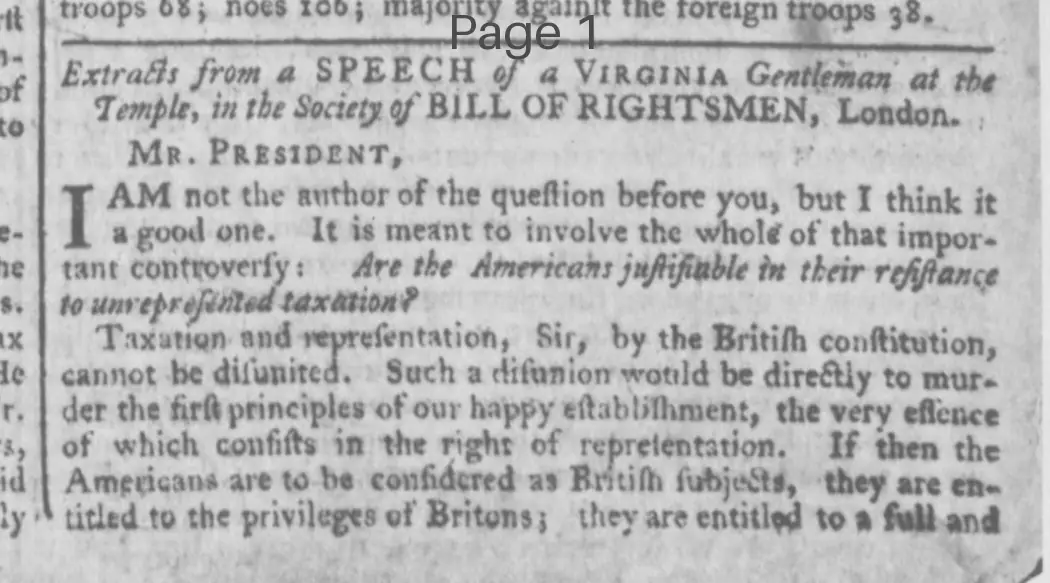
Temple, in the Society of BILL OF RIGHTSMEN, London.
MR. PRESIDENT,
I am not the author of the question before you, but I think it
a good one. It is meant to involve the whole of that impor-
tant controversy: Are the Americans justifiable in their resistance
to unrepresented taxation?
Taxation and representation, Sir, by the British constitution,
cannot be disunited. Such a disunion would be directly to mur-
der the first principles of our happy establishment, the very essence
of which consists in the right of representation. If then the
Americans are to be considered as British subjects, they are en-
titled to the privileges of Britons; they are entitled to a full and
Perfect representation. They are not, however, and from the nature and situation of things, it is granted, even by their enemies, that they cannot be represented in the British Parliament. Then to do that without representation, which by the true intention of the constitution requires the most perfect representation, is undoubtedly to violate that great, that important, that essential right, upon which the liberties of these kingdoms must for ever depend.
And when these rights are violated, Sydney, Locke, and the law of reason, will tell us, that the practical dissolution of all government ought to follow. Or, as my Lord Chief Justice Holt expresses it, "When the liberty of the subject is invaded, it is a provocation to all the subjects of the realm."
I will beg leave, Sir, to go deeper into the argument; and, not confining myself to taxation, I will confidently affirm, that no power on earth has a right to make or establish laws, prerogatives, or regulations, binding on the Americans, without their consent. This is the ground on which the dispute should have turned from the beginning. These are the rights of British subjects, which have been granted them by the God of nature. They have been confirmed to them by solemn compacts between the Sovereign and the subject; and they claim protection from that sacred usage, which commenced in our constitution before the memory of the oldest man alive. To sacrifice and give up these consecrated rights is to sacrifice themselves, their aged parents, their wives and children, the honours and sepulchres of their ancestors, the claims and blessings of posterity.—To this last object I would wish to fix their attention. There is an awful duty upon the Americans, to preserve the rights and liberties which have been transmitted to them from their ancestors; and, without unnatural barbarity, they cannot suffer the dearest inheritance of their children to be destroyed, or impaired.
There was a plan presented by my Lord Chatham, and said to be dictated by the American agents, which too tamely gave up many of these invaluable privileges. I know not whether it was the general sense of America, but this I am sure of, that my Lord Chatham's political refinements, from the beginning of this controversy, have been of infinite prejudice, both to Great Britain and America, by perplexing the arguments, and turning the minds of the people from the true object of contention. His distinction between external and internal taxation is founded, not on the liberties of mankind, but on his own preconceived laws of colonization. His idea of the line to be drawn between Great Britain and America is too finely spun to hold together, or to be reduced to practice. He has always confined himself to taxation, and lost sight of that leading principle of the constitution, that no law, rule, or regulation, shall be made binding on the subject, without his consent.
This is the only line which can be drawn with safety to America, and security to the British constitution. If they relax in any instance from these claims, however small that instance may be, who can tell, but in a very little time all those privileges, though ever so dear, though ever so valuable, may be ravished from them? One precedent creates another; they begin as matter of doubt, they end as solid doctrine. In a momentary space of time they assume the form of established laws. The Romans were led from shades and gradations of misbelief and wickedness, so as at last not to be at all surprised and alarmed at the loss of all their liberties, and the total subversion of the Roman empire.
I again repeat it, that no power on earth has a right to make laws, rules, or regulations, binding on the Americans, without their consent.
Let us now examine the important argument of protection, taken in the popular acceptation of the word. It is upon this argument of protection, and the fanciful dignity of Parliament, that fire and sword are sent like a pestilence to every corner of America. Sir, the Americans are not protected merely because they are British subjects; they are protected upon three grand considerations, resulting from self-interest; upon the extensive and beneficial advantages of their commerce and seamen; upon the dignity and importance they communicate to the British empire in every part of the globe; and upon the fear and danger of their falling into the hands of some other power, who, in consequence of such an acquisition, might discompose the balance of European politics. They feed many millions of people in Great Britain, Ireland, and the West Indies. The landed property is more than quadrupled by that connection. The navy of England, and the land army, are in a chief manner supported by their beneficial commerce. There is not a planter or a farmer in North America that does not pay at least more than quadruple the taxes that the inhabitants of Great Britain do; not, indeed, under the express denomination of taxes, but they pay them in substance. They pay them in the prodigious advantages on their exports and imports. There is not an article of British manufactory which goes from this country, that does not, upon an average with the articles of other countries, bear at least 50 per cent. when sold to the British Americans; and the Americans are obliged to purchase them, because they are so restricted by the British Parliament, that they cannot purchase them elsewhere.—There are some of their principal exports which have fallen at least 20 per cent. since the restrictions on their trade; and the Americans are obliged to sell them at that low valuation, because they are so restricted by the British legislature that they cannot carry them to any other market. But all their weighty contributions are not enough! The colonies must be taxed at pleasure, by unlimited authority! The royal confidence, and their own solemn charters, must be totally annihilated! They must become perfect slaves, and ALL on the score of protection! Sir the Americans want no protection at the expense of their liberties. They would rather be exterminated than breathe under so wretched an existence. At any rate they will try the contest with you; and why should they not? They have many bright examples to illuminate the path before them. They have the best troops in the world for an American war, hardy and intrepid; they are brought up to difficulties, and they are the best marksmen in the world. They have innumerable resources within themselves. The manufactories of arms and ammunition are rapidly advancing; and, above all, they have a title built upon that foundation against which "the gates of despotism can never prevail."
The Gentleman has told us, with all the daft strains of theatrical declamation, of "the heinous crime of American ingratitude; that if Great Britain had not protected the colonies they would have laboured under the deplorable misfortune of falling into the hands of France." Suppose they had, Sir? If that Gentleman was well acquainted with historical records, he would know, that the colonies of free states have been always more uniformly oppressed than the colonies of a pure monarchy, or even of despotism itself. I make no doubt the Americans would rather be subject to the dominion of a King of France, among a genteel and polite people, than be subject to the uncontrolled dominion of a rapacious and unconfined aristocracy, in a land overflowing with venality and corruption.—And if even subjection to the King of France is more desirable than subjection to the British Parliament, how much more readily will the Americans embrace the league, offensive and defensive, which we are well assured is held out to them by more European states than one.
It is a melancholy truth, Sir, that the British government has sunk from its original purity to a confined aristocracy. It is now confirmed, by fatal experience, to be a thing impossible for the few Ministers who govern to entertain a sincere regard for the many people who are governed; or that the friends and hirelings of arbitrary power will not endeavour to better those men who would choose to live and die in a free constitution; it is a point,
till more indubitable, that the few at the helm of affairs in Britain can have no sincere regard for the many that are put under their protection in America. From the late occurrences in the British Parliament, we want no further evidence to determine that matter; nor can we imagine but they will use every effort to enchain those colonies of North America which they have falsely pretended have long been inclined to republican principles. For my part, as a North Briton said before me (and, by the bye, it was a rare phenomenon in a North Briton) I do profess a speculative predilection for that form of government;—but I am convinced that the people of America would rather live under a mixed, under a limited monarchy, SO CONSTITUTED AS OURS, than under the most perfect REPUBLIC that ever was established upon earth. At the same time, Sir, I speak it, to the immortal honour of America, that the manners of those brave people are strictly and wholly republican.
You have been told, Sir, a great deal this evening about American independence. I shall be happy to place that matter in its proper light. The Americans wish for that peaceable re-establishment of the political and commercial union between Great Britain and the colonies which existed and subsisted at the close of the last war. They think it an object most ardently to be wished for. They tell you so from the General Congress, from every Assembly on the continent, from every county committee, and in every action of their lives. — Why then can you not rely on them? Have they ever forfeited their title to veracity? I defy the Gentleman to point me out a single instance in which they have ever deviated, in a collective body, from the strictest laws of moral and political truth. To misrepresent a people at so great a distance, and upon a matter of the very first importance, where their lives, their properties, their liberties, and their laws are at stake, is cruel and unjust. But it has been the fate of those unhappy people to have been misrepresented in every instance. Accept then of their offer, repeal the obnoxious acts, recall your fleets, and armies, and things will quickly subside into their old and wonted channel. Yet, in my opinion, such a connection is not the most eligible on the part of America.—But if you drive them to despair, necessity will oblige them to embrace that independence which has existed only in your own fears and apprehensions. For rather than submit to the British Ministry in their former and present despotic proceedings, the Americans will choose to exist independent of the mother country, though civil war and bloodshed were to be held in perpetual prospect.
My opponents in this controversy have asserted, that the Americans have not only acted in opposition to the British Parliament, but in opposition to their Sovereign. I affirm, Sir, that the one is a natural, an unavoidable consequence of the other; flowing, not from disloyalty in the Americans, but from the cruel and unprincely part which the Sovereign has taken against them. The original compact between the Sovereign and the people is, that if the Sovereign will protect, and secure to them, the rights and liberties of the constitution, they will pay him obedience and subjection. Such a contract is founded on the good of society; it is therefore ultimately founded on the laws of nature. In an establishment, this is the genuine meaning of the word protection. I agree with the Gentleman that protection and subjection are duties reciprocal; but when the protecting power fails in his part of the original contract, the subject is no longer held to the condition of obedience, but of consequence falls back into the primary state of nature, the condition of which state is to commence a new system of legislation. By this reasoning I mean to say, that if the King of England will afford this sort of protection to his American subjects, those subjects will always be ready to pay him obedience; but if the King of England will not afford this sort of protection to his American subjects, nor secure them from the insults and oppressions of his despotic Ministers, they will no longer render him subjection; they will begin a new system of civil and political regulations. Thus is the theory I mean to maintain, and this is the practice I would put into execution.
What sub-type of article is it?
What keywords are associated?
What entities or persons were involved?
Where did it happen?
Foreign News Details
Primary Location
America
Key Persons
Event Details
A Virginia gentleman argues in a London society that Americans are justified in resisting unrepresented taxation, as it violates British constitutional principles of representation and consent. He criticizes Lord Chatham's plan for conceding too much, asserts no laws can bind Americans without consent, refutes protection arguments, and warns of potential independence if rights are not upheld.