Thank you for visiting SNEWPapers!
Sign up free
The New Hampshire Gazette
Portsmouth, Rockingham County, New Hampshire
What is this article about?
Extract from Rev. Mr. Payton's election sermon at Concord, NH, on June 6, 1799, warning against the corrupting influence of vice as seen in the French Revolution, urging Americans to cherish virtue, support government, and fear God to avoid national ruin.
Merged-components note: This is the full text of the Rev. Mr. Payton's Election Sermon, continued across pages 1 and 2. The content is an opinionated religious and political discourse, better fitting 'editorial' than 'literary'.
Clippings
1 of 2
OCR Quality
Full Text
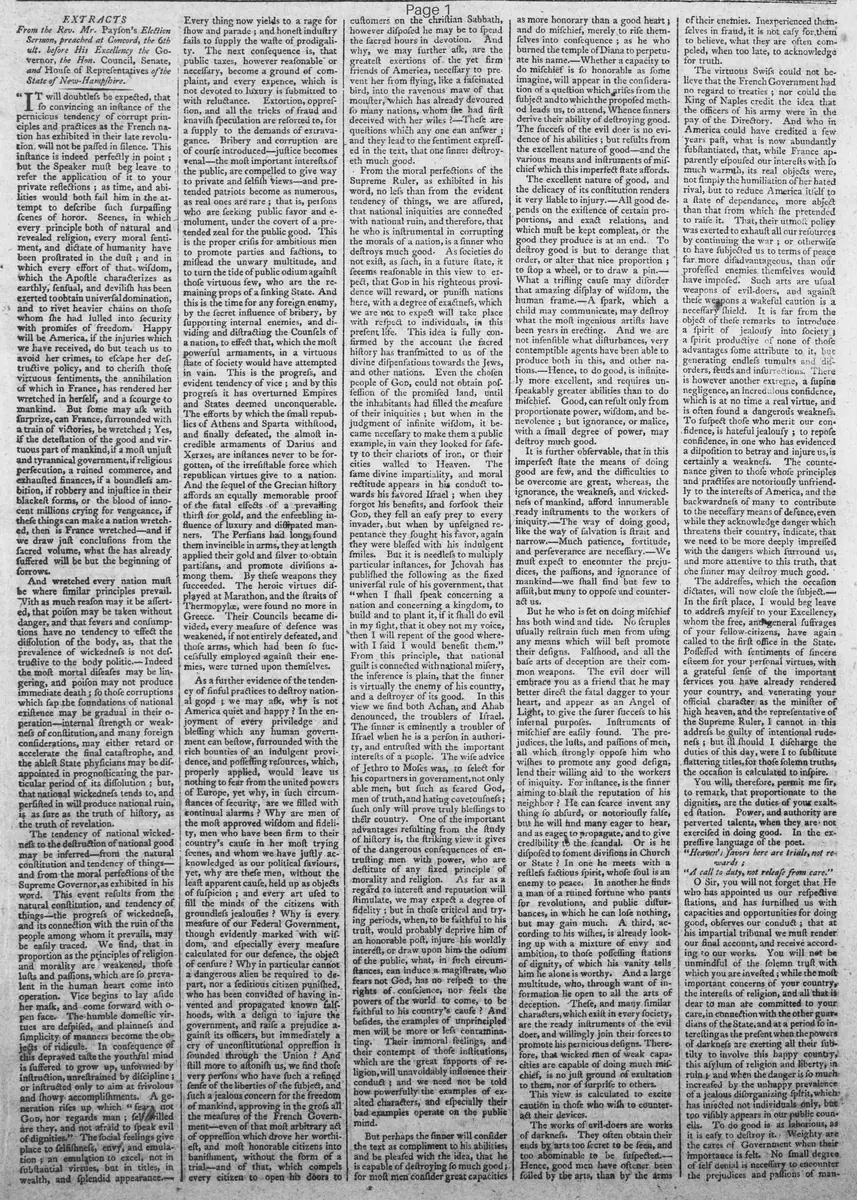
From the Rev. Mr. Payton's Election
Sermon, preached at Concord, the 6th
ult. before His Excellency the Go-
vernor, the Hon. Council, Senate,
and House of Representatives of the
State of New-Hampshire.
"It will doubtless be expected, that
so convincing an instance of the
pernicious tendency of corrupt prin-
ciples and practices as the French na-
tion has exhibited in their late revolu-
tion, will not be passed in silence. This
instance is indeed perfectly in point;
but the Speaker must beg leave to
refer the application of it to your
private reflections; as time, and abi-
lities would both fail him in the at-
tempt to describe such surpassing
scenes of horror. Scenes, in which
every principle both of natural and
revealed religion, every moral senti-
ment, and dictate of humanity have
been prostrated in the dust; and in
which every effort of that wisdom,
which the Apostle characterizes as
earthly, sensual, and devilish has been
exerted to obtain universal domination,
and to rivet heavier chains on those
whom she had lulled into security
with promises of freedom. Happy
will be America, if the injuries which
we have received, do but teach us to
avoid her crimes, to escape her de-
destructive policy, and to cherish those
virtuous sentiments, the annihilation
of which in France, has rendered her
wretched in herself, and a scourge to
mankind. But some may ask with
surprise, can France, surrounded with
a train of victories, be wretched? Yes,
if the detestation of the good and vir-
tuous part of mankind, if a most unjust
and tyrannical government, if religious
persecution, a ruined commerce, and
exhausted finances, if a boundless am-
bition, if robbery and injustice in their
blackest forms, or the blood of inno-
cent millions crying for vengeance, if
these things can make a nation wretch-
ed, then is France wretched--and if
we draw just conclusions from the
sacred volume, what she has already
suffered will be but the beginning of
sorrows.
And wretched every nation must
be where similar principles prevail.
With as much reason may it be as-
serted, that poison may be taken without
danger, and that fevers and consump-
tions have no tendency to effect the
dissolution of the body, as, that the
prevalence of wickedness is not de-
destructive to the body politic.-- Indeed
the most mortal diseases may be lin-
gering, and poison may not produce
immediate death; so those corruptions
which sap the foundations of national
existence may be gradual in their o-
peration-internal strength or weak-
ness of constitution, and many foreign
considerations, may either retard or
accelerate the final catastrophe, and
the ablest State physicians may be di-
appointed in prognosticating the par-
ticular period of its dissolution; but,
that national wickedness tends to, and
persisted in will produce national ruin,
is as sure as the truth of history, as
the truth of revelation.
The tendency of national wicked-
ness to the destruction of national good
may be inferred-from the natural
constitution and tendency of things-
and from the moral perfections of the
Supreme Governor,as exhibited in his
word. This event results from the
natural constitution, and tendency of
things--the progress of wickedness,
and its connection with the ruin of the
people among whom it prevails, may
be easily traced. We find, that in
proportion as the principles of religion
and morality are weakened, those
lusts and passions, which are so preva-
lent in the human heart come into
operation. Vice begins to lay aside
her mask, and come forward with o-
pen face. The humble domestic vir-
tues are despised, and plainness and
simplicity of manners become the ob-
jects of ridicule. In consequence of
this depraved state the youthful mind
is suffered to grow up, uninformed by
instruction, unrestrained by discipline;
or instructed only to aim at frivolous
and showy accomplishments. A ge-
neration rises up which "fears not
God, nor regards man; self-willed
are they, and not afraid to speak evil
of dignities." The social feelings give
place to selfishness, envy, and emula-
tion; an emulation to excel, not in
substantial virtues, but in titles, in
wealth, and splendid appearance.-
Every thing now yields to a rage for
show and parade; and honest industry
fails to supply the waste of prodiga-
ty. The next consequence is, that
public taxes, however reasonable" or
necessary, become a ground of com-
plaint, and every expense, which is
not devoted to luxury is submitted to
with reluctance. Extortion, oppre-
sion. and all the tricks of fraud and
knavish peculation are resorted to, for
a supply to the demands of extrava-
gance. Bribery and corruption are
of course introduced--justice becomes
venal-the most important interests of
the public, are compelled to give way
to private and selfish views-and pre-
tended patriots become as numerous,
as real ones are rare; that is, persons
who are seeking public favor and e-
molument, under the covert of a pre-
tended zeal for the public good. This
is the proper crisis for ambitious men
to promote parties and factions, to
mislead the unwary multitude, and
to turn the tide of public odium against
those virtuous few, who are the re-
maining props of a sinking State. And
this is the time for any foreign enemy.
by the secret influence of bribery, by
supporting internal enemies, and di-
viding and distracting the Councils of
a nation, to effect that, which the most
powerful armaments, in a virtuous
state of society would have attempted
in vain. This is the progress, and
evident tendency of vice; and by this
progress it has overturned Empires
and States deemed unconquerable.
The efforts by which the small repub-
lies of Athens and Sparta withstood,
and finally defeated, the almost in-
credible armaments of Darius and
Xerxes, are instances never to be for-
gotten, of the irresistible force which
republican virtues give to a nation.
And the sequel of the Grecian history
affords an equally memorable proof
of the fatal effects of a prevailing
thirst for gold, and the enfeebling in-
fluence of luxury and dissipated man-
ners. The Persians had long found
them invincible in arms, they at length
applied their gold and silver to obtain
partisans, and promote divisions a-
mong them. By these weapons they
succeeded. The heroic virtues dis-
played at Marathon, and the traits of
Thermopylæ, were found no more in
Greece. Their Councils became di-
vided, every measure of defence was
weakened, if not entirely defeated, and
those arms, which had been so suc-
cessfully employed against their ene-
mies, were turned upon themselves.
As a further evidence of the tenden-
cy of sinful practices to destroy nation-
al good; we may ask, why is not
America quiet and happy? In the en-
joyment of every privilege and
blessing which any human govern-
ment can bestow, surrounded with the
rich bounties of an indulgent provi-
dence, and possessing resources, which,
properly applied, would leave us
nothing to fear from the united powers
of Europe, yet why, in such circum-
stances of security, are we filled with
continual alarms? Why are men of
the most approved wisdom and fide-
lity, men who have been firm to their
country's cause in her most trying
scenes, and whom we have justly ac-
knowledged as our political saviours,
yet, why are these men, without the
least apparent cause, held up as objects
of suspicion; and every art used to
fill the minds of the citizens with
groundless jealousies? Why is every
measure of our Federal Government,
though evidently marked with wi-
dom, and especially every measure
calculated for our defence, the object
of censure? Why in particular cannot
a dangerous alien be required to de-
part, nor a seditious citizen punished,
who has been convicted of having in-
vented and propagated known false-
hoods, with a design to injure the
government, and raise a prejudice a-
gainst its officers, but immediately a
cry of unconstitutional oppression is
sounded through the Union? And
still more to astonish us, we find those
very persons who have such a refined
sense of the liberties of the subject, and
such a jealous concern for the freedom
of mankind, approving in the gross all
the measures of the French Govern-
ment--even of that most arbitrary act
of oppression which drove her worthi-
est, and most honorable citizens into
banishment, without the form of a
trial and of that, which compels
every citizen to open his doors to
customers on the christian Sabbath.
however disposed he may be to spend
the sacred hours in devotion. And
why, we may further ask, are the
greatest exertions of the yet firm
friends of America, necessary to pre-
vent her from flying, like a fascinated
bird, into the ravenous maw of that
monster, which has already devoured
so many nations, whom he had first
deceived with her wiles --These are
questions which any one can answer:
and they lead to the sentiment expre-
ssed in the text, that one sinner des-
troyeth much good.
From the moral perfections of the
Supreme Ruler, as exhibited in his
word, no less than from the evident
tendency of things, we are assured,
that national iniquities are connected
with national ruin, and therefore, that
he who is instrumental in corrupting
the morals of a nation, is a sinner who
destroys much good. As societies do
not exist, as such, in a future state, it
seems reasonable in this view to ex-
pect, that God in his righteous provi-
dence will reward, or punish nations
here, with a degree of exactness, which
we are not to expect will take place
with respect to individuals, in this
present life. This idea is fully con-
firmed by the account the sacred
history has transmitted to us of the
divine dispensations towards the Jews,
and other nations. Even the chosen
people of God, could not obtain pos-
session of the promised land, until
the inhabitants had filled the measure
of their iniquities: but when in the
judgment of infinite wisdom, it be-
came necessary to make them a public
example, in vain they looked for safe-
ty to their chariots of iron, or their
cities walled to Heaven. The
same divine impartiality, and moral
rectitude appears in his conduct to-
wards his favored Israel; when they
forgot his benefits, and forsook their
God, they fell an easy prey to every
invader, but when by unfeigned re-
pentance they sought his favor, again
they were blessed with his indulgent
smiles. But it is needless to multiply
particular instances, for Jehovah has
published the following as the fixed
universal rule of his government, that
"when I shall speak concerning a
nation and concerning a kingdom, to
build and to plant it, if it shall do evil
in my sight, that it obey not my voice,
then I will repent of the good where-
with I said I would benefit them."
From this principle, that national
guilt is connected with national misery,
the inference is plain, that the sinner
is virtually the enemy of his country.
and a destroyer of its good. In this
view we find both Achan, and Ahab
denounced, the troublers of Israel.
The sinner is eminently a troubler of
Israel when he is a person in authori-
ty, and entrusted with the important
interests of a people. The wise advice
of Jethro to Moses was, to elect for
his copartners in government, not only
able men, but such as feared God,
men of truth, and hating covetousness;
such only will prove truly blessings to
their country. One of the important
advantages resulting from the study
of history is, the striking view it gives
of the dangerous consequences of en-
trusting men with power, who are
destitute of any fixed principle' of
morality and religion. As far as a
regard to interest and reputation will
stimulate, we may expect a degree of
fidelity; but in those critical and try-
ing periods, when, to be faithful to his
trust, would probably deprive him of
an honorable post, injure his worldly
interest, or draw upon him the odium
of the public, what, in such circum-
stances, can induce a magistrate, who
fears not God, has no respect to the
rights of. conscience, nor feels the
powers of the world to come, to be
faithful to his country's cause? And
besides, the examples of unprincipled
men will be more or less contamina-
ting. Their immoral feelings, and
their contempt of those institutions,
which are the great supports of re-
ligion, will unavoidably influence their
conduct; and we need not be told
how powerfully the examples of ex-
alted characters, and especially their
bad examples operate on the public
mind.
But perhaps the sinner will consider
the text as compliment to his abilities;
and be pleased with the idea, that he
is capable of destroying so much good;
for most men consider great capacities
as more honorary than a good heart:
and do mischief, merely to raise them-
themselves into consequence; as he who
burned the temple of Diana to perpetu-
ate his name.-Whether a capacity to
do mischief is so honorable as some
imagine, will appear in the considera-
tion of a question which arises from the
subject and to which the proposed meth-
od leads us, to attend, Whence sinners
derive their ability of destroying good.
The success of the evil doer is no evi-
dence of his abilities: but results from
the excellent nature of good-and the
various means and instruments of mis-
chief which this imperfect state affords.
The excellent nature of good, and
the delicacy of its constitution renders
it very liable to injury.-All good de-
pends on the existence of certain pro-
portions, and exact relations, and
which must be kept complete, or the
good they produce is at an end. To
destroy good is but to derange that
order, or alter that nice proportion;
to stop a wheel, or to draw a pin.-
What a trifling cause may disorder
that amazing display of wisdom, the
human frame.--A spark, which a
child may communicate, may destroy
what the most ingenious artists have
been years in erecting. And we are
not insensible what disturbances, very
contemptible agents have been able to
produce both in this, and other na-
tions.-Hence, to do good, is infinite-
ly more excellent, and requires un-
speakably greater abilities than to do
mischief. Good, can result only from
proportionate power, wisdom, and be-
nevolence; but ignorance, or malice,
with a small degree of power, may
destroy much good.
It is further observable, that in this
imperfect state the means of doing
good are few, and the difficulties to
be overcome are great, whereas, the
ignorance, the weakness, and wicked-
ness of mankind, afford innumerable
ready instruments to the workers of
iniquity.--The way of doing good,
like the way of salvation is strait and
narrow.--Much patience, fortitude,
and perseverance are necessary.--We
must expect to encounter the preju-
dices, the passions, and ignorance of
mankind-we shall find but few to
assist, but many to oppose and counter-
act us.
But he who is set on doing mischief
has both wind and tide. No scruples
usually restrain such men from using
any means which will best promote
their designs. Falsehood, and all the
base arts of deception are their com-
mon weapons. The evil doer will
embrace you as a friend that he may
better direct the fatal dagger to your
heart, and appear as an Angel of
Light, to give the surer success to his
infernal purposes. Instruments of
mischief are easily found. The pre-
judices, the lusts, and passions of men,
all which strongly oppose him who
wishes to promote any good design,
lend their willing aid to the workers
of iniquity. For instance, is the sinner
aiming to blast the reputation of his
neighbor? He can scarce invent any
thing so absurd, or notoriously false,
but he will find many eager to hear,
and as eager to propagate, and to give
credibility to the scandal. Or is he
disposed to foment divisions in Church
or State? In one he meets with a
restless factious spirit, whose soul is an
enemy to peace. In another he finds
a man of a ruined fortune who pants
for revolutions, and public distur-
bances, in which he can lose nothing,
but may gain much. A third, ac-
cording to his wishes, is already look-
ing up with a mixture of envy and
ambition, to those possessing stations
of dignity, of which his vanity tells
him he alone is worthy. And a large
multitude, who, through want of in-
formation lie open to all the arts of
deception. These, and many similar
characters, which exist in every society,
are the ready instruments of the evil
doer, and willingly join their forces to
promote his pernicious designs. There-
fore, that wicked men of weak capa-
cities are capable of doing much mi-
chief, is no just ground of exultation
to them, nor of surprise to others.
This view is calculated to excite
caution in those who wish to counter-
act their devices.
The works of evil-doers are works
of darkness. They often obtain their
ends by arts too secret to be seen, and
too abominable to be suspected.--
Hence, good men have oftener been
foiled by the arts, than by the arms
of their enemies. Inexperienced them-
themselves in fraud. it is not easy for them
to believe, what they are often com-
pelled, when too late, to acknowledge
for truth.
The virtuous Swiss could not be-
lieve that the French Government had
no regard to treaties; nor could the
King of Naples credit the idea that
the officers of his army were in the
pay of the Directory. And who in
America could have credited a few
years past, what is now abundantly
substantiated, that, while France ap-
parently espoused our interests with so
much warmth, its real objects were,
not simply the humiliation of her hated
rival, but to reduce America itself to
a state of dependence, more abject
than that from which she pretended
to raise it. That, their utmost policy
was exerted to exhaust all our resources
by continuing the war; or otherwise
to have subjected us to terms of peace
far.more disadvantageous, than our
professed enemies themselves would
have imposed. Such arts are usual
weapons of evil-doers, and against
these weapons a wakeful caution is a
necessary shield. It is far from the
object of these remarks to introduce
a spirit of jealousy into society;
a spirit productive of none of those
advantages some attribute to it, but
generating endless tumults and dis-
orders, feuds and insurrections. There
is however another extreme, a supine
negligence, an incredulous confidence,
which is at no time a real virtue, and
is often found a dangerous weakness.
To suspect those who merit our con-
fidence, is hateful jealousy; to repose
confidence, in one who has evidenced
a disposition to betray and injure us, is
certainly a weakness. The counte-
nance given to those whose principles
and practices are notoriously unfriend-
ly to the interests of America, and the
backwardness of many to contribute
to the necessary means of defence, even
while they acknowledge danger which
threatens their country, indicate, that
we need to be more deeply impressed
with the dangers which surround us,
and more attentive to this truth, that
one sinner may destroy much good. '
The addresses, which the occasion
dictates, will now close the subject.-
In the first place, I would beg leave
to address myself to your Excellency,
whom the free, and general suffrages
of your fellow-citizens, have again
called to the first office in the State.
Possessed with sentiments of sincere
esteem for your personal virtues, with
a grateful sense of the important
services you have already rendered
your country, and venerating your
official character as the minister of
high heaven, and the representative of
the Supreme Ruler, I cannot in this
address be guilty of intentional rude-
ness; but ill should I discharge the
duties of this day, were I to substitute
flattering titles, for those solemn truths,
the occasion is calculated to inspire.
You will, therefore, permit me sir,
to remark, that proportionate to the
dignities, are the duties of your exalt-
ed station. Power, and authority are
perverted talents, when they are not
exercised in doing good. In the ex-
pressive language of the poet.
" Heaven's favors here are trials, not re-
wards;
" A call to duty, not release from care."
O Sir, you will not forget that He
who has appointed us our respective
stations, and has furnished us with
capacities and opportunities for doing
good, observes our conduct; that at
his impartial tribunal we must render
our final account, and receive accord-
ing to our works. You will not be
unmindful of the solemn trust with
which you are invested; while the most
important concerns of your country,
the interests of religion, and all that is
dear to man are committed to your
care, in connection with the other guar-
dians of the State, and at a period so in-
teresting as the present when the powers
of darkness are exerting all their sub-
tility to involve this happy country,
this asylum of religion and liberty, in
ruin. and when the danger is so much
increased by the unhappy prevalence
of a jealous disorganizing spirit, which
has infected not individuals only, but
too visibly appears in our public coun-
cils. To do good is as laborious, as
it is easy to destroy it., Weighty are
the cares of Government when their
importance is felt. No small degree
of self denial is necessary to encounter
the prejudices and passions of man-
kind. But how animating the reflection, that our Glorious Maker beholds with an eye of approbation the trials and conflicts of those, who are faithfully endeavouring to do good, and that his rich rewards are the blessings of an approving conscience, and crowns of immortal bliss. Animated and supported by these views, till may it be your Excellency's highest honor to do good. As a benefactor of your country, may you long live in the grateful feelings of Americans; and at some far distant period, possess the more substantial rewards which await the friends and benefactors of mankind.
To the honorable Council, the honorable Senate, and House of Representatives, would I also beg leave to present respectful addresses and cordial congratulations on this pleasing occasion. To promote the growing greatness of your happy country, to lead her in the paths of peace, to protect her important rights, and counteract the devices of her enemies, is the arduous, but honorable task to which you, our political fathers are now called. If the observations which have been made are productive of the effects most earnestly desired by the speaker, you will enter on those important services with minds penetrated with these sentiments—that sin is misery—that religion is the source and security of all human blessings—and that laws are but weak restraints, where the fear of God, and the moral sense of right and duty have ceased to exist. Under this view you will labor by your private influence and example, no less than by your official transactions to encourage virtue, and to discountenance vice and immorality.
More effectually to counteract the devices of evil doers, the importance of united Councils is obvious. The present, is one of those interesting periods, when a sense of common danger tends to draw to a closer union the real friends of their country. May these sentiments be fervently cherished, and all local prejudices, and party views be made to yield to the common interest.
Religion has become, if possible, of increased importance to Americans, in consequence of an uncommon connection between our political and religious interests. Our enemies are evidently seeking the destruction of our civil privileges, by undermining their surest defence, our religious and moral systems. This fortress taken, we fall their prey without resistance. To advance the interests of religion and virtue, and as a direct means thereto to promote useful knowledge, and moral instruction, we flatter ourselves will be a leading object in your deliberations.
Fathers, Brethren & Fellow Citizens,
With pleasure we recognize on this joyful occasion, this great leading principle both in our State and Federal Government, that the source of power is the people. This day brings into view the pleasing truth, that we are still in the full, and undisturbed possession of the important privilege of choosing to whom, among many worthy citizens, we will commit our most precious political interests. You now see before you those venerable characters to whose superior wisdom, information and patriotism you have committed the weighty concerns of government.—Let me ask! are they not men in whom you can confide? men of known wisdom, and approved fidelity? men of your own choice? Let them then have your confidence; and cordially and firmly unite with them in maintaining the authority of the laws, and the inviolability of the constitution. As we would exhibit a character becoming men and Christians, and approve ourselves capable of enjoying the blessings of a rational freedom, let us fixedly discountenance a practice, which has unhappily become too prevalent, of speaking evil of dignities, of indulging groundless suspicions of our rulers, and criminating, with unbounded licentiousness, the measures of Government. A practice as unreasonable and wicked, as it is ruinous and destructive. Our enemies have discovered this weakness, and have made it their principal point of attack, to separate us from our Government, and to destroy our confidence in those exalted characters, whose faithful exertions in the cause of their country, have justly rendered them the admiration of the world. It is of no small importance to Americans to distinguish their real from their pretended friends. In a political, no less than a religious sense, does the divine caution merit your attention; beware of false prophets who come to you in sheep's clothing, but inwardly they are ravening wolves. The man who would persuade you that religion is calculated to enslave the free born mind, and atheism the only basis of independence; that a spirit of jealousy is necessary to support a republican government, that France is a friend to the rights of mankind in general, or of America in particular; that the venerable character who presides over these States, is either ignorant of, or unfriendly to their interests, and that WASHINGTON is betraying the country he so gloriously preserved from ruin at the hazard of life. and by the sacrifice of every domestic comfort, of men, who would possess you of such sentiments, beware. They are destroyers of your good. It would be unjust indeed to attach the odious epithet of inner to all who advocate such political opinions—many doubtless who are real friends to the interests of their country, are led astray, by the cunning craftiness of those who lie in wait to deceive. but the prevalence of such principles will assuredly reduce us to a level with those unhappy nations, from whom we are now so gloriously distinguished.
O my countrymen! can you endure to see the rising glories of America erased, and the beautiful fabric which you have erected at such expense sinking into ruin? will you renounce that God who has been so remarkably the God, and Benefactor of America, for the vain phantom of philosophy; and abjure your religion, that precious boon, for which our pious ancestors preferred a dreary wilderness. to all the delights of cultivated Europe? Will you servilely bow the neck to a foreign yoke, and give up your dear posterity to the fraternal embraces of Frenchmen? To consent to sin, is virtually to consent to this: for in something thus reproachful, thus deplorable will sin end. We have no enemy to fear but sin. The united powers of earth and hell cannot wrest from us these important privileges, until by our own folly and wickedness, we have thrown down our guard. The perfections of the Supreme Disposer assure us, that he will not withdraw the blessings his goodness has bestowed, unless our prevailing iniquities render such a dispensation necessary.
Rouse then, my countrymen, from your slumbers, and seize the moment of salvation—fly from sin as from destruction and death—fear God and keep his commandments.—Let not the arts of infidelity rob you of your religion—bind to your hearts that dearest gift of indulgent heaven—beware of the allurements of luxury—deal not in bribing gold—cultivate the humble, domestic virtues—pursue useful knowledge, by instruction and discipline—endeavor to form the minds of your children to the habits of virtue—let not the contracted views of self-interest blind you to the more weighty concerns of your country, nor tempt you to withdraw your support from religion—remember with gratitude your benefactors—let not the important privilege of choosing your own rulers be, "as a price in the hand of a fool, who has no heart to improve it"—weigh the importance of choosing not only able men, but those who fear God, and regard his oath—having chosen such, let them have your confidence; revere them as the ministers of God, and be in subjection not only for wrath, but for conscience sake. In this, and in no other way can we reasonably expect to enjoy the continuance of our civil and religious privileges, transmit them to remote posterity; and hope for the plaudit of our Judge.
What sub-type of article is it?
What keywords are associated?
What entities or persons were involved?
Editorial Details
Primary Topic
Dangers Of National Wickedness Exemplified By French Revolution And Lessons For American Virtue
Stance / Tone
Moral Exhortation Urging Virtue, Religion, And Support For Government Against Vice And Foreign Threats
Key Figures
Key Arguments