Thank you for visiting SNEWPapers!
Sign up free
The Nome Nugget
Nome, Nome County, Alaska
What is this article about?
In 1951-1952, US Air Force and Army built a secret radar base on a remote Alaska mountain peak via airlift, costing $275,000, to plug Arctic air defense gap; operational by Dec 1951 despite harsh weather; named after pilot Capt. Spaarvohn.
Merged-components note: Continuation of the secret radar base story from page 1 to page 2.
Clippings
1 of 2
OCR Quality
Full Text
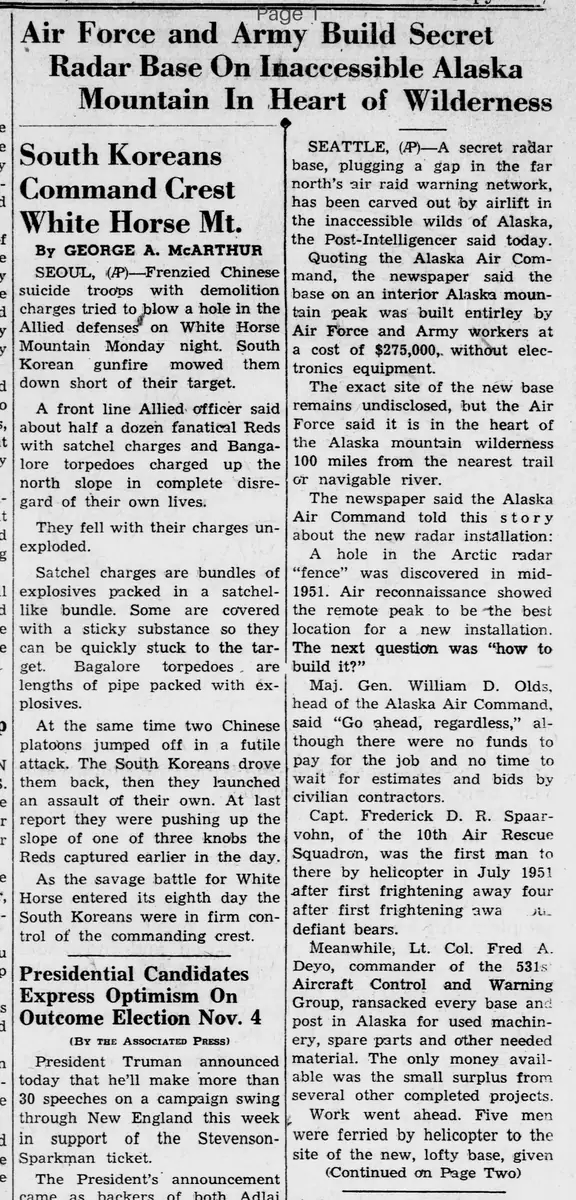
SEATTLE, (AP)--A secret radar base, plugging a gap in the far north's air raid warning network, has been carved out by airlift in the inaccessible wilds of Alaska, the Post-Intelligencer said today.
Quoting the Alaska Air Command, the newspaper said the base on an interior Alaska mountain peak was built entirely by Air Force and Army workers at a cost of $275,000, without electronics equipment.
The exact site of the new base remains undisclosed, but the Air Force said it is in the heart of the Alaska mountain wilderness 100 miles from the nearest trail or navigable river.
The newspaper said the Alaska Air Command told this story about the new radar installation:
A hole in the Arctic radar "fence" was discovered in mid-1951. Air reconnaissance showed the remote peak to be the best location for a new installation.
The next question was "how to build it?"
Maj. Gen. William D. Olds, head of the Alaska Air Command, said "Go ahead, regardless." although there were no funds to pay for the job and no time to wait for estimates and bids by civilian contractors.
Capt. Frederick D. R. Spaarvohn, of the 10th Air Rescue Squadron, was the first man to there by helicopter in July 1951 after first frightening away four defiant bears.
Meanwhile, Lt. Col. Fred A. Deyo, commander of the 531st Aircraft Control and Warning Group, ransacked every base and post in Alaska for used machinery, spare parts and other needed material. The only money available was the small surplus from several other completed projects.
Work went ahead. Five men were ferried by helicopter to the site of the new, lofty base, given
(Continued on Page Two)
Secret Radar Base Built
(Continued from Page One)
the code name "Spaarvohn" in honor of the 'copter pilot.
The next day, 20 more men were flown there, along with a tractor frame and tracks. Within the next 20 days, 130,000 pounds of supplies and equipment, including three tractors and bulldozers were dropped by parachute.
An airstrip was scraped out of the muskeg on a 7 per cent grade in the valley at the foot of the mountain. C-82 Flying Boxcars were able to make the risky landings. But so dangerous is the letdown and landing that replacement pilots must make 12 trips from a central supply base to the strip before handling the controls themselves.
The radar base was put into operation last December, and permanent buildings and barracks were completed this summer.
Weather conditions are extremely severe and hazardous.
Twice last December the radar towers blew down.
Later, in the dead of winter with the thermometer down to 60 below zero, two officers were blown off the mountain by a 120-mile an hour wind. It took them 26 hours to walk back to the base on the other side.
The station was put up by men of the 531st and an Army Aviation construction battalion.
Men now stationed there receive double credit toward rotation. The normal Alaska tour of duty now is two years.
It has been calculated that there are 10 billion tons of gold in the sea water of the world.
What sub-type of article is it?
What keywords are associated?
What entities or persons were involved?
Where did it happen?
Domestic News Details
Primary Location
Interior Alaska Mountain Peak
Event Date
Mid 1951 To Summer 1952
Key Persons
Outcome
base operational since december 1951; permanent buildings completed summer 1952; two officers blown off mountain by wind in winter 1951-1952, walked back after 26 hours; no deaths reported
Event Details
Secret radar base built by Air Force and Army on remote Alaska mountain to fill gap in Arctic radar network; constructed entirely by airlift and parachute drops without civilian contractors, using surplus materials and $275,000 cost; site 100 miles from nearest trail or river; code name 'Spaarvohn'; airstrip built in valley; severe weather including 120 mph winds and -60°F temperatures; men receive double rotation credit