Thank you for visiting SNEWPapers!
Sign up free
Story
November 18, 1950
The Detroit Tribune
Detroit, Wayne County, Michigan
What is this article about?
Dr. Duncan A. Cameron of Wayne University advises bystanders on safely assisting auto accident victims, stressing calm, minimal disturbance, and specific first aid steps to avoid harm. Includes demonstration by medical students.
Clipping
OCR Quality
100%
Excellent
Full Text
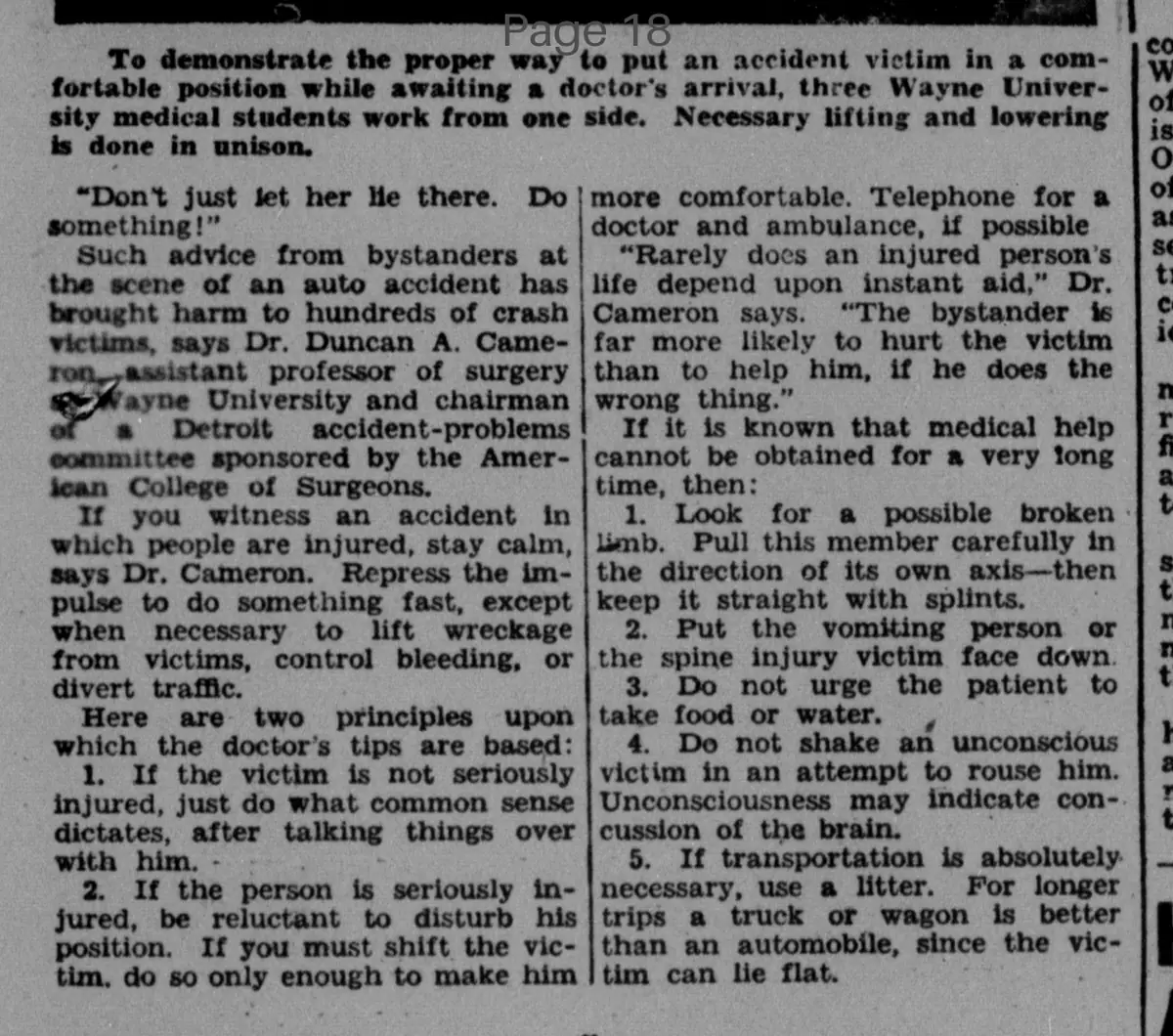
To demonstrate the proper way to put an accident victim in a comfortable position while awaiting a doctor's arrival, three Wayne University medical students work from one side. Necessary lifting and lowering is done in unison.
"Don't just let her lie there. Do something!" Such advice from bystanders at the scene of an auto accident has brought harm to hundreds of crash victims, says Dr. Duncan A. Cameron, assistant professor of surgery, Wayne University and chairman of the Detroit accident-problems committee sponsored by the American College of Surgeons.
If you witness an accident in which people are injured, stay calm, says Dr. Cameron. Repress the impulse to do something fast, except when necessary to lift wreckage from victims, control bleeding, or divert traffic.
Here are two principles upon which the doctor's tips are based:
1. If the victim is not seriously injured, just do what common sense dictates, after talking things over with him.
2. If the person is seriously injured, be reluctant to disturb his position. If you must shift the victim, do so only enough to make him more comfortable. Telephone for a doctor and ambulance, if possible.
"Rarely does an injured person's life depend upon instant aid," Dr. Cameron says. "The bystander is far more likely to hurt the victim than to help him, if he does the wrong thing."
If it is known that medical help cannot be obtained for a very long time, then:
1. Look for a possible broken limb. Pull this member carefully in the direction of its own axis—then keep it straight with splints.
2. Put the vomiting person or the spine injury victim face down.
3. Do not urge the patient to take food or water.
4. Do not shake an unconscious victim in an attempt to rouse him. Unconsciousness may indicate concussion of the brain.
5. If transportation is absolutely necessary, use a litter. For longer trips a truck or wagon is better than an automobile, since the victim can lie flat.
"Don't just let her lie there. Do something!" Such advice from bystanders at the scene of an auto accident has brought harm to hundreds of crash victims, says Dr. Duncan A. Cameron, assistant professor of surgery, Wayne University and chairman of the Detroit accident-problems committee sponsored by the American College of Surgeons.
If you witness an accident in which people are injured, stay calm, says Dr. Cameron. Repress the impulse to do something fast, except when necessary to lift wreckage from victims, control bleeding, or divert traffic.
Here are two principles upon which the doctor's tips are based:
1. If the victim is not seriously injured, just do what common sense dictates, after talking things over with him.
2. If the person is seriously injured, be reluctant to disturb his position. If you must shift the victim, do so only enough to make him more comfortable. Telephone for a doctor and ambulance, if possible.
"Rarely does an injured person's life depend upon instant aid," Dr. Cameron says. "The bystander is far more likely to hurt the victim than to help him, if he does the wrong thing."
If it is known that medical help cannot be obtained for a very long time, then:
1. Look for a possible broken limb. Pull this member carefully in the direction of its own axis—then keep it straight with splints.
2. Put the vomiting person or the spine injury victim face down.
3. Do not urge the patient to take food or water.
4. Do not shake an unconscious victim in an attempt to rouse him. Unconsciousness may indicate concussion of the brain.
5. If transportation is absolutely necessary, use a litter. For longer trips a truck or wagon is better than an automobile, since the victim can lie flat.
What sub-type of article is it?
Medical Advice
First Aid Instructions
What themes does it cover?
Recovery
Survival
Moral Virtue
What keywords are associated?
Auto Accident
Victim Assistance
Bystander Advice
Medical Intervention
First Aid Tips
What entities or persons were involved?
Dr. Duncan A. Cameron
Wayne University Medical Students
Where did it happen?
Detroit
Story Details
Key Persons
Dr. Duncan A. Cameron
Wayne University Medical Students
Location
Detroit
Story Details
Dr. Duncan A. Cameron provides guidance for bystanders at auto accidents: stay calm, avoid unnecessary movement of seriously injured victims, call for medical help, and follow specific principles for aid if help is delayed.