Thank you for visiting SNEWPapers!
Sign up free
Letter to Editor
September 27, 1820
Daily National Intelligencer
Washington, District Of Columbia
What is this article about?
A Lynchburg citizen corrects a prior letter's portrayal of the town as economically deserted post-speculation mania, asserting robust trade with 9,967 hogsheads of tobacco inspected and high volumes of other produce sold at good prices.
Clipping
OCR Quality
98%
Excellent
Full Text
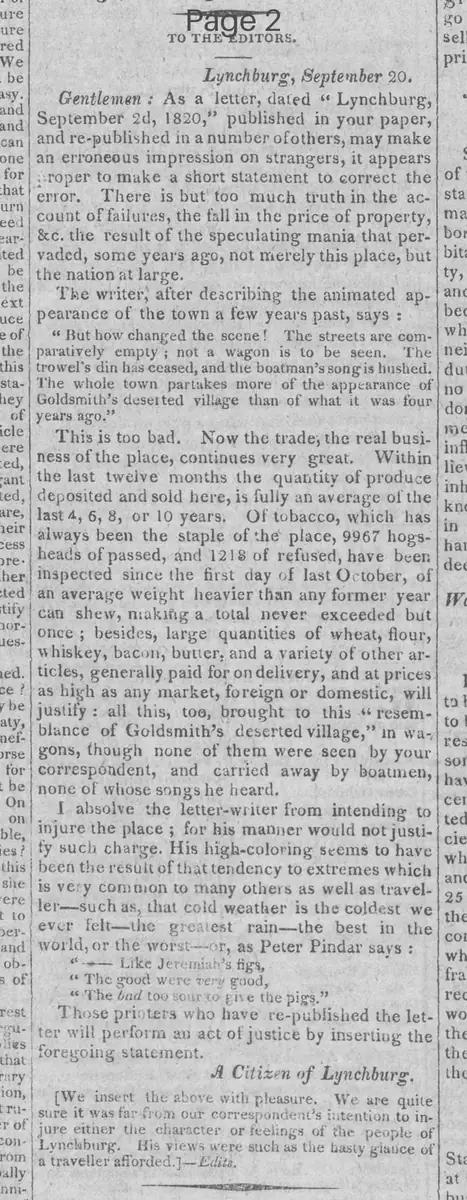
TO THE EDITORS.
Lynchburg, September 20.
Gentlemen: As a letter, dated "Lynchburg, September 2d, 1820," published in your paper, and re-published in a number of others, may make an erroneous impression on strangers, it appears proper to make a short statement to correct the error. There is but too much truth in the account of failures, the fall in the price of property, &c. the result of the speculating mania that pervaded, some years ago, not merely this place, but the nation at large.
The writer, after describing the animated appearance of the town a few years past, says: "But how changed the scene! The streets are comparatively empty; not a wagon is to be seen. The trowel's din has ceased, and the boatman's song is hushed. The whole town partakes more of the appearance of Goldsmith's deserted village than of what it was four years ago."
This is too bad. Now the trade; the real business of the place, continues very great. Within the last twelve months the quantity of produce deposited and sold here, is fully an average of the last 4, 6, 8, or 10 years. Of tobacco, which has always been the staple of the place, 9967 hogsheads of passed, and 1218 of refused, have been inspected since the first day of last October, of an average weight heavier than any former year can shew, making a total never exceeded but once; besides, large quantities of wheat, flour, whiskey, bacon, butter, and a variety of other articles, generally paid for on delivery, and at prices as high as any market, foreign or domestic, will justify: all this, too, brought to this "resemblance of Goldsmith's deserted village," in wagons, though none of them were seen by your correspondent, and carried away by boatmen, none of whose songs he heard.
I absolve the letter-writer from intending to injure the place; for his manner would not justify such charge. His high-coloring seems to have been the result of that tendency to extremes which is very common to many others as well as travellers—such as, that cold weather is the coldest we ever felt—the greatest rain—the best in the world, or the worst—or, as Peter Pindar says:
"Like Jeremiah's figs,
The good were very good,
The bad too sour to give the pigs."
Those printers who have re-published the letter will perform an act of justice by inserting the foregoing statement.
A Citizen of Lynchburg.
[We insert the above with pleasure. We are quite sure it was far from our correspondent's intention to injure either the character or feelings of the people of Lynchburg. His views were such as the hasty glance of a traveller afforded.]—Edits.
Lynchburg, September 20.
Gentlemen: As a letter, dated "Lynchburg, September 2d, 1820," published in your paper, and re-published in a number of others, may make an erroneous impression on strangers, it appears proper to make a short statement to correct the error. There is but too much truth in the account of failures, the fall in the price of property, &c. the result of the speculating mania that pervaded, some years ago, not merely this place, but the nation at large.
The writer, after describing the animated appearance of the town a few years past, says: "But how changed the scene! The streets are comparatively empty; not a wagon is to be seen. The trowel's din has ceased, and the boatman's song is hushed. The whole town partakes more of the appearance of Goldsmith's deserted village than of what it was four years ago."
This is too bad. Now the trade; the real business of the place, continues very great. Within the last twelve months the quantity of produce deposited and sold here, is fully an average of the last 4, 6, 8, or 10 years. Of tobacco, which has always been the staple of the place, 9967 hogsheads of passed, and 1218 of refused, have been inspected since the first day of last October, of an average weight heavier than any former year can shew, making a total never exceeded but once; besides, large quantities of wheat, flour, whiskey, bacon, butter, and a variety of other articles, generally paid for on delivery, and at prices as high as any market, foreign or domestic, will justify: all this, too, brought to this "resemblance of Goldsmith's deserted village," in wagons, though none of them were seen by your correspondent, and carried away by boatmen, none of whose songs he heard.
I absolve the letter-writer from intending to injure the place; for his manner would not justify such charge. His high-coloring seems to have been the result of that tendency to extremes which is very common to many others as well as travellers—such as, that cold weather is the coldest we ever felt—the greatest rain—the best in the world, or the worst—or, as Peter Pindar says:
"Like Jeremiah's figs,
The good were very good,
The bad too sour to give the pigs."
Those printers who have re-published the letter will perform an act of justice by inserting the foregoing statement.
A Citizen of Lynchburg.
[We insert the above with pleasure. We are quite sure it was far from our correspondent's intention to injure either the character or feelings of the people of Lynchburg. His views were such as the hasty glance of a traveller afforded.]—Edits.
What sub-type of article is it?
Informative
Persuasive
What themes does it cover?
Commerce Trade
Agriculture
What keywords are associated?
Lynchburg Economy
Tobacco Trade
Speculation Mania
Produce Sales
Economic Correction
What entities or persons were involved?
A Citizen Of Lynchburg
The Editors
Letter to Editor Details
Author
A Citizen Of Lynchburg
Recipient
The Editors
Main Argument
the previous letter's depiction of lynchburg as a deserted village is erroneous; trade and business remain strong, with high volumes of tobacco and produce sold at good prices despite past speculation failures.
Notable Details
References Goldsmith's 'Deserted Village'
Cites 9967 Hogsheads Of Tobacco Passed And 1218 Refused Inspected
Quotes Peter Pindar On Extremes