Thank you for visiting SNEWPapers!
Sign up free
Letter to Editor
October 18, 1805
Alexandria Daily Advertiser
Alexandria, Virginia
What is this article about?
Thomas Ewell shares experiments demonstrating that pulverized pit coal acts as a superior manure for corn and wheat growth on impoverished clay soil, promoting its use to restore Virginia's lands and inviting further contributions for his upcoming chemistry work.
Clipping
OCR Quality
98%
Excellent
Full Text
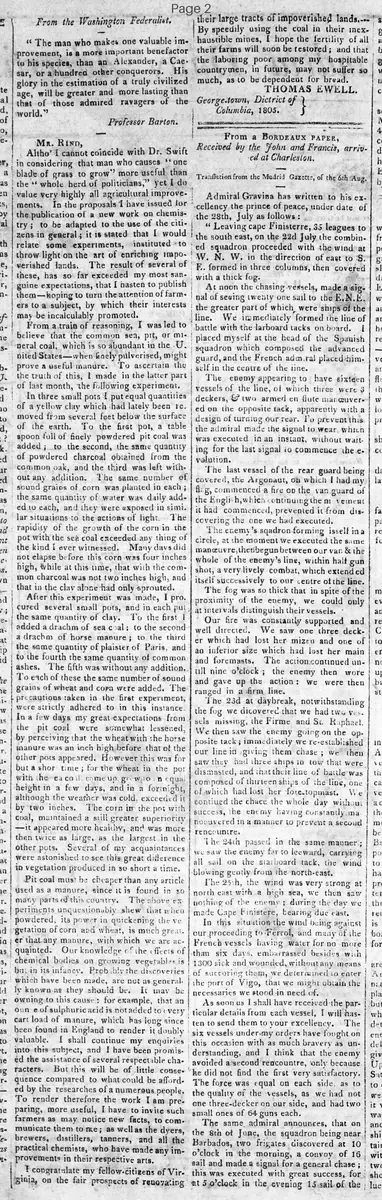
From the Washington Federalist.
"The man who makes one valuable improvement, is a more important benefactor to his species, than an Alexander, a Caesar, or a hundred other conquerors. His glory in the estimation of a truly civilized age, will be greater and more lasting than that of those admired ravagers of the world."
Professor Barton.
Mr. Rind,
Altho' I cannot coincide with Dr. Swift in considering that man who causes "one blade of grass to grow" more useful than the "whole herd of politicians," yet I do value very highly all agricultural improvements. In the proposals I have issued for the publication of a new work on chemistry; to be adapted to the use of the citizens in general; it is stated that I would relate some experiments, instituted to throw light on the art of enriching impoverished lands. The result of several of these, has so far exceeded my most sanguine expectations, that I hasten to publish them -- hoping to turn the attention of farmers to a subject, by which their interests may be incalculably promoted.
From a train of reasoning, I was led to believe that the common sea, pit, or mineral coal, which is so abundant in the United States -- when safely pulverised, might prove a useful manure. To ascertain the truth of this, I made in the latter part of last month, the following experiment.
In three small pots I put equal quantities of a yellow clay which had lately been removed from several feet below the surface of the earth. To the first pot, a table spoon full of finely powdered pit coal was added; to the second, the same quantity of powdered charcoal obtained from the common oak, and the third was left without any addition. The same number of sound grains of corn was planted in each; the same quantity of water was daily added to each, and they were exposed in similar situations to the actions of light. The rapidity of the growth of the corn in the pot with the sea coal exceeded any thing of the kind I ever witnessed. Many days did not elapse before this corn was four inches high, while at this time, that with the common charcoal was not two inches high, and that in the clay alone had only sprouted.
After this experiment was made, I procured several small pots, and in each put the same quantity of clay. To the first I added a drachm of sea coal: to the second a drachm of horse manure; to the third the same quantity of plaster of Paris, and to the fourth the same quantity of common ashes. The fifth was without any addition. To each of these the same number of sound grains of wheat and corn were added. The precautions taken in the first experiment, were strictly adhered to in this instance.
In a few days my great expectations from the pit coal were somewhat lessened, by perceiving that the wheat with the horse manure was an inch high before that of the other pots appeared. However this was but for a short time; for the wheat in the pot with the sea coal, came up, grew, and in a fortnight although the weather was cold, exceeded it by two inches. The corn in the pot with coal, maintained a still greater superiority -- it appeared more healthy, and was more than twice as large, as the largest in the other pots. Several of my acquaintances were astonished to see this great difference in vegetation produced in so short a time.
Pit coal must be cheaper than any article used as a manure, since it is found in so many parts of this country. The above experiments unquestionably shew that when powdered, its power in quickening the vegetation of corn and wheat, is much greater than any manure, with which we are acquainted. Our knowledge of the effects of chemical bodies on growing vegetables is but in its infancy. Probably the discoveries which have been made, are not as generally known as they should be. It may be owing to this cause: for example, that an ounce of sulphuric acid is not added to every cart load of manure, which has long since been found in England to render it doubly valuable. I shall continue my enquiries into this subject, and I have been promised the assistance of several respectable characters. But this will be of little consequence compared to what could be afforded by the researches of a numerous people.
To render therefore the work I am preparing, more useful, I have to invite such farmers as may notice new facts, to communicate them to me; as well as the dyers, brewers, distillers, tanners, and all the practical chemists, who have made any improvements in their respective arts.
I congratulate my fellow-citizens of Virginia, on the fair prospects of renovating their large tracts of impoverished lands. -- By speedily using the coal in their inexhaustible mines, I hope the fertility of all their farms will soon be restored; and that the laboring poor among my hospitable countrymen, in future, may not suffer so much, as to be dependent for bread.
THOMAS EWELL.
George-town, District of Columbia, 1805.
"The man who makes one valuable improvement, is a more important benefactor to his species, than an Alexander, a Caesar, or a hundred other conquerors. His glory in the estimation of a truly civilized age, will be greater and more lasting than that of those admired ravagers of the world."
Professor Barton.
Mr. Rind,
Altho' I cannot coincide with Dr. Swift in considering that man who causes "one blade of grass to grow" more useful than the "whole herd of politicians," yet I do value very highly all agricultural improvements. In the proposals I have issued for the publication of a new work on chemistry; to be adapted to the use of the citizens in general; it is stated that I would relate some experiments, instituted to throw light on the art of enriching impoverished lands. The result of several of these, has so far exceeded my most sanguine expectations, that I hasten to publish them -- hoping to turn the attention of farmers to a subject, by which their interests may be incalculably promoted.
From a train of reasoning, I was led to believe that the common sea, pit, or mineral coal, which is so abundant in the United States -- when safely pulverised, might prove a useful manure. To ascertain the truth of this, I made in the latter part of last month, the following experiment.
In three small pots I put equal quantities of a yellow clay which had lately been removed from several feet below the surface of the earth. To the first pot, a table spoon full of finely powdered pit coal was added; to the second, the same quantity of powdered charcoal obtained from the common oak, and the third was left without any addition. The same number of sound grains of corn was planted in each; the same quantity of water was daily added to each, and they were exposed in similar situations to the actions of light. The rapidity of the growth of the corn in the pot with the sea coal exceeded any thing of the kind I ever witnessed. Many days did not elapse before this corn was four inches high, while at this time, that with the common charcoal was not two inches high, and that in the clay alone had only sprouted.
After this experiment was made, I procured several small pots, and in each put the same quantity of clay. To the first I added a drachm of sea coal: to the second a drachm of horse manure; to the third the same quantity of plaster of Paris, and to the fourth the same quantity of common ashes. The fifth was without any addition. To each of these the same number of sound grains of wheat and corn were added. The precautions taken in the first experiment, were strictly adhered to in this instance.
In a few days my great expectations from the pit coal were somewhat lessened, by perceiving that the wheat with the horse manure was an inch high before that of the other pots appeared. However this was but for a short time; for the wheat in the pot with the sea coal, came up, grew, and in a fortnight although the weather was cold, exceeded it by two inches. The corn in the pot with coal, maintained a still greater superiority -- it appeared more healthy, and was more than twice as large, as the largest in the other pots. Several of my acquaintances were astonished to see this great difference in vegetation produced in so short a time.
Pit coal must be cheaper than any article used as a manure, since it is found in so many parts of this country. The above experiments unquestionably shew that when powdered, its power in quickening the vegetation of corn and wheat, is much greater than any manure, with which we are acquainted. Our knowledge of the effects of chemical bodies on growing vegetables is but in its infancy. Probably the discoveries which have been made, are not as generally known as they should be. It may be owing to this cause: for example, that an ounce of sulphuric acid is not added to every cart load of manure, which has long since been found in England to render it doubly valuable. I shall continue my enquiries into this subject, and I have been promised the assistance of several respectable characters. But this will be of little consequence compared to what could be afforded by the researches of a numerous people.
To render therefore the work I am preparing, more useful, I have to invite such farmers as may notice new facts, to communicate them to me; as well as the dyers, brewers, distillers, tanners, and all the practical chemists, who have made any improvements in their respective arts.
I congratulate my fellow-citizens of Virginia, on the fair prospects of renovating their large tracts of impoverished lands. -- By speedily using the coal in their inexhaustible mines, I hope the fertility of all their farms will soon be restored; and that the laboring poor among my hospitable countrymen, in future, may not suffer so much, as to be dependent for bread.
THOMAS EWELL.
George-town, District of Columbia, 1805.
What sub-type of article is it?
Informative
Persuasive
What themes does it cover?
Agriculture
Science Nature
What keywords are associated?
Pit Coal
Manure
Agricultural Experiments
Corn Growth
Wheat Growth
Impoverished Lands
Virginia Farms
Thomas Ewell
What entities or persons were involved?
Thomas Ewell
Mr. Rind
Letter to Editor Details
Author
Thomas Ewell
Recipient
Mr. Rind
Main Argument
pulverized pit coal serves as a cheap and highly effective manure for promoting the growth of corn and wheat on impoverished lands, outperforming other manures in experiments, and should be widely adopted by farmers to restore soil fertility.
Notable Details
Quotes Professor Barton On The Value Of Improvements Over Conquerors
References Dr. Swift On Grass Vs. Politicians
Describes Two Detailed Experiments With Pots, Clay, Corn, Wheat, And Various Additives
Mentions Sulphuric Acid In Manure From England
Invites Contributions From Farmers And Practical Chemists For Upcoming Chemistry Work