Thank you for visiting SNEWPapers!
Sign up free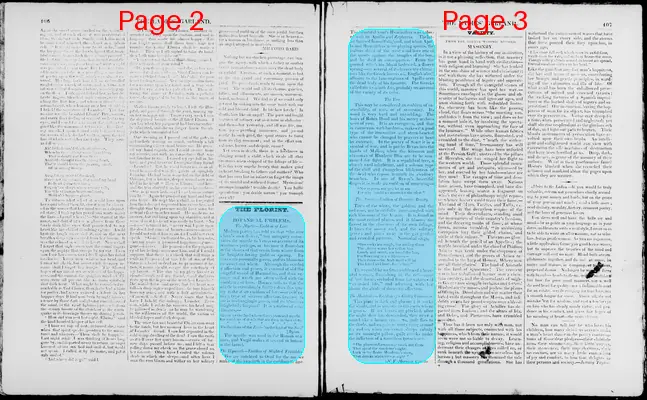
The Ladies' Garland
Harpers Ferry, Jefferson County, West Virginia
What is this article about?
Article on botanical emblems from 'The Florist': Myrtle symbolizes love (with references to antiquity, Horace, Byron); Hyacinth slighted friendship (Ovid myth); Yew insensibility, war, or mourning (Scott, Byron); Acacia domestic beauty (poetic quote); Mandrake guilty conscience. From N.Y. Morning Courier.
Merged-components note: Continuation of 'THE FLORIST. BOTANICAL EMBLEMS' across pages 2 and 3, as the text on emblems flows directly.
Clippings
1 of 2
OCR Quality
Full Text
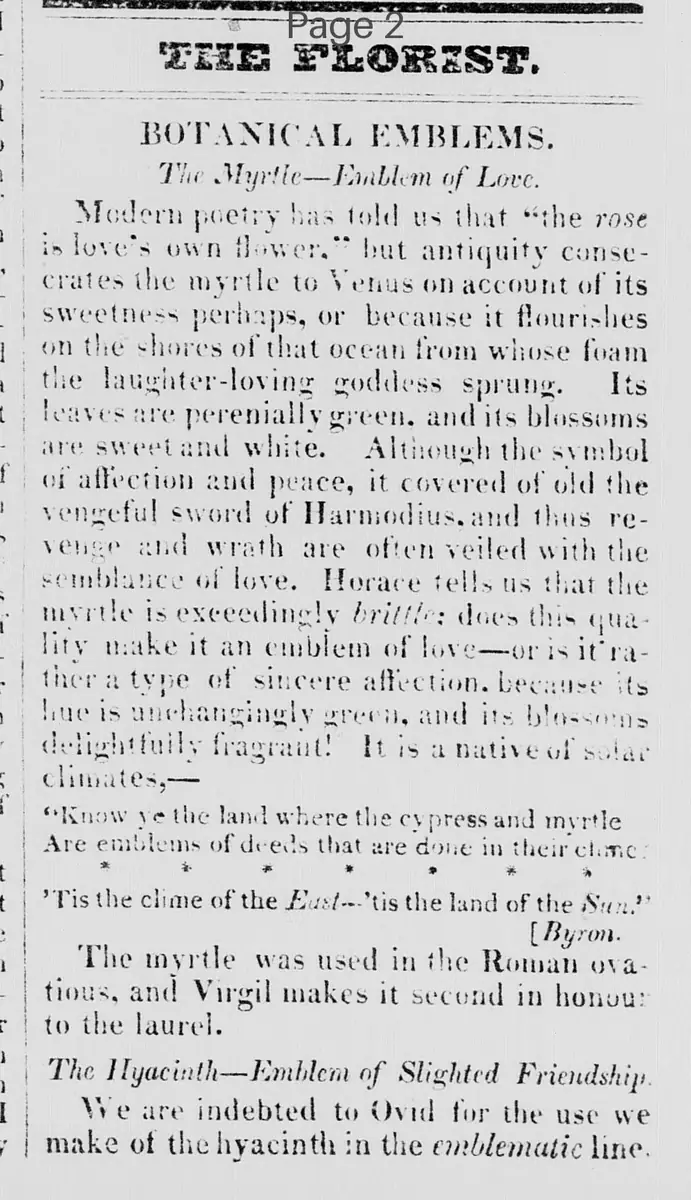
BOTANICAL EMBLEMS.
The Myrtle-Emblem of Love.
Modern poetry has told us that "the rose
is love's own flower." but antiquity conse-
crates the myrtle to Venus on account of its
sweetness perhaps, or because it flourishes
on the shores of that ocean from whose foam
the laughter-loving goddess sprung. Its
leaves are perenially green. and its blossoms
are sweet and white. Although the symbol
of affection and peace, it covered of old the
vengeful sword of Harmodius.and thus re-
venge and wrath are often veiled with the
semblance of love. Horace tells us that the
myrtle is exceedingly brittle: does this qua-
lity make it an emblem of love-or is it ra-
ther a type of sincere affection. because its
hue is unchangingly green, and its blossoms
delightfully fragrant! It is a native of solar
climates,--
"Know ye the land where the cypress and myrtle
Are emblems of deeds that are done in their clime
'Tis the clime of the East.'tis the land of the Sun.'
[Byron.
The myrtle was used in the Roman ova-
tious. and Virgil makes it second in honour
to the laurel.
The Hyacinth--Emblem of Slighted Friendship
We are indebted to Ovid for the use we
make of the hyacinth in the emblematic line.
The beautiful youth Hyacinthus was beloved both by Apollo and Zephyrus. The latter fancied himself slighted, and when Apollo and Hyacinthus were playing quoits, the jealous deity of the west wind bore one of the quoits against the temples of the boy, and he died in consequence. From the ground which his blood bedewed, a flower sprung--on several of its leaves are characters like the Greek letters ai, (English alas!) allusive to the lamentations of Apollo over the dead body of his favorite. The Greeks called the hyacinth Iris, probably on account of the variety of its color.
The Yew.
This may be considered an emblem of insensibility, of war, or of mourning. Its wood is very hard and unyielding. The bows of Robin Hood and his merry archers were of yew. It is an evergreen, and that in connexion with hardness, makes it a good type of the insensitive and stern-hearted who cannot be changed by prayers or bent by entreaty. In the poetry of Scott it is a symbol of war, and is put by Byron into the hands of Malise, when the kinsman and clansman of Roderic Dhu are to be summoned for fight. It is a sepulchral tree, a church-yard inhabitant, and a solemn type of the chill and changeless lifelessness of the dead who repose beneath its shadowy branches. In one of Byron's beautiful dirges it is made an emblem of mourning--
"Not cypress nor yew let us see
For why should we mourn for the blest."
The Acacia--Emblem of Domestic Beauty.
Tints of the white, the golden, and the red-rose, are beautifully intermingled with rich blossoms of the Acacia. It is found in the most retired places, and it blooms the fairest in the closeness of its own foliage. It loves the mossy rock and the solitary grove; and pines away in the gay garden and crowded parterre. Normahal sings,
"Our rocks are rough, but smiling there
The acacia waves her yellow hair
Lonely and sweet, nor loved the less,
For flowering in a wilderness--"
Then come--thy Arab maid will be
The loved and lone acacia tree.
It could be no fitter emblem of a beautiful woman, flourishing in the retirement of her home, secluded from the vanities of "crowded life," and adorning with her bloom the abode of domestic affection.
The Mandrake--Emblem of a Guilty Conscience
This plant is dark and gloomy: it seeks the shade, and is noxious to the earth where it grows. If its leaves are plucked, after the night dew has descended, they utter a sound like a human cry. So, guilt flies to the shade, and poisons every thing around it; and so, when innocence sleeps calmly on its midnight pillow, guilt shrieks under the infliction of a merciless conscience.
"The phantom forms--oh! touch not them
That appal the murderer's sight:
Lurk in the fleshy Mandrake's stem,
That shrieks when torn at night"
N.Y. Morning Courier.
What sub-type of article is it?
What themes does it cover?
What keywords are associated?
Literary Details
Title
Botanical Emblems
Subject
Emblems Of Plants: Myrtle (Love), Hyacinth (Slighted Friendship), Yew (Insensibility/War/Mourning), Acacia (Domestic Beauty), Mandrake (Guilty Conscience)
Form / Style
Prose Essay With Poetic Quotations
Key Lines