Thank you for visiting SNEWPapers!
Sign up free
Editorial
October 18, 1956
Gadsden County Times
Quincy, Gadsden County, Florida
What is this article about?
Frances Dell advises on optimal lawn feeding schedule of six light applications yearly, avoiding early spring to limit weeds, using balanced fertilizers, soil testing, and fall maintenance for healthy grass growth.
Clipping
OCR Quality
98%
Excellent
Full Text
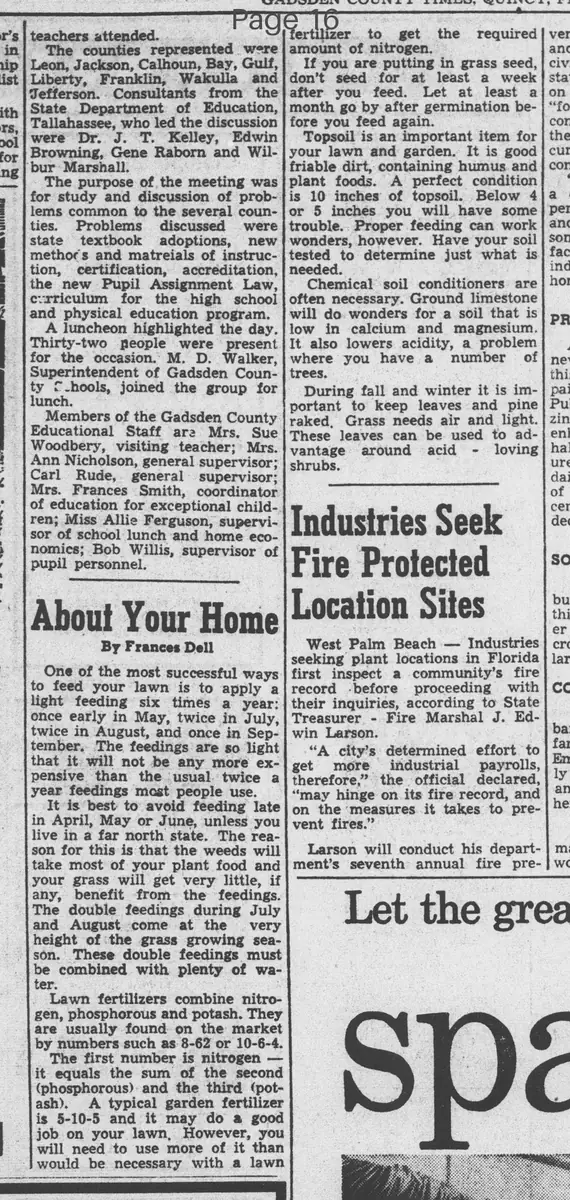
About Your Home
By Frances Dell
One of the most successful ways to feed your lawn is to apply a light feeding six times a year: once early in May, twice in July, twice in August, and once in September. The feedings are so light that it will not be any more expensive than the usual twice a year feedings most people use.
It is best to avoid feeding late in April, May or June, unless you live in a far north state. The reason for this is that the weeds will take most of your plant food and your grass will get very little, if any, benefit from the feedings.
The double feedings during July and August come at the very height of the grass growing season. These double feedings must be combined with plenty of water.
Lawn fertilizers combine nitrogen, phosphorous and potash. They are usually found on the market by numbers such as 8-6-2 or 10-6-4. The first number is nitrogen -- it equals the sum of the second (phosphorous) and the third (potash). A typical garden fertilizer is 5-10-5 and it may do a good job on your lawn. However, you will need to use more of it than would be necessary with a lawn
fertilizer to get the required amount of nitrogen.
If you are putting in grass seed, don't seed for at least a week after you feed. Let at least a month go by after germination before you feed again.
Topsoil is an important item for your lawn and garden. It is good friable dirt, containing humus and plant foods. A perfect condition is 10 inches of topsoil. Below 4 or 5 inches you will have some trouble. Proper feeding can work wonders, however. Have your soil tested to determine just what is needed.
Chemical soil conditioners are often necessary. Ground limestone will do wonders for a soil that is low in calcium and magnesium. It also lowers acidity, a problem where you have a number of trees.
During fall and winter it is important to keep leaves and pine raked. Grass needs air and light. These leaves can be used to advantage around acid-loving shrubs.
By Frances Dell
One of the most successful ways to feed your lawn is to apply a light feeding six times a year: once early in May, twice in July, twice in August, and once in September. The feedings are so light that it will not be any more expensive than the usual twice a year feedings most people use.
It is best to avoid feeding late in April, May or June, unless you live in a far north state. The reason for this is that the weeds will take most of your plant food and your grass will get very little, if any, benefit from the feedings.
The double feedings during July and August come at the very height of the grass growing season. These double feedings must be combined with plenty of water.
Lawn fertilizers combine nitrogen, phosphorous and potash. They are usually found on the market by numbers such as 8-6-2 or 10-6-4. The first number is nitrogen -- it equals the sum of the second (phosphorous) and the third (potash). A typical garden fertilizer is 5-10-5 and it may do a good job on your lawn. However, you will need to use more of it than would be necessary with a lawn
fertilizer to get the required amount of nitrogen.
If you are putting in grass seed, don't seed for at least a week after you feed. Let at least a month go by after germination before you feed again.
Topsoil is an important item for your lawn and garden. It is good friable dirt, containing humus and plant foods. A perfect condition is 10 inches of topsoil. Below 4 or 5 inches you will have some trouble. Proper feeding can work wonders, however. Have your soil tested to determine just what is needed.
Chemical soil conditioners are often necessary. Ground limestone will do wonders for a soil that is low in calcium and magnesium. It also lowers acidity, a problem where you have a number of trees.
During fall and winter it is important to keep leaves and pine raked. Grass needs air and light. These leaves can be used to advantage around acid-loving shrubs.
What sub-type of article is it?
Agriculture
What keywords are associated?
Lawn Feeding
Fertilizers
Soil Testing
Grass Care
Topsoil
Chemical Conditioners
Weeds
Watering
Seeding
Leaves Raking
What entities or persons were involved?
Frances Dell
Editorial Details
Primary Topic
Lawn Care And Feeding Advice
Stance / Tone
Practical Instructional
Key Figures
Frances Dell
Key Arguments
Apply Light Feeding Six Times A Year: Once Early May, Twice July, Twice August, Once September
Avoid Feeding Late April, May, Or June Unless In Far North State To Prevent Weeds Benefiting
Double Feedings In July And August Require Plenty Of Water
Lawn Fertilizers Like 8 6 2 Or 10 6 4 Provide Balanced Nitrogen, Phosphorous, Potash
Garden Fertilizer 5 10 5 Can Work But Requires More For Nitrogen
Wait A Week After Feeding Before Seeding Grass, And A Month After Germination Before Next Feeding
Topsoil Should Be 10 Inches Ideal, Test Soil For Needs
Use Ground Limestone For Low Calcium/Magnesium Or Acidic Soil
Rake Leaves And Pine In Fall/Winter For Air And Light To Grass, Use Around Acid Loving Shrubs