Thank you for visiting SNEWPapers!
Sign up free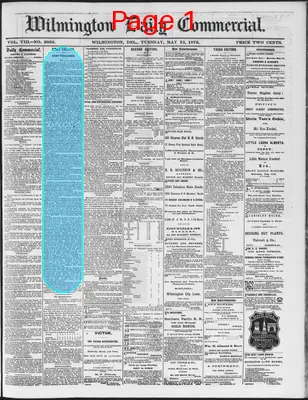
Wilmington Daily Commercial
Wilmington, New Castle County, Delaware
What is this article about?
Spring Term court proceedings in New Castle on May 12, 1873, including opening session, charge to grand jury by Judge Wales, and dispositions of cases: road obstruction, liquor sales fines, assault and battery sentencing, disorderly house trial, infanticide arraignment, larceny guilty plea and sentencing, election cases discharged.
Clipping

OCR Quality
Full Text
COURT PROCEEDINGS.
New Castle, May 12, 1873.
The Spring Term of the Courts of Oyer and Terminer and General Sessions of the Peace and Jail Delivery, also an adjourned Session of the Orphans Court, for this county, were opened, this morning, at 11 o'clock.
The names of the Grand and petit Juries were called, and George W. Sparks, of Wilmington, was appointed by the Court foreman of the Grand Jury.
The regular charge of the Court to the Grand Jury was delivered by Judge Wales, who stated it was the custom to charge the Jury at the Spring Term, only, instead of at both terms as formerly.
Judge Wales spoke of the ancient origin of Grand Juries, which have existed time out of mind, their object being to protect the innocent and bring the guilty to punishment; read the provisions in the U. S. and Delaware constitutions for trial by indictment and the mode prescribed in the latter for drawing of the Grand Juries. Their action was necessary before any one could be tried for a criminal offense. It was their duty to discover all violations of justice and of law, and any one of them knowing such facts was bound to present them to his fellow jurors. All indictments sent to them by the Attorney General, were to be endorsed either 'true bill' or 'ignored.' Their deliberations were secret, to be aided by instruction from the Attorney General, or the Court, if necessary.
The rule for their guidance was "to inquire whether there is sufficient cause to require a party to stand a trial before a jury of his peers".
Twenty-four Grand Jurors were summoned, but not more than 23 nor less than 12, sworn. and no indictment was good unless found by 12; so a person convicted of a crime was heard by 24 of his peers before conviction. No crime was so old or stale as to prevent indictment, even though refused by a former jury. Chapters 126 to 133, inclusive, of the Revised Code on crimes and misdemeanors, were referred to. Homicide was defined and the different degrees of murder in the first and second degree under the Statute with the respective punishments explained at length. Murder required a malicious intent, and if the intent were to kill, it was murder in the first degree, if not intent to kill, murder in the second degree. Manslaughter involved no malicious intent. Express malice was the deliberate design to kill another, implied or constructive. Malice is a construction of law from the facts, as from the commission of an unlawful act which results in death. Justifiable and excusable homicide were also explained.
The Judge further charged the Court upon finding indictments in cases of nuisances and misdemeanors indictable at common law. A nuisance was such a use of one's property as rendered it offensive to citizens and in violation of the laws of the State. It need not be injurious to health, sufficient if offensive, e. g. bad smells. No length of time—not even 20 years—will justify the continuance of a nuisance.
The Mayor of Wilmington, Sheriff, Coroner, Justices of the Peace and County Constables required by law to attend the Court on the first day thereof were successively called.
State vs. Vincent O. Hill, indicted at Nov. Term, 1872, for obstructing a public road. Nolle pros entered on the payment of costs by Defendant.
A number of liquor cases were settled, mostly by payment of fines and costs of prosecution. Among those John Stoecklein was fined $5 and costs in 23 cases, 12 of which were for selling liquor to minors. The remaining 11, for doing the same (selling liquor) on Sundays.
Vincent O. Hill, was also fined $20 and costs in case No. 39, for selling liquor on Sunday, and a nol. pros. was entered on payment of costs in several other cases.
State vs. Citizen G. Badson, col., under indictment and arraigned for assault and battery with intent to kill Mary E. Badson, his wife, on 14th of last month. Plead guilty to assault and battery to avoid standing trial on the graver charge of burglary with intent to kill his wife. Sentenced to pay $1000 fine and costs of prosecution, on Saturday next, 17th inst., between 10 o'clock A. M. and 5 P. M., to stand 1 hour in the pillory and be imprisoned for 5 years, commencing May 17th, 1873, and ending 16th of May, 1878. W. R. Hodgson, Esq., for prisoner.
The only case tried was that of State vs. Eliza Devereaux, indicted at November term, 1872, for keeping a disorderly house. This consumed nearly the entire day. The state endeavored to show by the evidence produced that the Defendant who keeps a country store at Mt. Pleasant station, in St. George's Hd., selling liquor in connection therewith, disturbed the neighborhood with the crowds of noisy, swearing and fighting frequenters, mostly negroes, of her store. Counsel for defendant endeavored to prove the noises were no greater than proceeded from persons of that description when collected and drinking and that the disturbance was from other houses in the place. After a short charge from the Court, in which the Chief Justice said the Jury would not consider any disorders prior to Oct. 8th last or subsequent to the last term of court, and that one offense only would not be ground for conviction, the Jury retired about 5 P. M. and not returning 6 P. M., remained out all night. Attorney General Lore for State. J. R. Booth, Esq., for Defendant.
State vs. Mary E. Meteer (col) indicted for killing her illegitimate infant son, Charles E. Meteer, on the 11th of February last by cutting his throat with a knife. Arraigned and plead "guilty." But the Court directed a plea of not guilty to be entered and assigned for prisoner's counsel W. R. Hodgson Esq. Wednesday is set for the trial.
State vs. Jas. Reed, indicted for larceny on March 31st 1873, of 1 cloth coat $10, vest $5, 1 silver watch $5, the property of Hiram Kimble. Arraigned and plead guilty. Sentenced to pay restitution money, $20 and costs, to be whipped on Saturday next between 10 and 5 P. M. with 20 lashes, be imprisoned 5 months thereafter to wear a convict's jacket for six months after his discharge.
The witnesses in the election cases, indicted for last term, were discharged for this term. This is a virtual discontinuance of these cases, brought at the last term for illegal voting &c., it being understood that the election cases now pending in the U. S. Court against the Levy Court and collectors will be abandoned.
What sub-type of article is it?
What keywords are associated?
What entities or persons were involved?
Where did it happen?
Domestic News Details
Primary Location
New Castle
Event Date
May 12, 1873
Key Persons
Outcome
nolle pros in road obstruction and some liquor cases; fines in liquor cases including $5 each for john stoecklein in 23 cases and $20 for vincent o. hill; citizen g. badson sentenced to $1000 fine, 1 hour pillory, 5 years imprisonment; eliza devereaux disorderly house trial ongoing with jury out overnight; mary e. meteer plea changed to not guilty, trial set for wednesday; jas. reed sentenced to restitution, $20 fine, 20 lashes, 5 months imprisonment, 6 months convict's jacket; election cases discharged.
Event Details
Spring Term courts opened at 11 o'clock; grand and petit juries called, George W. Sparks appointed foreman; Judge Wales delivered charge on grand jury duties, origins, homicide definitions, nuisances, misdemeanors; officials called; cases handled as above.