Thank you for visiting SNEWPapers!
Sign up free
Literary
September 13, 1819
Daily National Intelligencer
Washington, District Of Columbia
What is this article about?
This continued historical sketch details the assassination of Emperor Peter III by conspirators including the Orloffs, Catherine II's rise to power, her reign and conquests, the strained relations with her son Paul I, his eccentric rule and assassination in 1801, and the accession of Alexander I. It includes biographical anecdotes and reflections on Russian imperial revolutions.
Clipping
OCR Quality
95%
Excellent
Full Text
National Intelligencer.
A SHORT SKETCH OF A HISTORY OF THE RUSSIAN EMPIRE, WITH BIOGRAPHICAL ANECDOTES OF THE LATE IMPERIAL SOVEREIGNS, AND EXTRAORDINARY REVOLUTIONS.
[CONTINUED.]
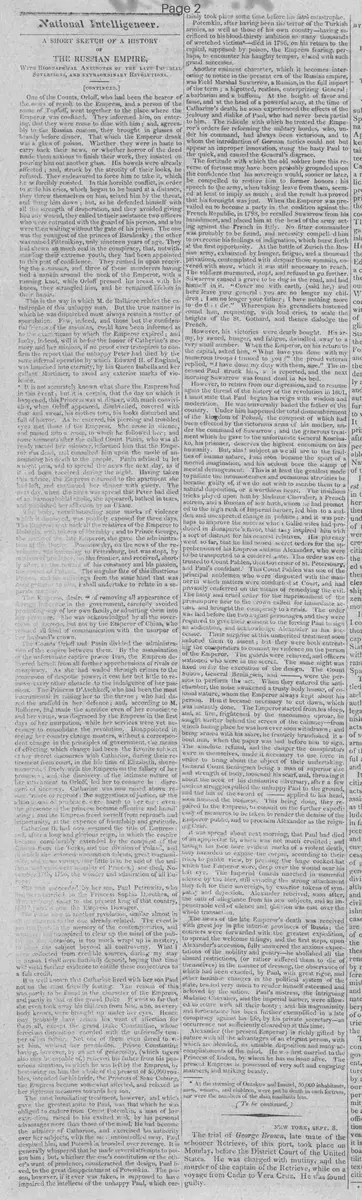
One of the Counts, Orloff, who had been the bearer of the news of revolt to the Empress, and a person of the name of Topioff, went together to the place where the Emperor was confined. They informed him, on entering, that they were come to dine with him; and, agreeably to the Russian custom, they brought in glasses of brandy before dinner. That which the Emperor drank was a glass of poison. Whether they were in haste to carry back their news, or whether horror of the deed made them anxious to finish their work, they insisted on pouring him out another glass. His bowels were already affected: and, struck by the atrocity of their looks, he refused. They endeavored to force him to take it, which he as forcibly resisted. In this horrible conflict, in order to stifle his cries, which began to be heard at a distance, they threw themselves on him, seized him by the throat, and flung him down: but, as he defended himself with all the strength of desperation, and they avoided giving him any wound, they called to their assistance two officers who were entrusted with the guard of his person, and who were then waiting without the gate of his prison. The one was the youngest of the princes of Baralinsky; the other was named Pittenikiny, only nineteen years of age. They had shewn so much zeal in the conspiracy, that, notwithstanding their extreme youth, they had been appointed to this post of confidence. They rushed in upon receiving the summons, and three of these murderers having tied a napkin around the neck of the Emperor, with a running knot, while Orloff pressed his breast with his knees, they strangled him, and he remained lifeless in their hands.
This is the way in which M. de Rulliere relates the catastrophe of this unhappy man. But the true manner in which he was dispatched must always remain a matter of speculation. Few, indeed, and those but the confidential friends of the assassins, could have been informed as to the exact means by which the Emperor expired; and lucky, indeed, will it be for the honor of Catherine's memory and her minions, if no proof ever transpires to confirm the report that the unhappy Peter had died by the same infernal operation by which Edward II. of England, was launched into eternity, by his Queen Isabella and her gallant Mortimer, to avoid any exterior marks of violence.
It is not accurately known what share the Empress had in this event; but it is certain, that the day on which it happened, this Princess was at dinner, with much conviviality, when Orloff appeared, dishevelled, covered with dust and sweat, his clothes torn, his looks disturbed and full of horror. As he entered, his piercing and troubled eyes met those of the Empress. She arose in silence, and passed into a room, to which he followed her; and some moments after she called Count Panin, who was already named her minister, informed him that the Emperor was dead, and consulted him upon the mode of announcing his death to the people. Panin advised to let a night pass, and to spread the news the next day, as if it had been received during the night. Having taken this advice, the Empress returned to the apartment she had left, and continued her dinner with gaiety. The next day, when the news was spread that Peter had died of a haemorrhoidal cholic, she appeared, bathed in tears, and published her affliction by an Ukase.
The body, notwithstanding some marks of violence which it displayed, was publicly exposed for three days. The Empress sent back all the relatives of the Emperor to Holstein, with tokens of liberality; and to Prince George, the uncle of the late Emperor, she gave the administration of the Duchy. Poniatowsky, on the news of the revolution, was hastening to Petersburg, but was stopped, by motives of prudence, in the frontier, and received, shortly after, as the reward of his constancy and his passion, the crown of Poland. The singular fate of this illustrious Prince, and his sufferings from the same hand that was once grateful to him, I shall undertake to relate in a separate memoir.
The Empress, desirous of removing all appearance of foreign influence in the government, carefully avoided promoting any of her own family, or admitting them into her presence. She was acknowledged by all the sovereigns of Europe, but not by the Emperor of China, who refused all kind of communication with the usurper of her husband's crown.
The Counts Orloff and Panin divided the administration of the empire between them. By the assassination of the unfortunate captive prince Ivan, the Empress delivered herself from all further apprehensions of rivals or conspiracy. As she had waded through crimes to the possession of despotic power, it cost her but little to remove every other obstacle to the indulgence of her passions. The Princess D'Aschkoff, who had been the most instrumental in raising her to the throne; who had dared the scaffold in her defence; and, according to M. Rulhiere, had made the sacrifice even of her conscience and her virtue, was disgraced by the Empress in the first days of her usurpation, while her services were yet necessary to consolidate the revolution. Disappointed in seeing her country change masters, without a correspondent change in the principles of government, the means of effecting which change had been the favorite subject of her secret discourses with Catharine, during their retirement from court, in the life time of Elizabeth, she remonstrated freely with the Empress on the fallacy of her promises, and the discovery of the intimate nature of her attachment to Orloff, led her to censure her disregard of decency. Catharine was now raised above remorse, fear or reproof: the suggestions of justice, or the admonitions of prudence were harsh to her ear: even the presence of the princess became offensive and humiliating; and the Empress freed herself from reproach and importunity, at the expense of friendship and gratitude.
Catharine II. had now assumed the title of Empress: and, after a long and glorious reign, in which the empire became considerably extended by the conquest of the Crimea from the Turks, and the division of Poland, and in which she evinced uncommon talents, great magnanimity, and some virtues, (for little is to be said of the uniform consistent morality of Princes.) she died, November 17th, 1796, the wonder and admiration of all Europe.
She was succeeded by her son, Paul Petrowitz, who had been married to the Princess Sophia Dorothea, of Wurtemberg, sister to the present king of that country, (and is now the Empress Dowager.)
We now come to another revolution, similar almost in this to the one already related. The event is yet rather fresh in the memory of the contemporaries, and what transpired to clear up the mind of the public on that occasion, is too much wrapt up in mystery, to list the subject beyond all controversy. What I have collected from credible sources, during my stay in Russia I shall here faithfully deposit, hoping that time will yield further evidence to entitle these conjectures to a full credit.
It is well known that Catharine lived with her son Paul not on the most friendly footing. The reason of this was partly to be found in the character of the Empress, and partly in that of the grand Duke. It went so far that she even took away his children from him, who, as every body knows, were brought up under her eyes. Hence may probably have arisen his want of affection for them all, except the grand Duke Constantine, whose ferocious disposition accorded with the unfriendly temper of his father. Not one of them even dared to visit him, without her permission. Prince Constantine having, however, by an act of generosity, (which tigers also may be capable of,) relieved his father from his penurious situation, in which he was left by the Empress, by bestowing on him the whole of the present of 50,000 roubles, intended for his bride, the Princess of Saxe Coburg, the Empress became somewhat affected, and relaxed in her rigorous measures towards her son.
The most humiliating treatment, however, and which gave the greatest spite to Paul, was that which he was obliged to endure from Count Potemkin, a man of low extraction; raised to his exalted rank by his personal advantages more than those of the mind. He had become the admirer of Catharine, and exercised his authority over her subjects, with the most uncontrolled sway. Paul despised him, and Potemkin brooded over revenge. It is generally whispered that he made several attempts to poison him; but, whether the one's constitution or the other's want of prudence, counteracted the design, Paul lived, to the great disappointment of Potemkin. The poison, however, if it ever was taken, is supposed to have impaired the intellects of the unhappy Paul, which certainly took place some time before his fatal catastrophe.
Potemkin, after having been the terror of the Turkish armies, as well as those of his own country—having sacrificed to his blood-thirsty ambition so many thousands of wretched victims—died in 1796, on his return to the capital, supposed by poison, the Empress fearing, perhaps, to encounter his haughty temper, elated with such grand successes.
Another eminent character, which it becomes interesting to notice in the present era of the Russian empire, was Field Marshal Suwarrow, a Russian, in the full import of the term; a bigotted, restless, enterprizing General; a barbarian and a buffoon. At the height of favor and fame, and at the head of a powerful army, at the time of Catharine's death, he soon experienced the effects of the jealousy and dislike of Paul, who had never been partial to him. The ridicule with which he treated the Emperor's orders for reforming the military hordes, who, under his command, had always been victorious, and to whom the introduction of German tactics could not but appear an improper innovation, stung the hasty Paul to the quick, and caused the General's disgrace.
The fortitude with which the old soldier bore this reverse of fortune may have been probably grounded upon the confidence that his sovereign would, sooner or later, be compelled to restore him to former honors: his speech to the army, when taking leave from them, seemed at least to imply as much; and the result has proved that his foresight was just. When the Emperor was prevailed on to become a party in the coalition against the French Republic, in 1798, he recalled Suwarrow from his banishment, and placed him at the head of the army acting against the French in Italy. No fitter commander was probably to be found, and necessity compelled him to overcome his feelings of indignation, which burst forth at the first opportunity. At the battle of Zurich the Russian army, exhausted by hunger, fatigue, and a thousand privations, contemplated with despair those summits, covered with snow, which it was still necessary to reach. The soldiers murmured, stopped, and refused to go further. Suwarrow caused a grave to be dug in the road, and laid himself in it. "Cover me with earth, (said he,) and here leave your general: you are no longer my children; I am no longer your father; I have nothing more to do. I die." Whereupon his grenadiers hastened round him, requesting, with loud cries, to scale the heights of the St. Gothard, and thence dislodge the French.
However, his victories were dearly bought. His army, by sword, hunger, and fatigue, dwindled away to a very small number. When the Emperor, on his return to the capital, asked him, "What have you done with my numerous troops I trusted to you?" the proud veteran replied, "I have done my duty with them, sire." The incensed Paul struck him, as is reported, and the next morning Suwarrow was found dead in his bed.
However, to return from our digression, and to resume again the thread of the history of the revolution in 1801, I must state that Paul began his reign with wisdom and moderation. He was universally hailed the father of the country. Under him happened the total dismemberment of the kingdom of Poland, the conquest of which had been effected by the victorious arms of his mother, under the command of Suwarrow; and the generous treatment which he gave to the unfortunate General Kosciuszko, his prisoner, deserves the highest encomium on his humanity. But, alas! subject as we all are to the frailties of human nature, Paul soon became the sport of a morbid imagination, and his actions bore the stamp of mental derangement. This is at least the gentlest mode to palliate the inconsistencies and occasional atrocities he became guilty of, if we do not wish to ascribe them to a natural disposition, or a worthless heart. The insidious tricks played upon him by Madame Chevalier, a French actress, and a Russian of low birth, whom he had promoted to the high rank of Imperial barber, led him to a sudden and unexpected change in politics; and it was perhaps to improve the success which Gallic wiles had produced in Bonaparte's favor, that they inspired him with a sort of distrust for his nearest relatives. His phrenzy went so far, that he had issued secret orders for the apprehension of his Empress and son Alexander, who were to be transported to a colder climate. This order was entrusted to Count Pahlen, then Governor of St. Petersburg, and Paul's confidant. This Count Pahlen was one of the principal noblemen who were disgusted with the manner in which matters were conducted at Court, and had privately conferred on the means of remedying the evil. The hasty and cruel order for the imprisonment of the presumptive heir to the crown called for immediate action, and brought the conspiracy to a crisis. The order was laid before the two august personages, and they were required to give their consent to the forcing Paul to sign an abdication, and acknowledge Alexander as his successor. Their surprise at this unmerited treatment soon induced them to assent; but they were both entreating the conspirators to commit no violence on the person of the Emperor. The guards were relieved, and officers stationed who were in the secret. The same night was fixed on for the execution of the design. The Count Subow, General Beningsen, and others, were the persons to perform the act. When they entered the anti-chamber, the noise awakened a trusty body hussar, of colossal stature, whom the Emperor always kept about his person. Him it became necessary to cut down, which was instantly done. The Emperor started from his sleep, and, at first, frightened by the uncommon uproar, he sought shelter behind the screen of the chimney—from which hiding place he was however soon withdrawn; and being armed with his sabre, he frantically brandished it about him, when the paper was laid before him to sign. The absolute refusal, and the danger the conspirators were in themselves, made it necessary to use force in order to bring about the object of their undertaking. General Count Beningsen being a man of superior size and strength of body, loosened his scarf, and, throwing it about the neck of his diminutive adversary, after a few useless struggles pulled the unhappy Paul to the ground, and the hilt of the sword of one of the party applied to his head, soon finished the business. This being done, they repaired to the Empress, to consult on the further expediency of measures to be taken to render the demise of the Emperor public, and to proclaim Alexander as the reigning Czar.
It was spread about next morning, that Paul had died of an apoplectic fit, which was not much credited; and though his face bore evident marks of a violent death, they hazarded to expose the corpse, according to their rites, to public view, by pressing the huge cocked-hat which the Emperor wore, deep over the wound near his left eye. The Imperial Guards marched in mournful silence by the bier, still evincing the strong attachment they felt for their sovereign, by exterior tokens of sympathy and dejection. Alexander received, soon after, the oath of allegiance from his new subjects, and an impenetrable veil of silence and oblivion was cast over the whole transaction.
The news of the late Emperor's death was received with great joy in the interior provinces of Russia; the couriers were forwarded with the greatest expedition, to spread the welcome tidings; and the first steps, upon Alexander's accession, fully answered the anxious expectations of the nobility and gentry—he abolished all the absurd restrictions, (or rather suffered them to die of themselves) in the manner of dressing, the observance of which had been exacted, by Paul, with great rigor, and other laudable changes in the political system of the state, tended very much to render himself esteemed and beloved by the nation. Paul's mistress, the intriguing Madame Chevalier, and the imperial barber, were allowed to retire with all their booty; and his magnanimity and forbearance has been further exemplified in a late conspiracy against his life, by his private secretary—an occurrence not sufficiently cleared up at this time.
Alexander (the present Emperor) is richly gifted by nature with all the advantages of an elegant person, with which are blended, an amiable disposition and many accomplishments of the mind. He was first married to the Princess of Baden, by whom he has no issue alive. The present Empress is possessed of very soft and engaging manners, and striking beauty.
* At the storming of Oczakow and Ismael, 30,000 inhabitants, men, women, and children, were put to death in each fortress, nor were the numbers of the slain assailants less.
(To be continued.)
A SHORT SKETCH OF A HISTORY OF THE RUSSIAN EMPIRE, WITH BIOGRAPHICAL ANECDOTES OF THE LATE IMPERIAL SOVEREIGNS, AND EXTRAORDINARY REVOLUTIONS.
[CONTINUED.]
One of the Counts, Orloff, who had been the bearer of the news of revolt to the Empress, and a person of the name of Topioff, went together to the place where the Emperor was confined. They informed him, on entering, that they were come to dine with him; and, agreeably to the Russian custom, they brought in glasses of brandy before dinner. That which the Emperor drank was a glass of poison. Whether they were in haste to carry back their news, or whether horror of the deed made them anxious to finish their work, they insisted on pouring him out another glass. His bowels were already affected: and, struck by the atrocity of their looks, he refused. They endeavored to force him to take it, which he as forcibly resisted. In this horrible conflict, in order to stifle his cries, which began to be heard at a distance, they threw themselves on him, seized him by the throat, and flung him down: but, as he defended himself with all the strength of desperation, and they avoided giving him any wound, they called to their assistance two officers who were entrusted with the guard of his person, and who were then waiting without the gate of his prison. The one was the youngest of the princes of Baralinsky; the other was named Pittenikiny, only nineteen years of age. They had shewn so much zeal in the conspiracy, that, notwithstanding their extreme youth, they had been appointed to this post of confidence. They rushed in upon receiving the summons, and three of these murderers having tied a napkin around the neck of the Emperor, with a running knot, while Orloff pressed his breast with his knees, they strangled him, and he remained lifeless in their hands.
This is the way in which M. de Rulliere relates the catastrophe of this unhappy man. But the true manner in which he was dispatched must always remain a matter of speculation. Few, indeed, and those but the confidential friends of the assassins, could have been informed as to the exact means by which the Emperor expired; and lucky, indeed, will it be for the honor of Catherine's memory and her minions, if no proof ever transpires to confirm the report that the unhappy Peter had died by the same infernal operation by which Edward II. of England, was launched into eternity, by his Queen Isabella and her gallant Mortimer, to avoid any exterior marks of violence.
It is not accurately known what share the Empress had in this event; but it is certain, that the day on which it happened, this Princess was at dinner, with much conviviality, when Orloff appeared, dishevelled, covered with dust and sweat, his clothes torn, his looks disturbed and full of horror. As he entered, his piercing and troubled eyes met those of the Empress. She arose in silence, and passed into a room, to which he followed her; and some moments after she called Count Panin, who was already named her minister, informed him that the Emperor was dead, and consulted him upon the mode of announcing his death to the people. Panin advised to let a night pass, and to spread the news the next day, as if it had been received during the night. Having taken this advice, the Empress returned to the apartment she had left, and continued her dinner with gaiety. The next day, when the news was spread that Peter had died of a haemorrhoidal cholic, she appeared, bathed in tears, and published her affliction by an Ukase.
The body, notwithstanding some marks of violence which it displayed, was publicly exposed for three days. The Empress sent back all the relatives of the Emperor to Holstein, with tokens of liberality; and to Prince George, the uncle of the late Emperor, she gave the administration of the Duchy. Poniatowsky, on the news of the revolution, was hastening to Petersburg, but was stopped, by motives of prudence, in the frontier, and received, shortly after, as the reward of his constancy and his passion, the crown of Poland. The singular fate of this illustrious Prince, and his sufferings from the same hand that was once grateful to him, I shall undertake to relate in a separate memoir.
The Empress, desirous of removing all appearance of foreign influence in the government, carefully avoided promoting any of her own family, or admitting them into her presence. She was acknowledged by all the sovereigns of Europe, but not by the Emperor of China, who refused all kind of communication with the usurper of her husband's crown.
The Counts Orloff and Panin divided the administration of the empire between them. By the assassination of the unfortunate captive prince Ivan, the Empress delivered herself from all further apprehensions of rivals or conspiracy. As she had waded through crimes to the possession of despotic power, it cost her but little to remove every other obstacle to the indulgence of her passions. The Princess D'Aschkoff, who had been the most instrumental in raising her to the throne; who had dared the scaffold in her defence; and, according to M. Rulhiere, had made the sacrifice even of her conscience and her virtue, was disgraced by the Empress in the first days of her usurpation, while her services were yet necessary to consolidate the revolution. Disappointed in seeing her country change masters, without a correspondent change in the principles of government, the means of effecting which change had been the favorite subject of her secret discourses with Catharine, during their retirement from court, in the life time of Elizabeth, she remonstrated freely with the Empress on the fallacy of her promises, and the discovery of the intimate nature of her attachment to Orloff, led her to censure her disregard of decency. Catharine was now raised above remorse, fear or reproof: the suggestions of justice, or the admonitions of prudence were harsh to her ear: even the presence of the princess became offensive and humiliating; and the Empress freed herself from reproach and importunity, at the expense of friendship and gratitude.
Catharine II. had now assumed the title of Empress: and, after a long and glorious reign, in which the empire became considerably extended by the conquest of the Crimea from the Turks, and the division of Poland, and in which she evinced uncommon talents, great magnanimity, and some virtues, (for little is to be said of the uniform consistent morality of Princes.) she died, November 17th, 1796, the wonder and admiration of all Europe.
She was succeeded by her son, Paul Petrowitz, who had been married to the Princess Sophia Dorothea, of Wurtemberg, sister to the present king of that country, (and is now the Empress Dowager.)
We now come to another revolution, similar almost in this to the one already related. The event is yet rather fresh in the memory of the contemporaries, and what transpired to clear up the mind of the public on that occasion, is too much wrapt up in mystery, to list the subject beyond all controversy. What I have collected from credible sources, during my stay in Russia I shall here faithfully deposit, hoping that time will yield further evidence to entitle these conjectures to a full credit.
It is well known that Catharine lived with her son Paul not on the most friendly footing. The reason of this was partly to be found in the character of the Empress, and partly in that of the grand Duke. It went so far that she even took away his children from him, who, as every body knows, were brought up under her eyes. Hence may probably have arisen his want of affection for them all, except the grand Duke Constantine, whose ferocious disposition accorded with the unfriendly temper of his father. Not one of them even dared to visit him, without her permission. Prince Constantine having, however, by an act of generosity, (which tigers also may be capable of,) relieved his father from his penurious situation, in which he was left by the Empress, by bestowing on him the whole of the present of 50,000 roubles, intended for his bride, the Princess of Saxe Coburg, the Empress became somewhat affected, and relaxed in her rigorous measures towards her son.
The most humiliating treatment, however, and which gave the greatest spite to Paul, was that which he was obliged to endure from Count Potemkin, a man of low extraction; raised to his exalted rank by his personal advantages more than those of the mind. He had become the admirer of Catharine, and exercised his authority over her subjects, with the most uncontrolled sway. Paul despised him, and Potemkin brooded over revenge. It is generally whispered that he made several attempts to poison him; but, whether the one's constitution or the other's want of prudence, counteracted the design, Paul lived, to the great disappointment of Potemkin. The poison, however, if it ever was taken, is supposed to have impaired the intellects of the unhappy Paul, which certainly took place some time before his fatal catastrophe.
Potemkin, after having been the terror of the Turkish armies, as well as those of his own country—having sacrificed to his blood-thirsty ambition so many thousands of wretched victims—died in 1796, on his return to the capital, supposed by poison, the Empress fearing, perhaps, to encounter his haughty temper, elated with such grand successes.
Another eminent character, which it becomes interesting to notice in the present era of the Russian empire, was Field Marshal Suwarrow, a Russian, in the full import of the term; a bigotted, restless, enterprizing General; a barbarian and a buffoon. At the height of favor and fame, and at the head of a powerful army, at the time of Catharine's death, he soon experienced the effects of the jealousy and dislike of Paul, who had never been partial to him. The ridicule with which he treated the Emperor's orders for reforming the military hordes, who, under his command, had always been victorious, and to whom the introduction of German tactics could not but appear an improper innovation, stung the hasty Paul to the quick, and caused the General's disgrace.
The fortitude with which the old soldier bore this reverse of fortune may have been probably grounded upon the confidence that his sovereign would, sooner or later, be compelled to restore him to former honors: his speech to the army, when taking leave from them, seemed at least to imply as much; and the result has proved that his foresight was just. When the Emperor was prevailed on to become a party in the coalition against the French Republic, in 1798, he recalled Suwarrow from his banishment, and placed him at the head of the army acting against the French in Italy. No fitter commander was probably to be found, and necessity compelled him to overcome his feelings of indignation, which burst forth at the first opportunity. At the battle of Zurich the Russian army, exhausted by hunger, fatigue, and a thousand privations, contemplated with despair those summits, covered with snow, which it was still necessary to reach. The soldiers murmured, stopped, and refused to go further. Suwarrow caused a grave to be dug in the road, and laid himself in it. "Cover me with earth, (said he,) and here leave your general: you are no longer my children; I am no longer your father; I have nothing more to do. I die." Whereupon his grenadiers hastened round him, requesting, with loud cries, to scale the heights of the St. Gothard, and thence dislodge the French.
However, his victories were dearly bought. His army, by sword, hunger, and fatigue, dwindled away to a very small number. When the Emperor, on his return to the capital, asked him, "What have you done with my numerous troops I trusted to you?" the proud veteran replied, "I have done my duty with them, sire." The incensed Paul struck him, as is reported, and the next morning Suwarrow was found dead in his bed.
However, to return from our digression, and to resume again the thread of the history of the revolution in 1801, I must state that Paul began his reign with wisdom and moderation. He was universally hailed the father of the country. Under him happened the total dismemberment of the kingdom of Poland, the conquest of which had been effected by the victorious arms of his mother, under the command of Suwarrow; and the generous treatment which he gave to the unfortunate General Kosciuszko, his prisoner, deserves the highest encomium on his humanity. But, alas! subject as we all are to the frailties of human nature, Paul soon became the sport of a morbid imagination, and his actions bore the stamp of mental derangement. This is at least the gentlest mode to palliate the inconsistencies and occasional atrocities he became guilty of, if we do not wish to ascribe them to a natural disposition, or a worthless heart. The insidious tricks played upon him by Madame Chevalier, a French actress, and a Russian of low birth, whom he had promoted to the high rank of Imperial barber, led him to a sudden and unexpected change in politics; and it was perhaps to improve the success which Gallic wiles had produced in Bonaparte's favor, that they inspired him with a sort of distrust for his nearest relatives. His phrenzy went so far, that he had issued secret orders for the apprehension of his Empress and son Alexander, who were to be transported to a colder climate. This order was entrusted to Count Pahlen, then Governor of St. Petersburg, and Paul's confidant. This Count Pahlen was one of the principal noblemen who were disgusted with the manner in which matters were conducted at Court, and had privately conferred on the means of remedying the evil. The hasty and cruel order for the imprisonment of the presumptive heir to the crown called for immediate action, and brought the conspiracy to a crisis. The order was laid before the two august personages, and they were required to give their consent to the forcing Paul to sign an abdication, and acknowledge Alexander as his successor. Their surprise at this unmerited treatment soon induced them to assent; but they were both entreating the conspirators to commit no violence on the person of the Emperor. The guards were relieved, and officers stationed who were in the secret. The same night was fixed on for the execution of the design. The Count Subow, General Beningsen, and others, were the persons to perform the act. When they entered the anti-chamber, the noise awakened a trusty body hussar, of colossal stature, whom the Emperor always kept about his person. Him it became necessary to cut down, which was instantly done. The Emperor started from his sleep, and, at first, frightened by the uncommon uproar, he sought shelter behind the screen of the chimney—from which hiding place he was however soon withdrawn; and being armed with his sabre, he frantically brandished it about him, when the paper was laid before him to sign. The absolute refusal, and the danger the conspirators were in themselves, made it necessary to use force in order to bring about the object of their undertaking. General Count Beningsen being a man of superior size and strength of body, loosened his scarf, and, throwing it about the neck of his diminutive adversary, after a few useless struggles pulled the unhappy Paul to the ground, and the hilt of the sword of one of the party applied to his head, soon finished the business. This being done, they repaired to the Empress, to consult on the further expediency of measures to be taken to render the demise of the Emperor public, and to proclaim Alexander as the reigning Czar.
It was spread about next morning, that Paul had died of an apoplectic fit, which was not much credited; and though his face bore evident marks of a violent death, they hazarded to expose the corpse, according to their rites, to public view, by pressing the huge cocked-hat which the Emperor wore, deep over the wound near his left eye. The Imperial Guards marched in mournful silence by the bier, still evincing the strong attachment they felt for their sovereign, by exterior tokens of sympathy and dejection. Alexander received, soon after, the oath of allegiance from his new subjects, and an impenetrable veil of silence and oblivion was cast over the whole transaction.
The news of the late Emperor's death was received with great joy in the interior provinces of Russia; the couriers were forwarded with the greatest expedition, to spread the welcome tidings; and the first steps, upon Alexander's accession, fully answered the anxious expectations of the nobility and gentry—he abolished all the absurd restrictions, (or rather suffered them to die of themselves) in the manner of dressing, the observance of which had been exacted, by Paul, with great rigor, and other laudable changes in the political system of the state, tended very much to render himself esteemed and beloved by the nation. Paul's mistress, the intriguing Madame Chevalier, and the imperial barber, were allowed to retire with all their booty; and his magnanimity and forbearance has been further exemplified in a late conspiracy against his life, by his private secretary—an occurrence not sufficiently cleared up at this time.
Alexander (the present Emperor) is richly gifted by nature with all the advantages of an elegant person, with which are blended, an amiable disposition and many accomplishments of the mind. He was first married to the Princess of Baden, by whom he has no issue alive. The present Empress is possessed of very soft and engaging manners, and striking beauty.
* At the storming of Oczakow and Ismael, 30,000 inhabitants, men, women, and children, were put to death in each fortress, nor were the numbers of the slain assailants less.
(To be continued.)
What sub-type of article is it?
Essay
What themes does it cover?
Political
War Peace
Death Mortality
What keywords are associated?
Russian Empire
Catherine Ii
Peter Iii
Paul I
Alexander I
Assassination
Revolution
Conspiracy
Conquest
Potemkin
Literary Details
Title
A Short Sketch Of A History Of The Russian Empire, With Biographical Anecdotes Of The Late Imperial Sovereigns, And Extraordinary Revolutions.
Form / Style
Narrative Historical Essay With Biographical Anecdotes
Key Lines
This Is The Way In Which M. De Rulliere Relates The Catastrophe Of This Unhappy Man. But The True Manner In Which He Was Dispatched Must Always Remain A Matter Of Speculation.
Catharine Ii. Had Now Assumed The Title Of Empress: And, After A Long And Glorious Reign... She Died, November 17th, 1796, The Wonder And Admiration Of All Europe.
General Count Beningsen Being A Man Of Superior Size And Strength Of Body, Loosened His Scarf, And, Throwing It About The Neck Of His Diminutive Adversary, After A Few Useless Struggles Pulled The Unhappy Paul To The Ground, And The Hilt Of The Sword Of One Of The Party Applied To His Head, Soon Finished The Business.
* At The Storming Of Oczakow And Ismael, 30,000 Inhabitants, Men, Women, And Children, Were Put To Death In Each Fortress, Nor Were The Numbers Of The Slain Assailants Less.