Thank you for visiting SNEWPapers!

Sign up free

Page thumbnail for South Carolina Temperance Advocate
Story December 29, 1853

South Carolina Temperance Advocate

Charleston, Camden, Kershaw County, South Carolina

What is this article about?

Ipswich artisan Thos. Stanard invents a perpetual motion machine model that self-acts after initial motion, runs 36+ hours undiminished, and grinds iron against one person's resistance. Local firms reject; London engineers buy it and relocate him. (178 chars)

Clipping
OCR Quality

95% Excellent

Full Text

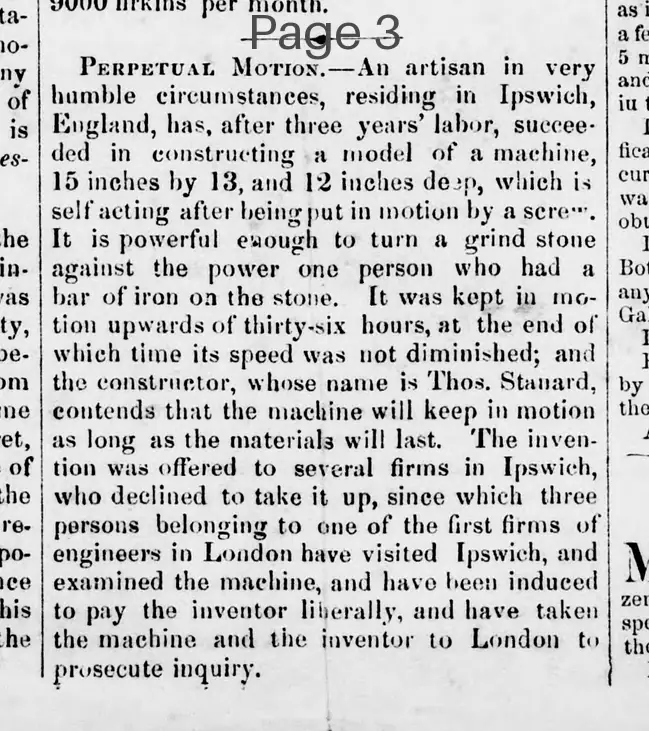
PERPETUAL Motion.—An artisan in very humble circumstances, residing in Ipswich, England, has, after three years' labor, succeeded in constructing a model of a machine, 15 inches by 13, and 12 inches deep, which is self-acting after being put in motion by a screw. It is powerful enough to turn a grindstone against the power of one person who had a bar of iron on the stone. It was kept in motion upwards of thirty-six hours, at the end of which time its speed was not diminished; and the constructor, whose name is Thos. Stanard, contends that the machine will keep in motion as long as the materials will last. The invention was offered to several firms in Ipswich, who declined to take it up, since which three persons belonging to one of the first firms of engineers in London have visited Ipswich, and examined the machine, and have been induced to pay the inventor liberally, and have taken the machine and the inventor to London to prosecute inquiry.

What sub-type of article is it?

Curiosity Extraordinary Event

What themes does it cover?

Triumph Fortune Reversal

What keywords are associated?

Perpetual Motion Invention Ipswich Thomas Stanard Engineers London

What entities or persons were involved?

Thos. Stanard

Where did it happen?

Ipswich, England

Story Details

Key Persons

Thos. Stanard

Location

Ipswich, England

Story Details

An artisan in Ipswich constructs a self-acting perpetual motion machine model after three years' labor. It measures 15 inches by 13 inches and 12 inches deep, runs for over 36 hours without slowing, and powers a grindstone against one person's effort. Local firms decline it, but London engineers examine, pay him liberally, and take the machine and inventor to London.

Are you sure?